Three days sounds like a marketing promise — the kind of thing that works for somebody else’s unusually cooperative child. But potty training in 3 days is a real, well-worn method, and for the right kid at the right time, it does what it claims. The catch is that almost everything that makes or breaks it happens before you take the diaper off. This guide gives you the honest version: who it works for, exactly what to do hour by hour, and the mistakes that quietly sabotage day two.
Stop googling at 3am.
Five calm, evidence-aware guides + 20 printables — for the whole first year.
Get The First Year · $27 →Potty training in 3 days is an intensive method where you clear your calendar, keep your toddler bottomless at home for three full days, and offer the potty constantly while watching for cues — so your child connects the feeling of needing to go with actually getting to the potty. It works best for kids showing clear readiness signs, usually between 22 and 30 months. It’s not magic and rarely means zero accidents by day four. It means the core skill clicks fast.
Key takeaways
- Potty training in 3 days only works if your child is genuinely ready — chasing the calendar instead of the readiness signs is the number-one reason it fails.
- The method is intensive by design: you stay home, your toddler stays bottomless, and one adult is fully focused on them for three straight days.
- “Three days” means the core skill clicks, not that accidents vanish completely — daytime mastery in three days is realistic; nights take much longer.
- Ditch pull-ups during the day from the start; they feel like diapers and send a mixed signal that slows everything down.
- Stay calm and matter-of-fact about accidents — frustration teaches your child to hide or hold it, which causes constipation and setbacks.
- Pick your three days carefully: no travel, no new sibling, no big disruptions, and ideally a long weekend with backup help.
What potty training in 3 days actually means
The three-day method is a short, intense burst of focused training, not a casual “we’ll see how it goes” approach — and knowing what you’re signing up for prevents half the disappointment. The approach was popularized by author Lora Jensen and later refined by versions like Jamie Glowacki’s “Oh Crap” method, but the core idea is older than any book: immerse your child in the experience until the connection forms.
Here’s the logic. A toddler in a diaper has spent their whole life going whenever and wherever, with the diaper absorbing the evidence. They have never had to notice the signal that comes before. The three-day method strips that away — literally. With no diaper and no clothes on the bottom half, your toddler feels everything, sees the consequences, and starts to link the physical sensation of needing to go with the action of going on the potty. That link is the entire skill. Everything else is logistics.

A bedtime that's finally
boring.
Fix the room, build the routine, learn the eight scripts. No sleep training, no crying it out — just a sequence that stops needing your patience.
Get The No-Fight Bedtime$17 · 70 pages · instant PDF · yours forever
“Intensive” is the operative word. This isn’t something you do while also working from home or running errands. For three days, one parent’s job is to watch their child like a hawk, catch the pre-pee signals — a pause, a grab, a particular face — and rush them to the potty in time. You’ll over-offer the potty, hover, and celebrate the wins. It’s exhausting. It’s also why it’s fast.
What it doesn’t mean is a tidy finish line at hour 72. Realistic outcomes: most ready kids get the daytime concept within three days and have far fewer accidents by the end than the start. Full daytime reliability often takes another week or two of normal life. Naptime dryness usually follows within weeks. Nighttime is a separate, biology-driven process that can take months or years longer — it depends on a hormone called vasopressin that concentrates urine overnight, and you can’t train a hormone. Judge the three days by whether the skill is forming, not by perfection.
Warm on the feeling. Firm on the limit. Boring on the drama.
Explore The Toddler Years bundle →5 calm ebooks + 20 printables · $27
Is your toddler actually ready?
Readiness is the single biggest predictor of success, and starting before your child is ready turns three days of training into three weeks of frustration for both of you. There’s no magic age — readiness is about signs, not birthdays. That said, most children land in the window between roughly 22 and 30 months, and pushing a younger, unready toddler rarely speeds anything up.
You decide what and when.
They decide whether and how much.
Almost every mealtime fight is one person doing the other's job. The No-Fight Table turns that one idea into the exact words for every refusal you'll hear.
Read what's inside$17 · 70 pages · instant download


You’re looking for a cluster of signs, not just one. Physical readiness: your child stays dry for around two hours at a stretch, has predictable bowel movements, and can pull pants up and down with a little help. Cognitive readiness: they can follow a simple two-step instruction and tell you — in words, signs, or unmistakable body language — that they’re going or about to. Behavioral readiness: they show interest in the toilet, dislike a dirty diaper, or want to copy you or older siblings.
Seventy pages. Six script tables.
What to do, and exactly what to say, when it happens in the supermarket, the restaurant, the car, or in front of everyone.


Instant PDF · 24 photographs · yours forever
| Readiness sign | What it looks like | Why it matters |
|---|---|---|
| Stays dry ~2 hours | Diaper dry after a nap or for long stretches | Shows bladder control is developing |
| Predictable poops | Goes around the same time daily | Lets you anticipate and catch it |
| Communicates the need | Says “pee,” grabs, hides, or makes a face | They can’t train if they can’t notice |
| Pulls pants up/down | Manages clothing with minimal help | Independence speeds real-world success |
| Shows interest | Follows you to the bathroom, asks questions | Motivation makes the whole thing easier |
| Hates a dirty diaper | Asks to be changed, fusses when wet | The discomfort gives them a reason to want the potty |
If your toddler ticks most of these boxes, you’re in good shape. If they tick almost none, wait a month and check again. There is zero prize for early potty training, and a forced early start that ends in a power struggle can set you back further than simply waiting would have.
Before you start: the prep that makes or breaks it
The two or three days before you begin matter more than most parents expect, because the right setup removes the friction that derails day one. Get these pieces in place ahead of time so you’re not improvising mid-accident.
Block the calendar properly. You need three consecutive days at home with no travel, no big outings, and no major life events — not the week of a move or a new baby. A long weekend is ideal, especially with a second adult around to trade shifts, because the watching is relentless.
Inside The Preschool Years bundle:
- Big Emotions, Small Humans
- Whining, Hitting, Talking-Back
- Preschool Bedtime Battles
- Screen Time at 3–5
- Kindergarten Ready
- + 20 printables
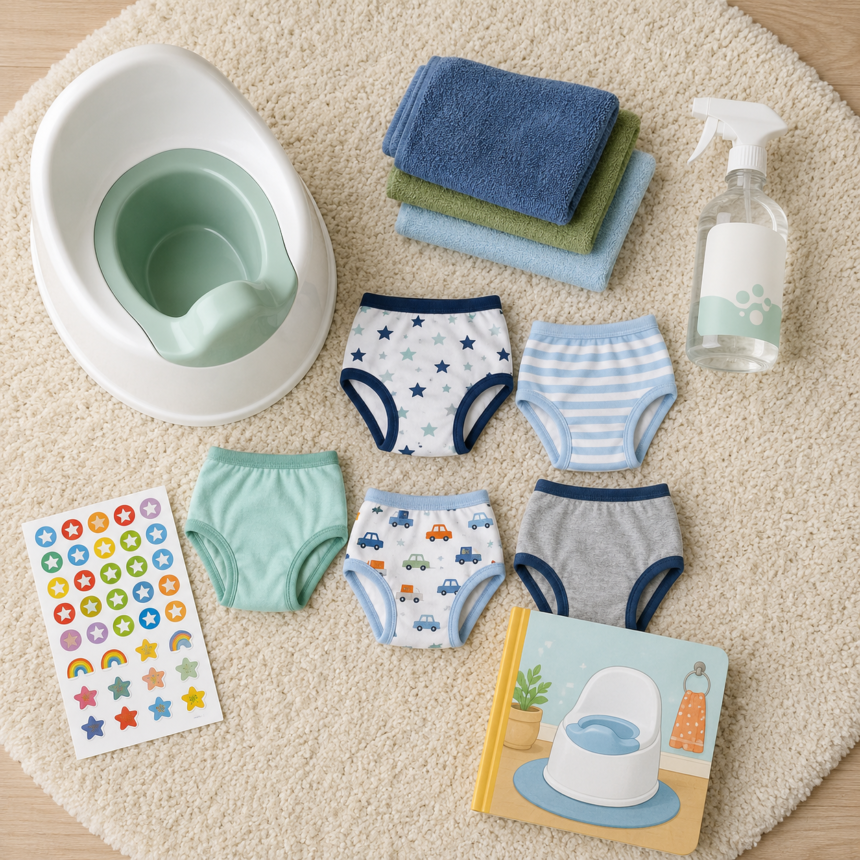
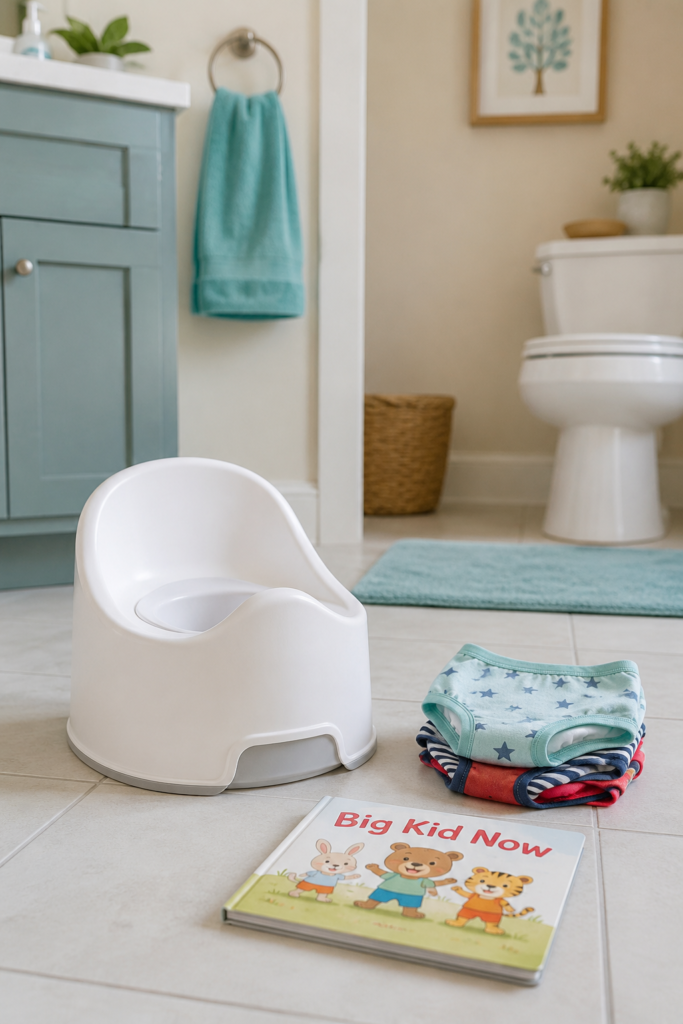
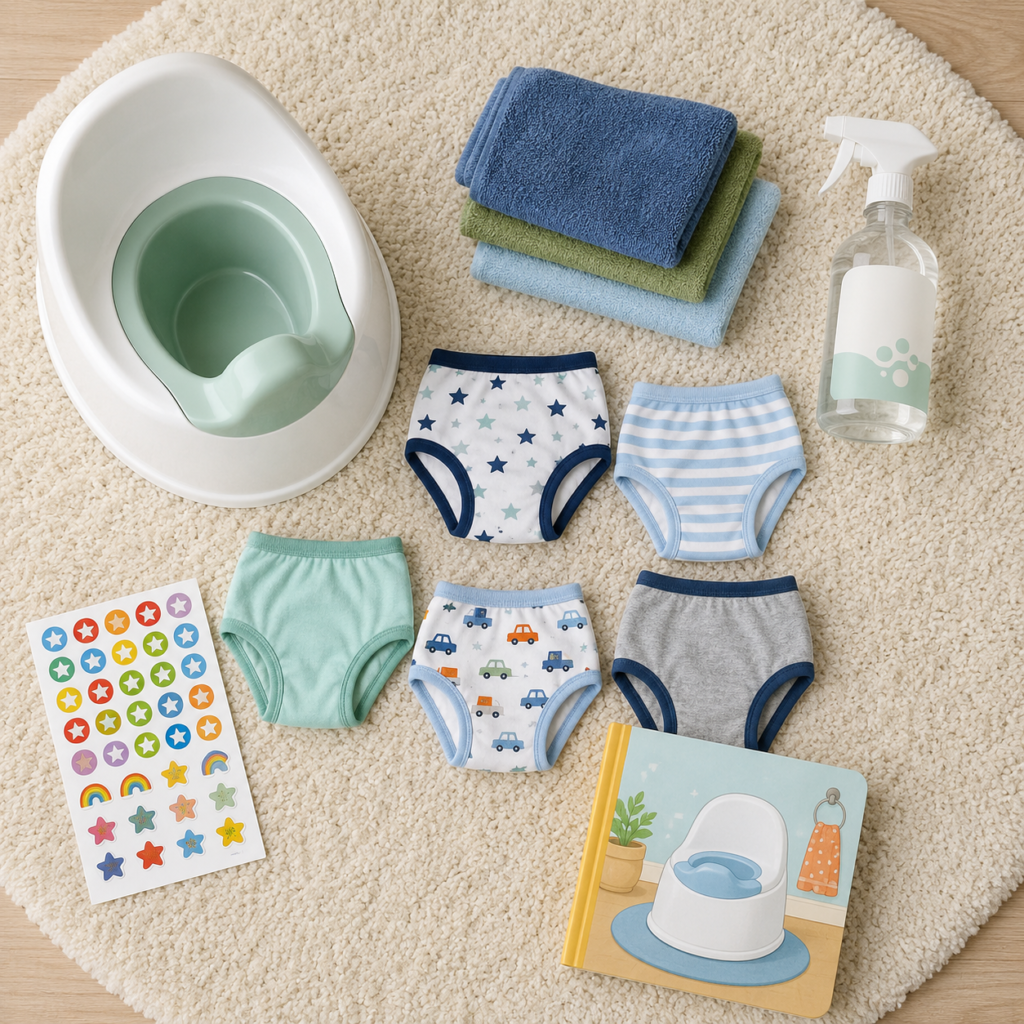
Stock up. You’ll want a small floor potty (or two — one for each main floor of your home), or a toddler seat insert if your child prefers the big toilet. Buy more underwear than feels reasonable; ten to twelve pairs is not too many for the messy stretch. Have a stack of old towels, a good enzyme cleaner for accidents, and easy-to-pull-on pants for when you do add bottoms back. Keep drinks flowing during training — more fluids means more practice reps.
Prime your toddler. In the days before, talk it up like an exciting milestone, not a test. Read a potty book together, let them pick out their “big kid” underwear, and explain simply what’s going to happen: “Soon, pee and poop go in the potty, not the diaper.” Don’t over-hype it into pressure, but do build a little anticipation.
Sort your own head out, too. The fastest way to stall the process is to bring tension to it. Accidents are not failures — they’re data and practice. If you can stay genuinely calm and upbeat when the floor gets wet, your child relaxes and learns faster. Go in expecting a mess. You’ll get one, and it’s fine.
The 3-day potty training plan, day by day
Here’s how the three days unfold in practice, with the goal shifting from pure observation on day one to growing independence by day three. Treat this as a flexible framework, not a rigid script — every child moves at their own pace within it.
Day 1 — Naked and watched. The diaper comes off in the morning and stays off below the waist all day. Your toddler is bottomless so they can feel and see everything. Your job today is simple and exhausting: watch constantly and offer the potty often, roughly every 20 to 30 minutes, plus any time you spot a pre-pee signal. When an accident starts, calmly move them to the potty mid-stream if you can — even a few drops landing in the potty is a win to celebrate warmly. Keep fluids high. Expect lots of accidents today; that’s normal and exactly how the learning happens. By evening, many kids have caught at least one pee in the potty.

The School-Age Years
Big feelings, the homework truce, friendship drama, screens & raising a capable kid — the words to say, minus the lectures.
Day 2 — Connection forming. Same bottomless setup, same vigilance, but you’ll start to see the link forming — your child may pause, grab, or even head toward the potty on their own. Keep offering, but begin giving them a beat to tell you first instead of rushing them every time. Today is when many parents try a short, low-stakes outing late in the day: a quick walk around the block right after a successful potty trip, in loose pants with no diaper, just to practice the real world in small doses. Accidents still happen. Stay matter-of-fact.
Day 3 — Building independence. By the third day, you’re handing more of the responsibility to your toddler. Prompt less, ask more: “Do you need to go?” Add easy bottoms — loose shorts or leggings, no underwear underneath at first, since underwear can feel diaper-like and trigger old habits. Practice a couple of slightly longer outings. The aim by the end of today isn’t flawlessness; it’s a child who recognizes the urge and mostly tells you or heads to the potty, with you as backup.
After the three days, you’re in the maintenance phase. Keep prompting before transitions — leaving the house, before naps, before bed. Expect a regression or two over the coming weeks; they’re normal and pass with calm consistency. Tackle nighttime separately and later, once daytime is solid.
Handling poop, naps, nights, and going out
Pee usually clicks faster than the trickier parts — poop, sleep, and leaving the house each have their own quirks, and ignoring them is how a promising three days unravels in week two. Plan for each.
My Day, My Way — The Complete Toddler Routine System
6 ready-made picture charts, 36 cut-out cards, a First–Then board, trackers & a parent guide — everything to help your toddler run their own day. 24 pages, instant download.
Poop often lags behind pee, and some kids hold it or get anxious about pooping on the potty. Don’t force it. Watch for their usual poop time and signs (going quiet, squatting, hiding), and calmly guide them to sit. If they’re holding for days, back off the pressure — withholding leads to constipation, which makes pooping painful and creates a fear cycle that’s genuinely hard to break. Keep fiber and fluids up.
For naps and nights, the simplest approach during the first three days is to use a diaper or training pant for sleep while you nail daytime — the two skills are separate. Trying to force night dryness before your child’s body is ready just guarantees wet sheets and frustration. Move to nighttime training later, once they’re consistently waking with a dry diaper.

The Teen Years
Staying close, the hard talks, independence, moods & letting go — the actual words to say when it counts, without the lecture.
Going out is its own skill. Once daytime is reasonably solid, start with short trips and always potty right before you leave. Carry a portable potty or seat, a full change of clothes, and wipes. Skip the pull-up for daytime outings if you can — slipping a pull-up on the moment you leave the house teaches your toddler that the rules change outdoors, which muddies the whole lesson. A few public accidents are part of the deal; pack accordingly and stay relaxed.
Common mistakes parents make
These are the errors that derail three-day training even when the method itself is sound.
Starting because of the calendar, not the child. Daycare deadlines, an upcoming birthday, or a friend’s success story push parents to start before their toddler shows readiness signs. An unready child can’t connect the sensation to the action no matter how perfect your method, and the failed attempt can sour them on the whole idea. Watch the child, not the date.
Using pull-ups during the day. Pull-ups feel like diapers and absorb like diapers, so your toddler keeps treating them like diapers. Slipping one on “just for the car” or “just for the store” sends the message that going in your pants is sometimes fine — exactly the habit you’re trying to break. Commit to real underwear or bare-bottom by day, and reserve pull-ups for sleep only.
Reacting to accidents with frustration. A sigh, a sharp “again?”, or visible irritation teaches your child that accidents are bad and the bathroom is stressful. Stressed kids hold it, hide, and regress. The fix is a flat, unbothered response every single time: “Pee goes in the potty. Let’s clean up.” Save your energy and your warmth for the successes.
Over-celebrating with treats and prizes. A candy or sticker for every single pee turns a body process into a transaction, and toddlers are excellent negotiators. Some kids start producing tiny dribbles on demand to farm the reward. Praise the wins genuinely and warmly, but keep tangible rewards light and fade them quickly so the motivation becomes “I did it myself,” not “what do I get?”
Quitting at the first hard day. Day two is often messier than day one — kids test, regress, and resist as the novelty fades. Parents read that as proof it isn’t working and abandon ship. Pushing through the bumpy middle is usually what gets you to the breakthrough. If your child is truly miserable and showing zero progress after three solid days, that’s a different signal — pause and try again in a few weeks.
FAQ
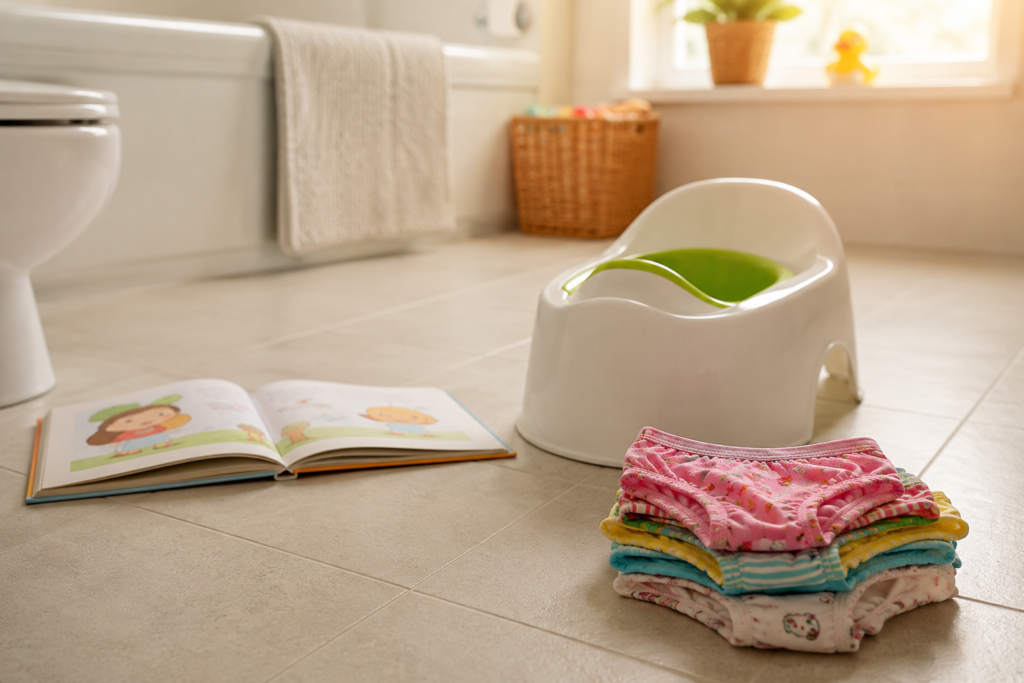
What age is best for potty training in 3 days? There’s no single right age — readiness signs matter far more than the number. Most children are ready somewhere between 22 and 30 months, when they can stay dry for a couple of hours, communicate the need, and pull their pants down with a little help. Starting earlier than your child is ready usually backfires, so watch for the signs rather than racing a deadline or matching another family’s timeline.
Does the 3-day potty training method really work? For a ready child with a fully committed parent, yes — but “works” means the core skill clicks in three days, not that accidents disappear. Most kids grasp the daytime concept and have far fewer accidents by day three, then need another week or two of normal life to become reliable. If your toddler isn’t ready, no method works in three days, so readiness is the real deciding factor here.
Should I use pull-ups during 3-day potty training? Not during the day — pull-ups feel and absorb like diapers, so they undermine the whole lesson and slow your child down. Stick to bare-bottom or real underwear while training and for daytime outings once you’ve started. Pull-ups are fine for naps and overnight, since nighttime dryness is a separate, hormone-driven process that takes much longer and can’t be rushed by training.
What if my toddler refuses to poop on the potty? Poop often lags behind pee, and pushing hard usually makes it worse. Never force a sit or show frustration — that can trigger withholding, which leads to painful constipation and a fear cycle. Instead, watch for their usual poop time and signs, offer the potty calmly, and keep fluids and fiber high. Some kids briefly ask for a diaper to poop; meeting that need while you keep practicing is okay.
How long does nighttime potty training take? Much longer than daytime, and it’s mostly out of your control. Staying dry overnight depends on a hormone called vasopressin that concentrates urine while your child sleeps, plus the ability to wake to a full bladder — both of which mature on their own timeline. Many kids aren’t reliably dry at night until well after their third or fourth birthday, and that’s completely normal, not a training failure.
What should I do if potty training regresses after a few weeks? Regressions are normal and usually temporary, often triggered by a change like a new sibling, illness, travel, or starting daycare. Stay calm and go back to basics: more frequent prompts, fewer distractions, and zero shaming. Avoid putting them back in daytime diapers, which sends a confusing message. Most regressions resolve within a week or two of steady, low-pressure consistency, so ride it out rather than starting over.
The bottom line
Potty training in 3 days isn’t a guarantee or a gimmick — it’s an intensive, focused method that genuinely works when you start with a ready child and bring calm instead of pressure. Nail the readiness check and the prep, accept that day two will be messy, and judge your three days by whether the skill is forming rather than whether the floor stays dry. Pick your weekend, clear the decks, and trust that the connection your toddler builds in those three days is the hard part — the polish comes with ordinary time.

Get The Calm Parent Roadmap — free.
The whole journey, from "I do" to "they're grown." 8 stages, one calm method, 13 beautiful pages. Drop your email and it's yours.
Instant PDF download · no spam · unsubscribe anytime.