My Day, My Way — The Complete Toddler Routine System
6 ready-made picture charts, 36 cut-out cards, a First–Then board, trackers & a parent guide — everything to help your toddler run their own day. 24 pages, instant download.
Mornings with a toddler can feel like negotiating with a tiny, barefoot diplomat who has lost all interest in the talks. A toddler routine chart fixes more of that daily chaos than almost anything else you can hang on a wall — but only if you build it the right way. Most charts fail in week two, not because the idea is flawed, but because of a few small setup mistakes nobody warns you about. This guide shows you exactly what to put on one, how to make it, and how to keep your kid using it long after the novelty wears off.
A toddler routine chart is a visual schedule — pictures, not words — that shows your child the steps of their day in order: wake up, get dressed, breakfast, brush teeth. It works because toddlers can’t tell time but can follow a picture sequence, which lowers their anxiety and cuts down the power struggles. Keep each routine to four to six steps, use real photos or simple icons, and let your child physically move a marker as they finish each one. Build separate charts for mornings and bedtime rather than one giant all-day version.
Key takeaways
- A toddler routine chart works because it replaces your nagging voice with a visual your child can read independently — toddlers follow pictures long before they can tell time or read words.
- Keep each routine to four to six steps; a chart crammed with fifteen items overwhelms a two-year-old and gets ignored by day three.
- Use real photographs of your own child doing each step whenever you can — kids engage far more with images of themselves than with generic clip-art.
- The chart only sticks if your toddler physically interacts with it: moving a clip, flipping a card, or adding a magnet as each step is finished.
- Build two small charts for the hardest transitions — morning and bedtime — instead of one overwhelming all-day chart.
- Plan to refresh the chart every few months, because what motivates a two-year-old will bore a four-year-old.
Why a toddler routine chart works
A routine chart isn’t a parenting gimmick — it works because of how a toddler’s brain actually processes the day, and understanding that is what separates a chart that sticks from one that ends up behind the couch. The core problem is simple: your toddler has no functioning sense of time. “Five more minutes” means nothing. “After lunch” is an abstraction. So when you announce that it’s time to leave the park, you’re asking a small person with no internal clock to abandon something fun for a future they can’t picture. No wonder it ends in tears.
A visual schedule — a sequence of images showing what happens and in what order — gives that abstract day a concrete shape your toddler can see and touch. This isn’t a homemade theory. Visual schedules are a staple in Montessori classrooms, in mainstream preschools, and in the toolkit of nearly every pediatric occupational therapist, precisely because they ease the transitions that wreck toddler days. The chart turns “we’re moving on now” into “look, brushing teeth comes next, then story” — a story your child can follow.
My Day, My Way — The Complete Toddler Routine System
6 ready-made picture charts, 36 cut-out cards, a First–Then board, trackers & a parent guide — everything to help your toddler run their own day. 24 pages, instant download.
There’s a calming effect underneath it, too. Predictability lowers stress. When a toddler knows the shape of what’s coming, the part of their nervous system that fires up at the unexpected gets to stand down. A child who can predict their morning is a child with fewer meltdowns built into it.
Then there’s the part parents love most: the chart takes you out of the fight. Instead of being the human alarm clock who says “get dressed” eleven times before 8am, you become the calm person who says, “What does the chart say is next?” The chart becomes the authority. You become the ally helping your kid follow it. That single shift — from nag to teammate — is the whole reason these things work, and it’s also the part most parents accidentally skip.
My Day, My Way — The Complete Toddler Routine System
6 ready-made picture charts, 36 cut-out cards, a First–Then board, trackers & a parent guide — everything to help your toddler run their own day. 24 pages, instant download.
Finally, a chart builds genuine independence. A three-year-old who can glance at five pictures and run their own morning is practicing exactly the self-direction you want them to have at six and sixteen. You’re not just surviving today. You’re training a habit.
What to put on a toddler routine chart by age
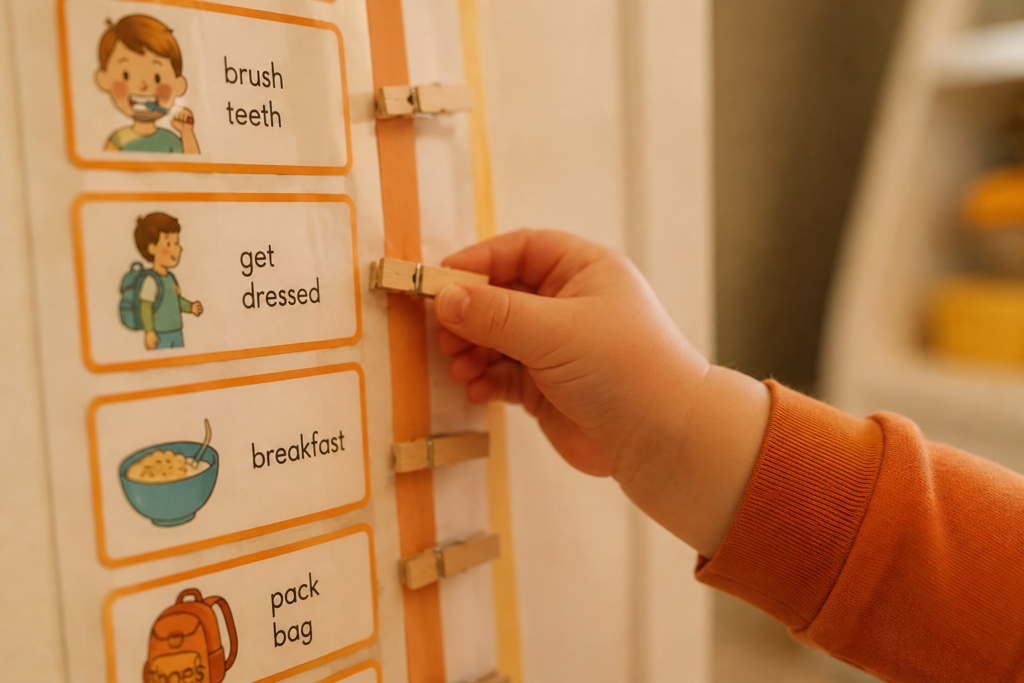
What belongs on the chart depends entirely on your child’s age and what they can realistically do on their own — a two-year-old’s chart and a four-year-old’s chart should look nothing alike. The mistake is copying a Pinterest chart built for a five-year-old and slapping it on your toddler’s wall. Match the steps to the actual human in your house.
For a young toddler around age two, keep it brutally simple. Two-year-olds can follow a three-to-four-step sequence and not much more. Steps should be things they can mostly do with help: get out of bed, potty or diaper, get dressed, eat breakfast. Don’t put “make your bed” on a two-year-old’s chart unless you enjoy disappointment.
By three, you can stretch to five or six steps and add small independent tasks: put pajamas in the hamper, choose between two outfits, wash hands. Three-year-olds love a job they can own, so give them one or two.
My Day, My Way — The Complete Toddler Routine System
6 ready-made picture charts, 36 cut-out cards, a First–Then board, trackers & a parent guide — everything to help your toddler run their own day. 24 pages, instant download.
By four and five, the chart becomes a launchpad for real self-management. They can handle a fuller sequence, time-limited steps (“get dressed before the song ends”), and small responsibilities like feeding the pet or setting out their own shoes.
| Age | Steps to include | Morning chart example | Bedtime chart example |
|---|---|---|---|
| 2 years | 3–4 simple, mostly assisted | Wake up · potty/diaper · get dressed · breakfast | Bath · pajamas · one book · into bed |
| 3 years | 5–6, one or two independent | Potty · get dressed · breakfast · brush teeth · shoes · backpack | Tidy toys · bath · pajamas · brush teeth · two books · lights out |
| 4–5 years | 6–8, time-limited and responsible | Make bed · dress · breakfast · brush teeth · pack bag · feed pet · shoes · coat | Tidy room · bath · pajamas · brush teeth · choose tomorrow’s clothes · read · lights out |
Notice the pattern: the chart grows with the child. A good toddler routine chart is never finished — it’s a living thing you edit as your kid levels up.
How to build a toddler routine chart that sticks
Building the chart takes about an hour, and getting these steps right is the difference between a tool your child uses and a craft project you regret. Follow this order.
Start with one routine, not the whole day. Pick your single worst transition — usually morning or bedtime — and build only that. One small chart that works beats a sprawling all-day chart that overwhelms everyone. You can add the second routine once the first is humming.
Watch your actual routine before you design it. For two days, just notice the real steps your morning takes, in the real order they happen. Parents tend to design the routine they wish they had, then wonder why the chart doesn’t match reality. The chart has to mirror what actually occurs, including the un-glamorous bits.
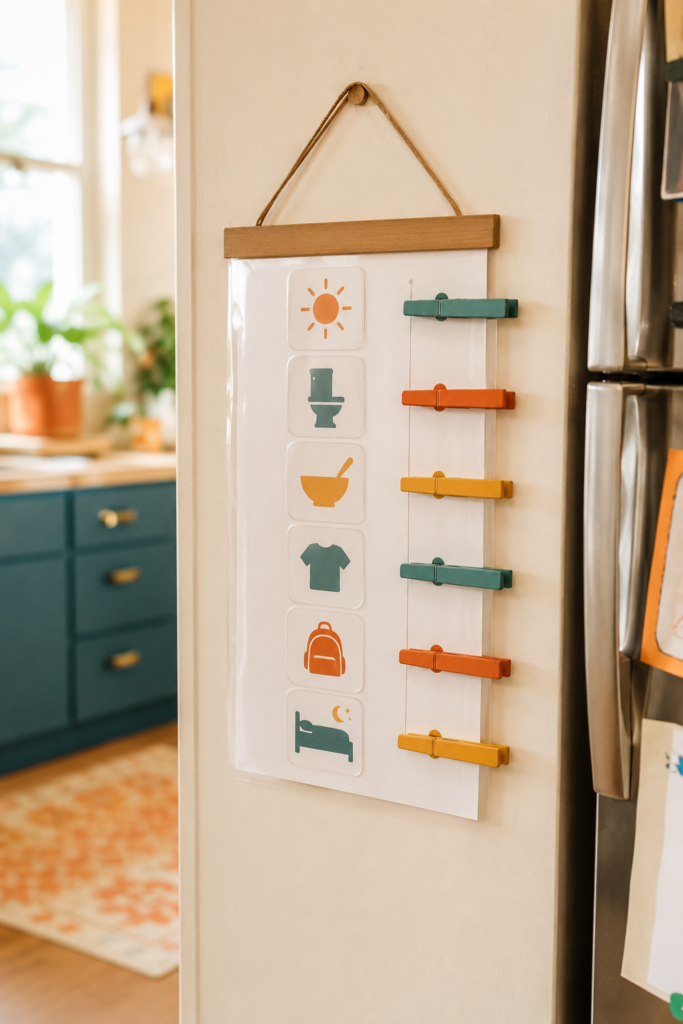
Choose images your child connects with. Real photographs win, and the best ones are photos of your own child doing each step. Kids are fascinated by themselves — a picture of your toddler brushing their own teeth pulls focus far better than a cartoon toothbrush. No photos? Simple, clear icons work fine. Avoid busy, detailed clip-art that distracts more than it directs.
My Day, My Way — The Complete Toddler Routine System
6 ready-made picture charts, 36 cut-out cards, a First–Then board, trackers & a parent guide — everything to help your toddler run their own day. 24 pages, instant download.
Cap it at four to six steps. This is the rule people break most. Each extra step past six roughly halves the odds your toddler finishes the sequence. If your routine genuinely has ten steps, group them — “get ready” can quietly contain dressing, hair, and shoes under one picture.
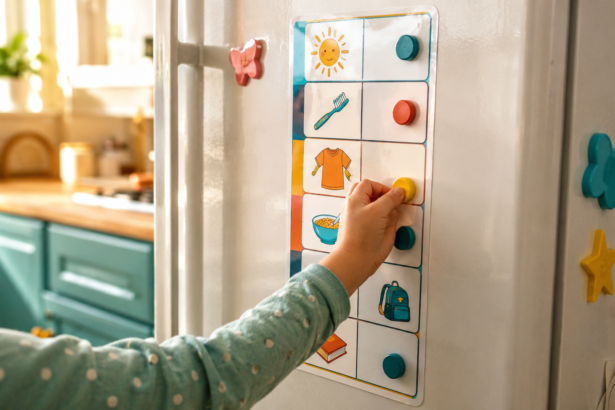
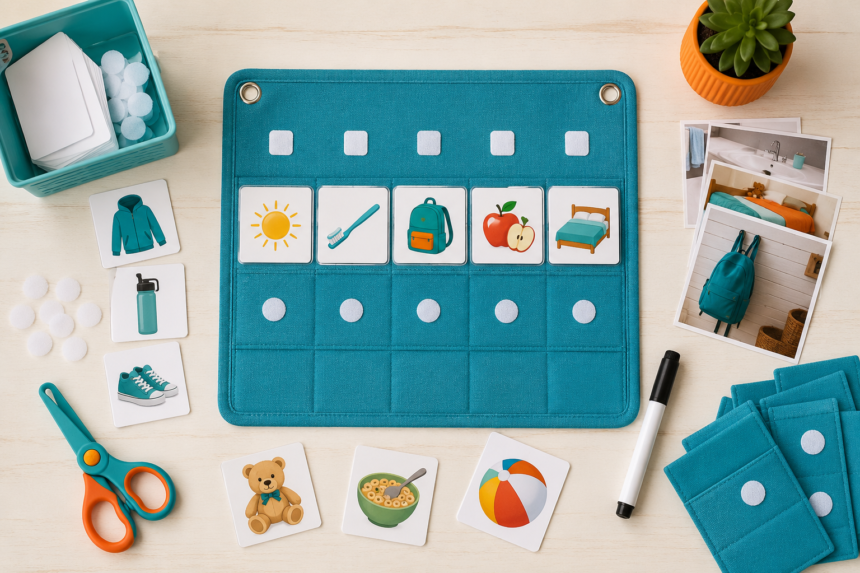
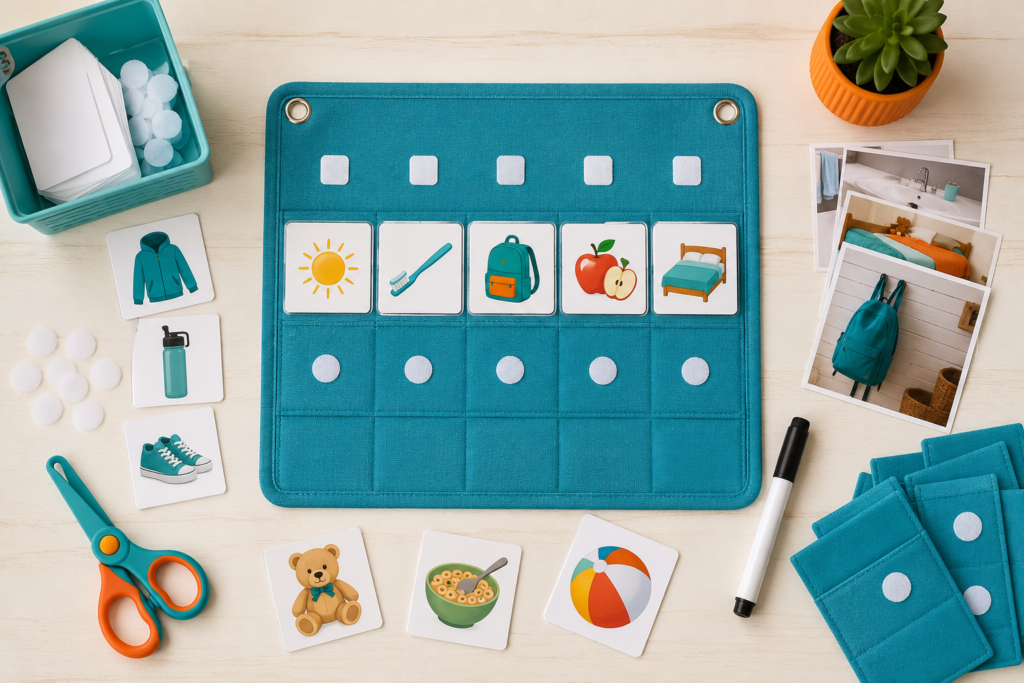
Make it physical. A chart your child only looks at is a poster. A chart your child operates is a tool. Add a way for them to mark each step done: a clothespin they slide down, laminated cards they flip or move into a “done” pocket, magnets, or velcro pieces they pull off. That little hit of “I did it” is what keeps them coming back.
Place it where the routine happens, at their eye level. The morning chart goes where mornings happen — bedroom or kitchen. The bedtime chart goes in the bedroom or bathroom. And it must hang low enough for your toddler to see and touch without you lifting them. A chart at adult eye level is a chart for adults.
Build it together. Let your toddler help choose the photos, place the icons, and pick the marker. A child who helped make the chart feels ownership of it, and ownership is most of the battle. Fifteen minutes of “you’re the boss of this chart” buys you weeks of cooperation.
Choosing a format: printable, magnetic, or app
The format you choose shapes how easy the chart is to use and update, and each option trades off cost, durability, and flexibility differently. There’s no single best one — there’s the best one for your kid and your patience level.
A laminated printable is the classic for good reason: cheap, fast, and endlessly customizable. You print it, laminate it, add velcro or a dry-erase marker, and you’re done in an afternoon. The catch is that lamination makes it feel permanent, so parents resist editing it as the child grows.
My Day, My Way — The Complete Toddler Routine System
6 ready-made picture charts, 36 cut-out cards, a First–Then board, trackers & a parent guide — everything to help your toddler run their own day. 24 pages, instant download.
A magnetic board lives on the fridge and survives toddler enthusiasm better than paper. The pieces are satisfying to move, which kids love. Downside: pieces get lost, and a good magnetic set costs more than a printout.
A dry-erase or chalkboard chart is the most flexible — wipe and rewrite as the routine changes. But it relies on you drawing or writing, which leans more word-heavy and less picture-driven, making it a better fit for four-plus than for a brand-new two-year-old.
A routine app on a tablet brings timers, sounds, and animations. For some kids it’s magic. For others it becomes one more screen to negotiate, and it puts a device in your child’s hands first thing in the morning — exactly when many families are trying to keep screens out of the routine.
| Format | Cost | Durability | Easy to edit | Best for |
|---|---|---|---|---|
| Laminated printable | Low | Medium | Medium | Most families starting out |
| Magnetic board | Medium | High | High | Toddlers who love moving pieces |
| Dry-erase / chalkboard | Low–medium | High | Very high | Ages 4–5, frequently changing routines |
| Routine app | Free–medium | High | High | Kids motivated by tech, screen-tolerant homes |
If you’re undecided, start with the laminated printable. It’s the lowest-stakes way to learn what your child actually responds to before you invest in anything fancier.
How to use the chart so it sticks past week two
A chart’s success is decided in week two, not week one — the novelty carries you through the first few days, and what you do after it fades determines whether the chart becomes a habit or a wall decoration. Here’s how to get past the slump.
Let the chart be the boss, not you. The moment your toddler stalls, resist barking the instruction. Instead, point: “What’s next on your chart?” You’re handing the authority to the chart and keeping your own relationship with your child out of the power struggle. Say it the same calm way every time, even on the rough mornings — especially on the rough mornings.
Narrate and celebrate the doing, lightly. “You moved your clip to ‘shoes’ — you’re flying through this.” Keep it low-key and specific. You’re reinforcing the system, not throwing a parade for brushing teeth.
Don’t bolt on a reward economy right away. A common trap is pairing the chart with stickers, points, or treats from day one. Do that and you accidentally teach your toddler that following their own routine is a paid job, and soon you’re negotiating rates. The chart itself — the satisfaction of completing it — is usually motivation enough for a toddler. Save tangible rewards for genuinely hard, specific goals, and even then, fade them out.
Expect backsliding and don’t panic. Your toddler will have days, sometimes whole weeks, where the chart gets ignored. Illness, a growth spurt, a new sibling, a bad night — any of these can knock a routine off the rails. Keep offering the chart calmly and consistently. Routines aren’t a switch you flip once; they’re a groove you wear in over time.
And refresh it before it goes stale. When you notice your child glazing over at the chart, change something — new photos, a new marker, an added “big kid” step. A small update re-engages a bored toddler far faster than nagging ever will.
Common mistakes parents make with toddler routine charts
These are the errors that quietly sink a chart even when the parent has done everything else right.
Cramming the whole day onto one chart. It feels efficient to map the entire day top to bottom. It isn’t. A fifteen-item all-day chart is a wall of obligation that overwhelms a toddler into doing none of it. Build small, separate charts for the two or three transitions that actually need help, and leave the rest of the day off entirely.
Using words for a child who can’t read. A chart that says “Get Dressed” in tidy letters is useless to a pre-reader, no matter how nice it looks. Your toddler needs to decode the chart at a glance, and that means pictures. If you want words, put them under the picture as a bonus, never instead of it.
Becoming the enforcer. This is the subtle one. Parents build a beautiful chart and then stand over it repeating every instruction out loud — which turns the chart into a decorative backdrop for the same old nagging. The entire point is to transfer the prompting from your voice to the chart. If you’re still narrating every step, the chart isn’t doing its job and your toddler knows it.
Reaching for rewards too fast. Slapping a sticker reward on the chart from the start feels motivating, but it shifts your child’s reason for cooperating from “this is just what we do” to “what do I get?” Once that’s the deal, the price only goes up. Let the routine stand on its own first; add rewards sparingly and only for a specific stretch goal.
Making it too precious to change. A heavily laminated, lovingly designed chart becomes something parents are reluctant to alter — so it stops matching the child within a couple of months and slowly loses relevance. Treat the chart as disposable and editable. The best chart is the one you’ve revised three times, not the one that’s survived untouched since you made it.
FAQ
What age can a toddler start using a routine chart? Most children can start following a simple picture chart around age two, though it should have just three or four steps at that age. Younger toddlers under two usually can’t track a sequence yet and do better with a consistent verbal routine and a couple of songs. By three, kids can manage five or six steps and start owning small tasks on their own.
Should a toddler routine chart use pictures or words? Pictures, always — your toddler can’t read yet, so a word-only chart is meaningless to them. Real photos work best, ideally of your own child doing each step, because kids connect strongly with images of themselves. If your child is four or five and starting to recognize letters, you can add a word under each picture as a bonus, but the image should always lead.
How many tasks should be on a toddler routine chart? Four to six steps is the sweet spot for most toddlers, and you should lean toward the lower end for kids under three. Each step beyond six sharply increases the odds your child gives up partway through. If your real routine has more steps than that, group several small ones under a single picture, or build two separate charts for morning and bedtime instead of one long list.
Do reward charts work for toddlers? They can, but they backfire if you start too soon or reward everything. Tying stickers or treats to a basic routine teaches your toddler to expect payment for ordinary tasks, and the demands tend to escalate. A better approach is to let the routine chart stand on its own first, then add a small, time-limited reward only for a specific hard goal, and fade it out once the habit forms.
Where should I put my toddler’s routine chart? Put it exactly where the routine happens and low enough for your child to see and touch without help. The morning chart belongs in the bedroom or kitchen; the bedtime chart in the bedroom or bathroom. Hang it at your toddler’s eye level, not yours — a chart placed up high for adult convenience defeats the whole point, since your child can’t independently check what comes next.
My toddler ignores the routine chart — what do I do? First, check that you’re pointing to the chart instead of repeating instructions yourself; if you’re still nagging, the chart never gets a real chance. Then make it interactive — let them physically move a clip or magnet as each step is done. If it’s gone stale, refresh the photos or add a new “big kid” step. Consistency over a couple of weeks usually revives it.
The bottom line
A toddler routine chart isn’t about control — it’s about handing your child a map of their own day so you can stop being the alarm clock that goes off every ninety seconds. Start with one routine, keep it to a handful of picture steps your child can read at a glance, and let the chart do the talking for a full two weeks before you judge whether it’s working. Build the first one this weekend and pay attention to how much quieter your next few mornings get.