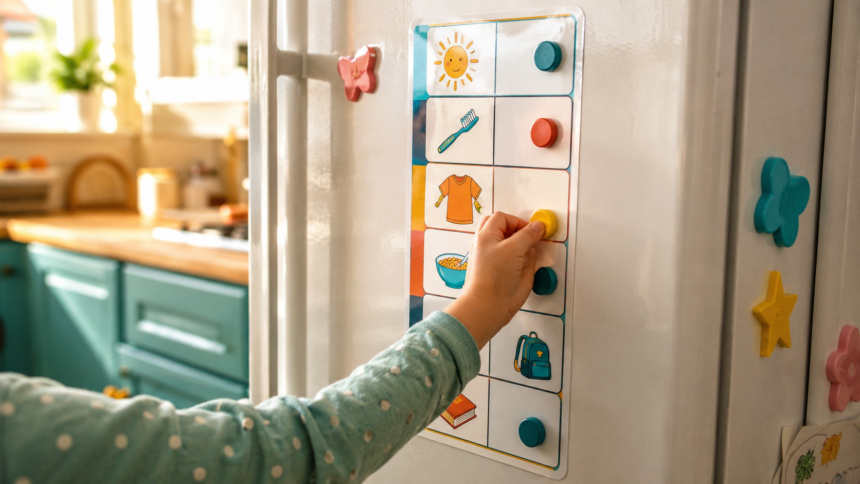
You’ve got fourteen minutes, one shoe, and a toddler who has decided that today is the day they will not wear pants. A solid toddler morning routine is the difference between calmly walking out the door and arriving everywhere sweaty and frazzled — and it has almost nothing to do with waking up earlier. The chaos usually comes from a handful of predictable pressure points you can actually fix. This article gives you a step-by-step morning sequence, sample routines by age, and the one trick that makes it stick past the first week.

My Day, My Way — The Complete Toddler Routine System
6 ready-made picture charts, 36 cut-out cards, a First–Then board, trackers & a parent guide — everything to help your toddler run their own day. 24 pages, instant download.
A good toddler morning routine is a short, predictable sequence of the same steps in the same order every day — usually wake, potty, get dressed, breakfast, brush teeth, shoes. It works because toddlers can’t tell time but can follow a routine they’ve memorized, which lowers resistance and cuts the number of decisions everyone has to make before 8am. Keep it to five or six steps, run the calmest version you can manage, and use a picture chart so your child can follow it without you repeating yourself.
Key takeaways
- A toddler morning routine works because predictability removes the negotiation — your child stops fighting steps they already expect to happen.
- Most morning meltdowns come from hunger, rushing, or too many choices, not defiance, so fix those pressure points before you blame attitude.
- Keep the sequence to five or six steps and run it in the same order every single day, weekends included wherever you can.
- Connection before direction: two minutes of calm attention at wake-up prevents more resistance than any reward or threat.
- A picture chart hands the routine to your toddler so you can stop being the human alarm clock repeating “get dressed” eleven times.
- Prep the night before — clothes, bags, breakfast plan — because decisions made at 7am are the ones that derail the whole morning.
Why your toddler morning routine keeps melting down

Before you can fix your mornings, you have to understand that your toddler usually isn’t giving you a hard time — they’re having a hard time, and four specific forces are working against both of you. Naming them is half the battle, because each one has a different fix.
The first is biology. Your toddler wakes up groggy and running on empty. They’ve gone ten or more hours without food, so their blood sugar is low right when you’re asking them to cooperate, focus, and move fast. A hungry, half-asleep two-year-old is not a reasonable negotiating partner. This is why so many mornings improve the moment food appears — the meltdown was a fuel problem wearing a behavior costume.
The second is your stress, transmitted straight to them. Toddlers co-regulate, meaning they borrow their emotional state from the nearest adult. When you’re rushing — clipped voice, fast movements, checking the clock — your child’s nervous system reads “danger” and ramps up, not down. The cruel irony is that the faster you push, the slower they often go, because a dysregulated toddler can’t access cooperation. Your calm is a tool, not a luxury.
My Day, My Way — The Complete Toddler Routine System
6 ready-made picture charts, 36 cut-out cards, a First–Then board, trackers & a parent guide — everything to help your toddler run their own day. 24 pages, instant download.
The third is decision fatigue. Every “What do you want for breakfast?” and “Which shirt?” hands a small, tired brain another choice to process. Pile up enough open-ended questions and you get stalling, indecision, and the classic floor-flop. Toddlers crave autonomy but drown in too many options.
The fourth is unpredictability. If the morning looks different every day — different order, different expectations, a surprise here and there — your toddler can’t anticipate what’s coming, and the unknown is exactly what triggers resistance and clinginess. A routine that runs the same way every day removes that low-grade anxiety. Your child stops bracing for surprises because there aren’t any.
Notice what’s not on this list: deliberate defiance. Once you stop reading mornings as a battle of wills and start reading them as a fuel-plus-predictability problem, the fixes get obvious — and most of them happen before your toddler is even awake.
The ideal toddler morning routine, step by step
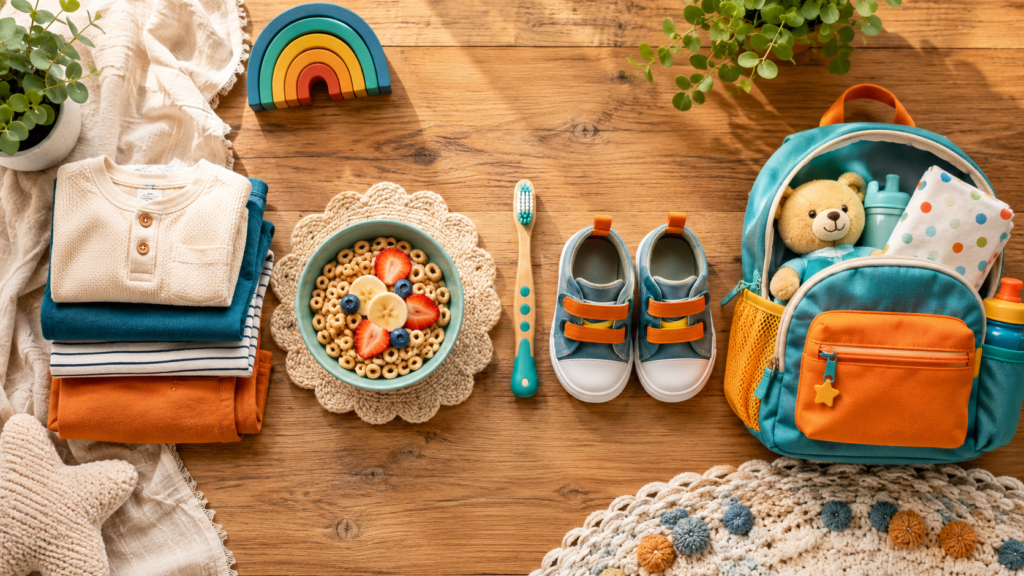
The best morning routine is short, runs in a fixed order, and front-loads the calm so the rushing never starts — here’s the sequence that works for most families, and the reasoning behind the order. Adapt the specifics, but keep the structure.
Step 1 — Wake gently, with two minutes of connection. Before any instruction, give your toddler a soft landing: a cuddle, a stretch, opening the curtains together, a quiet “good morning.” This isn’t fluff. Those two minutes fill your child’s tank so they have something to cooperate with. Skip it and you’ll spend the next twenty minutes paying for it.
Step 2 — Potty or diaper. Get this out of the way early while they’re still calm. For potty-training kids, the morning pee is the easiest catch of the day.
Step 3 — Get dressed. Clothes should already be chosen and laid out (more on that below). Many families dress before breakfast; plenty dress after to avoid the inevitable yogurt handprint. Pick one and keep it consistent — the order matters more than which order.
Step 4 — Breakfast. Feed the beast. A predictable, low-effort breakfast steadies blood sugar and mood. This is not the morning to debate the menu.
Step 5 — Brush teeth, face, hair. Group the bathroom tasks together so it’s one stop, not three. Keep a stool at the sink so your child can do as much as possible themselves.
Step 6 — Shoes, bag, out the door. The final sprint. Shoes and bag live by the door, ready to go, so the last step is grab-and-go rather than a frantic hunt.
The whole thing should take twenty to thirty minutes once it’s grooved in. The single biggest accelerator isn’t doing any step faster — it’s doing the same six steps in the same order until your toddler runs them on autopilot. Novelty is the enemy of a smooth morning.
Sample morning routines by age

The right routine depends entirely on what your child can realistically do alone, so a two-year-old’s morning and a five-year-old’s morning should look genuinely different. Match the number of steps and the level of independence to the actual kid in front of you, not to an ideal you saw online.
My Day, My Way — The Complete Toddler Routine System
6 ready-made picture charts, 36 cut-out cards, a First–Then board, trackers & a parent guide — everything to help your toddler run their own day. 24 pages, instant download.
A two-year-old can follow a three-to-four-step sequence and needs help with most of it — your job is mostly guiding and doing it alongside them. A three-year-old can manage five steps and should own one or two tasks completely, because three-year-olds are powered by the pride of “I did it myself.” By four and five, your child can run a fuller, more independent routine with real responsibilities, and you shift from doer to supervisor.
| Age | Steps | What they do | Your role | Rough timing |
|---|---|---|---|---|
| 2 years | 3–4 | Wake, potty, get dressed (with help), breakfast | Hands-on guide, doing most steps together | Allow extra time; expect help |
| 3 years | 5 | Potty, dress with one choice, breakfast, teeth, shoes | Coach; let them own dressing or shoes | 20–30 min |
| 4–5 years | 6–7 | Make bed, dress, breakfast, teeth, pack bag, shoes, coat | Supervisor; step in only when stuck | 25–30 min, mostly independent |
The pattern is simple: as your child grows, you hand over one more piece. A morning routine that still has you dressing a capable four-year-old isn’t saving time — it’s training dependence and quietly making future mornings harder. Let them do everything they’re able to do, even when it’s slower at first.
How to make the morning routine stick
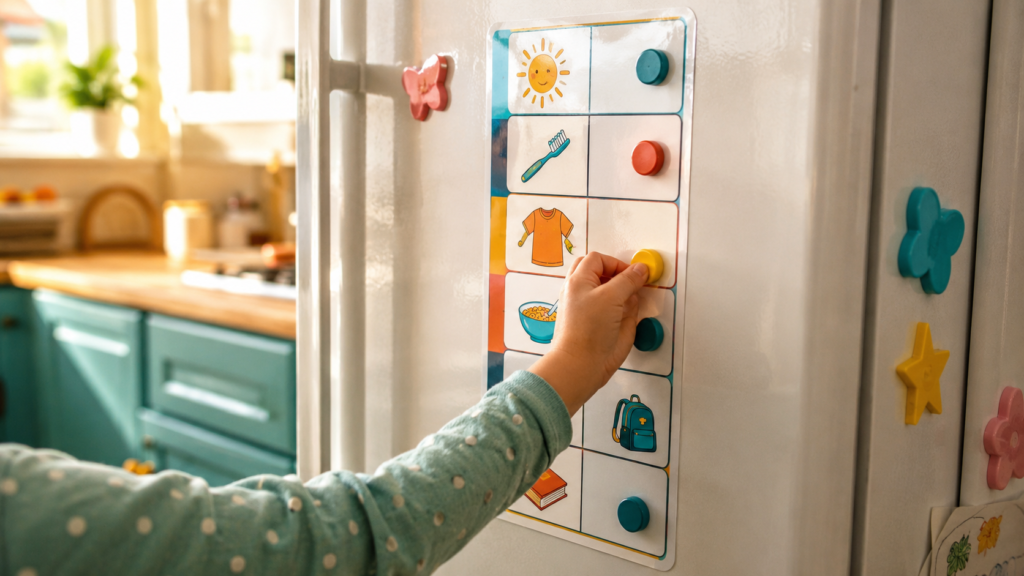
A morning routine only works if it survives past the first enthusiastic week, and the difference between one that sticks and one that fizzles is whether you transfer the prompting off your voice and onto something your toddler can follow themselves. The tool for that is a picture chart — a visual schedule showing each step as an image your pre-reader can read at a glance.
It works for a concrete reason: your toddler can’t tell time and can’t read words, but they can absolutely follow a row of pictures they’ve memorized. The chart turns “we’re running late, please get dressed” into “look — getting dressed is next, then breakfast.” Instead of being the voice that nags, you become the calm person who points and asks, “What’s next on your chart?” That shift — from enforcer to teammate — is the whole reason charts outperform reminders.
A few rules make it land. Keep it to five or six steps. Use real photos where you can, ideally of your own child doing each task, because kids engage far more with images of themselves than with generic clip-art. Hang it where the morning happens and at your child’s eye level, not yours. And make it interactive — let your toddler move a clip, flip a card, or color a star as each step is done, because the little hit of “I finished that” is what keeps them coming back to it day after day.
You can build one yourself with a printer and some lamination, or skip the DIY entirely. The point isn’t the craft project — it’s getting a clear, durable, picture-based sequence onto the wall so your toddler can drive their own morning while you make the coffee.
The other half of “making it stick” happens the night before. Mornings are decided at bedtime. Lay out the next day’s clothes (let your child pick from two options the evening before, when there’s no time pressure). Pack the bag and park it by the door. Decide breakfast. Every decision you move out of the 7am rush is one less thing to negotiate when everyone is tired and the clock is ticking. Prep is the unglamorous secret of calm mornings.
The dawdler and the won’t-get-dressed standoff
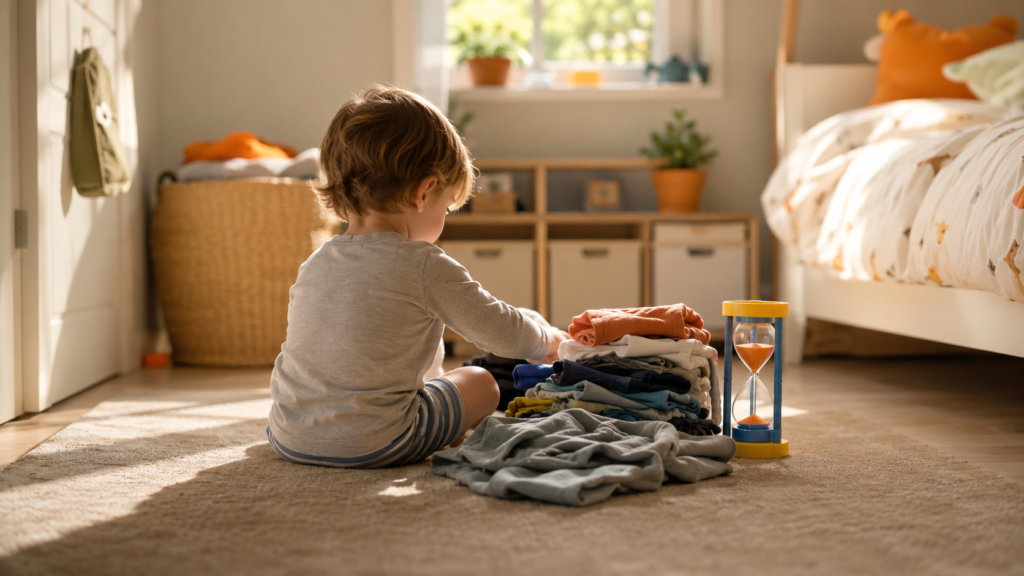
Two specific battles wreck more mornings than anything else — the child who moves at glacial speed and the child who refuses to get dressed — and both respond to the same calm, structured tactics rather than to louder demands. Force escalates these standoffs; structure dissolves them.
My Day, My Way — The Complete Toddler Routine System
6 ready-made picture charts, 36 cut-out cards, a First–Then board, trackers & a parent guide — everything to help your toddler run their own day. 24 pages, instant download.
For the toddler who won’t get dressed, start with choice inside a boundary. “Getting dressed isn’t optional, but you can choose the red shirt or the blue one.” A controlled choice gives your child the autonomy they’re fighting for without opening the door to “no clothes at all.” Lay both options out the night before so the choice is quick. Turn it into play when you can — get dressed in a race against a song, narrate it like a sports commentator, or let them dress a favorite stuffed animal alongside themselves. For the child who melts down at cold clothes or sensory discomfort, warm the outfit on a radiator or pick softer, tag-free fabrics; sometimes “I won’t get dressed” is really “those clothes feel awful.”
When all else stalls, offer the clean either-or: “You can put your shirt on, or I can help you. You choose.” Then follow through calmly. The goal isn’t to win — it’s to keep the routine moving without a power struggle.
For the dawdler, resist the urge to nag faster, because nagging is background noise a toddler learns to tune out. Use visual time instead: a sand timer or a visual countdown gives “hurry up” a concrete shape a child who can’t tell time can grasp. Break the routine into the picture-chart steps so the next action is always visible. And lean on the First–Then structure for the truly stuck moments — “First shoes, then we feed the ducks on the way” — which pairs the boring task with something your toddler actually wants. Above all, build in a buffer. A dawdler in a ten-minute window is a guaranteed meltdown; the same child with a twenty-five-minute window often drifts through the routine just fine.
Common mistakes parents make with morning routines

These are the errors that quietly sabotage mornings even when you’re doing everything else right.
Issuing commands the second they wake up. Walking into your toddler’s room and immediately firing off “get up, get dressed, we’re late” skips the connection buffer their groggy nervous system needs, and you’ll meet resistance at every step that follows. Spend the first two minutes connecting — a cuddle, a calm greeting — before you ask for anything. It feels like the slow option. It’s the fastest one.
Offering open-ended choices. “What do you want to wear?” and “What do you want for breakfast?” sound respectful but overload a tired toddler into stalling or melting down. The fix is the controlled choice: always two options, both of which work for you. “Banana or yogurt?” moves the morning forward; “what do you want?” stops it dead.
My Day, My Way — The Complete Toddler Routine System
6 ready-made picture charts, 36 cut-out cards, a First–Then board, trackers & a parent guide — everything to help your toddler run their own day. 24 pages, instant download.
Letting your own rush set the tempo. When you speed up and tense up, your toddler absorbs the panic and slows down — the exact opposite of what you need. Your calm, unhurried pace is what regulates them. Wake fifteen minutes earlier yourself if you must, so the morning has slack and your child isn’t co-regulating to your stress.
Doing every step for them to save time. Dressing a capable three-year-old or carrying a four-year-old to the car feels efficient in the moment, but it erodes the independence that makes mornings easier long-term, and your child learns that resistance gets them carried. Build in time for them to do what they can, even slowly. The minutes you “lose” now you get back tenfold once they can run the routine themselves.
Changing the routine on weekends. Running a totally different, loose morning on Saturday and Sunday breaks the memorized sequence your toddler relies on, and Monday becomes a fresh fight. Keep the same anchors — wake, eat, dress — even on relaxed days. You can loosen the timing without scrapping the order.
FAQ

What time should a toddler wake up? Most toddlers naturally wake between 6 and 7:30am, and the exact time matters less than consistency — waking around the same time daily keeps their body clock steady and mornings predictable. Work backwards from the sleep your child needs (roughly 11 to 14 hours across 24 hours for ages one to two, including naps). If wake-ups are painfully early, look at bedtime and nap length before trying to shift the morning.
What order should a toddler morning routine go in? A reliable order is wake, potty, get dressed, breakfast, brush teeth, then shoes and bag. The specific order matters less than keeping it identical every day, because the predictability is what reduces resistance. Some families swap dressing to after breakfast to avoid spills — that’s fine. Pick your sequence, put it on a picture chart, and run it the same way each morning so your toddler can follow it on autopilot.
How do I get my toddler to get dressed in the morning? Offer a controlled choice — “red shirt or blue?” — instead of an open question, and lay both options out the night before to keep it quick. Make it playful with a race against a song or a “beat the timer” game. For sensory-sensitive kids, choose soft, tag-free clothes and warm them first. If they still stall, calmly offer “you do it or I help you,” then follow through.
My toddler is so slow in the morning — how do I speed them up? Stop nagging, which they tune out, and use visual time instead: a sand timer or countdown gives “hurry” a shape a toddler can understand. Show the next step on a picture chart so they always know what’s coming. Use “first this, then something fun” to pull them through dull steps. Most importantly, add a buffer — a rushed dawdler melts down, while the same child with extra time drifts through fine.
Should toddlers eat breakfast before or after getting dressed? Either works — what matters is consistency, so pick one and keep it. Many families dress after breakfast to avoid food stains on clean clothes, especially with messy eaters. Others dress first because a fed, dressed child is closer to out-the-door. If your toddler is a chaotic eater, a bib over clothes or dressing afterward saves laundry. Choose the version that fits your kid and run it daily.
How long should a toddler morning routine take? Plan for about 20 to 30 minutes once the routine is established, and more while your toddler is still learning it. Younger toddlers and dawdlers need extra buffer, so build in slack rather than cutting it close — a tight window almost guarantees a meltdown. The routine speeds up naturally as your child memorizes the steps and gains independence, so resist rushing them through it in the early weeks.
The bottom line
The fastest way to fix a chaotic toddler morning routine isn’t an earlier alarm — it’s a calmer, more predictable sequence your child can run largely on their own. Pick your five or six steps, prep what you can the night before, and put the routine on the wall where your toddler can see it and follow along. Try it for one full week before you judge it, and pay attention to how much of the morning fight quietly disappears once the surprises are gone.