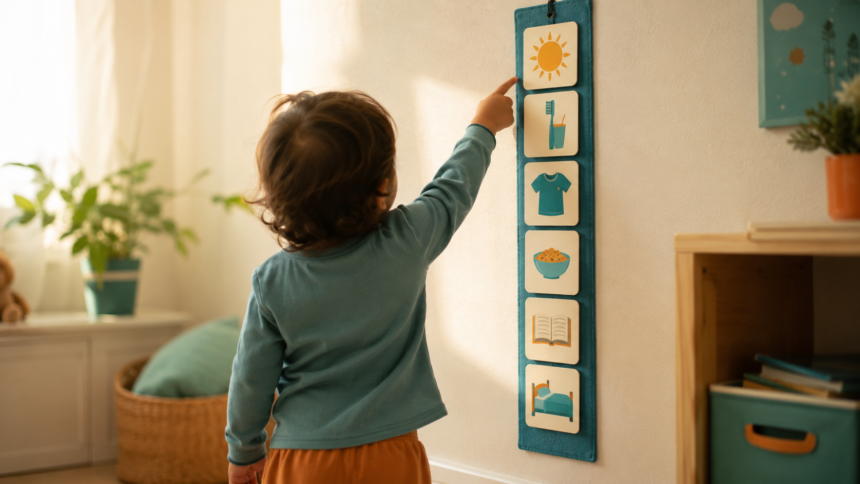
Your toddler hears “time to leave the park” and dissolves onto the grass like the world is ending. The problem usually isn’t the leaving — it’s that they had no idea it was coming. A visual schedule for toddlers fixes exactly that: it shows your child what happens next, in pictures they can actually read, so transitions stop feeling like ambushes. This guide explains what one is, why it works so well for little kids, and how to build one in an afternoon.
The whole first year, calmed — in one bundle.
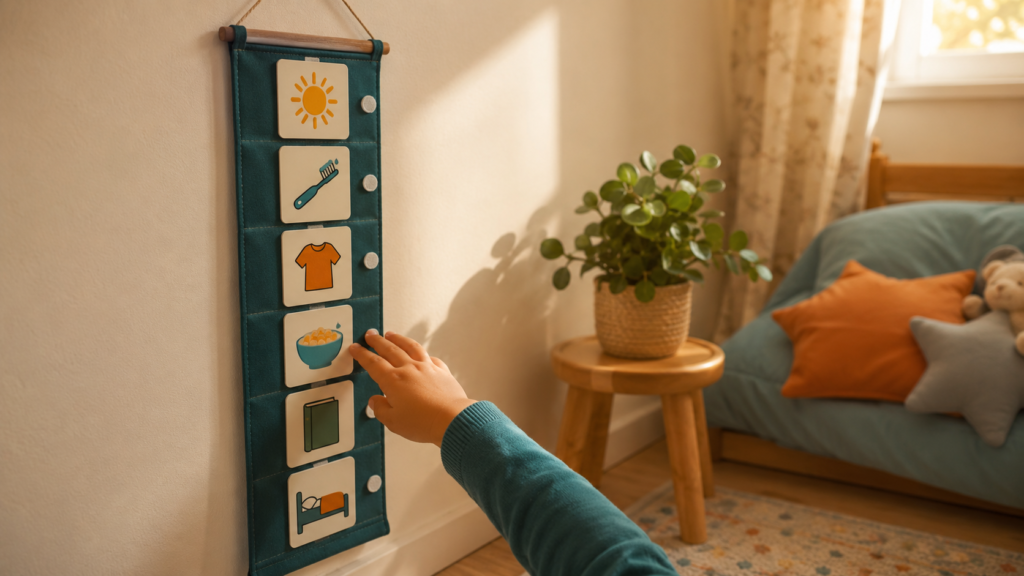
A visual schedule for toddlers is a row or column of pictures showing the steps of an activity or the events of the day in order — get dressed, breakfast, brush teeth, shoes. It works because toddlers can’t tell time or read words but can follow images, so the schedule turns the abstract day into something they can see and predict. That predictability lowers anxiety and cuts the power struggles around transitions, because your child always knows what’s coming next.
Key takeaways
- A visual schedule for toddlers replaces the words your child can’t process yet with pictures they can, making the day predictable instead of a string of surprises.
- Predictability is the active ingredient — when a toddler can see what’s coming, the meltdowns built into transitions shrink dramatically.
- Visual schedules are an evidence-based tool used by occupational therapists, speech therapists, and preschools for all children, not only those who are neurodiverse.
- The three main types — linear, first–then, and object schedules — suit different ages and needs, and you can use more than one.
- Real photos of your own child or familiar objects work better than generic clip-art, because toddlers engage far more with the familiar.
- A schedule only works if your child interacts with it and you let it do the prompting — pointing to it instead of repeating yourself.
What a visual schedule for toddlers actually is
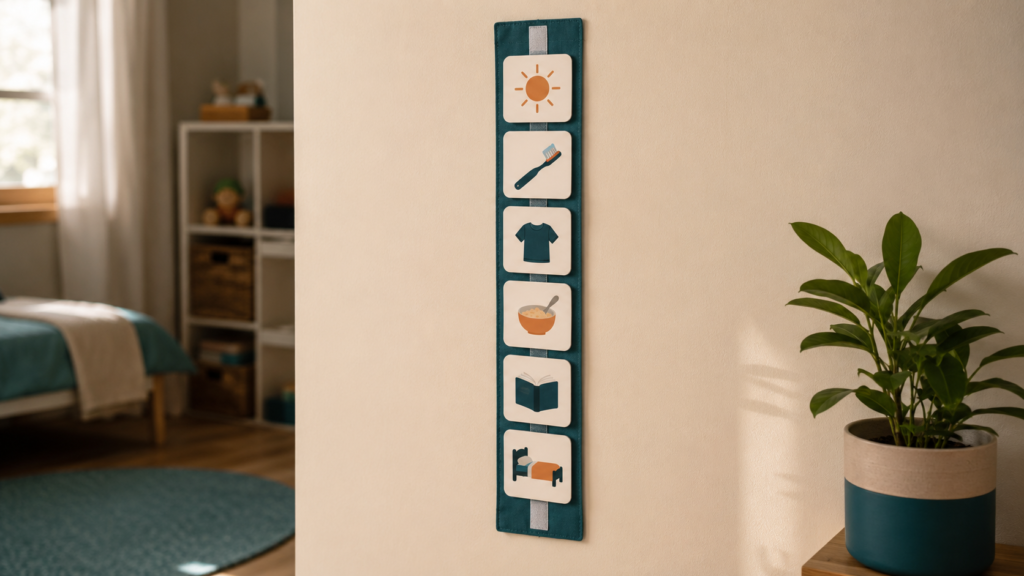
A visual schedule is simply a sequence of pictures that shows your child what’s happening and in what order, and understanding the basic forms it takes is the first step to using one well. The term sounds clinical, but the idea is plain: instead of telling your toddler the plan in words they can’t fully hold onto, you show it to them in images they can.
It usually takes one of two shapes. The first is a routine sequence — the steps of a single activity laid out in order, like a morning routine that runs wake, potty, dressed, breakfast, teeth, shoes. The second is a daily schedule — the bigger blocks of the whole day, like breakfast, play, snack, nap, park, dinner, bath, bed. Both do the same job: they make the invisible structure of time visible.

A bedtime that's finally
boring.
Fix the room, build the routine, learn the eight scripts. No sleep training, no crying it out — just a sequence that stops needing your patience.
Get The No-Fight Bedtime$17 · 70 pages · instant PDF · yours forever
This matters because of where your toddler is developmentally. A two- or three-year-old has almost no working sense of time. “In ten minutes,” “after lunch,” and “soon” are abstractions their brain can’t picture, which is why those phrases do so little to prepare them for what’s coming. A line of pictures, on the other hand, gives that abstract plan a concrete, physical form. Your child can look at it, point to it, and see exactly where they are in the day and what comes next.
Think of it as the difference between someone telling you directions out loud while you drive versus handing you a map. The map doesn’t change the route — it just lets you see it. A visual schedule is your toddler’s map of the day. It’s not a behavior chart, not a reward system, and not a punishment tool. It’s a communication aid that closes the gap between what you know is coming and what your child can understand is coming.
Fewer battles. More calm.
Five calm guides + 20 printables — for tantrums, sleep, food, potty & talking.
Get The Toddler Years · $27 →Why a visual schedule for toddlers works
A visual schedule works because it solves the two things that drive most toddler resistance — unpredictability and a lack of control — at the same time, and it does so without you having to repeat yourself. The mechanism is simple once you see it.
Seventy pages. Two script tables.
Every meal, without the battle — the setup, the scripts, and exactly what to say when they won't eat it.


Instant PDF · 26 photographs · yours forever
Start with predictability. Surprise is what triggers a toddler. When the day arrives in a series of unannounced demands — “stop playing, we’re leaving,” “time for bed now” — your child is constantly being yanked out of one thing into another with no warning, and the nervous system reads that as something to fight. A schedule removes the surprises. Because your toddler can see that “park” is followed by “snack” and then “home,” the transition stops being an ambush and becomes the next expected thing. The anxiety that fuels so many meltdowns simply has less to feed on.
Breathe out.
Get down.
Two sentences.
That's the four-step response — and it works in the supermarket, the restaurant, the car park and the departure gate. The Public Meltdown Field Guide gives you the exact words for each one.
Read what's inside$17 · 70 pages · instant download


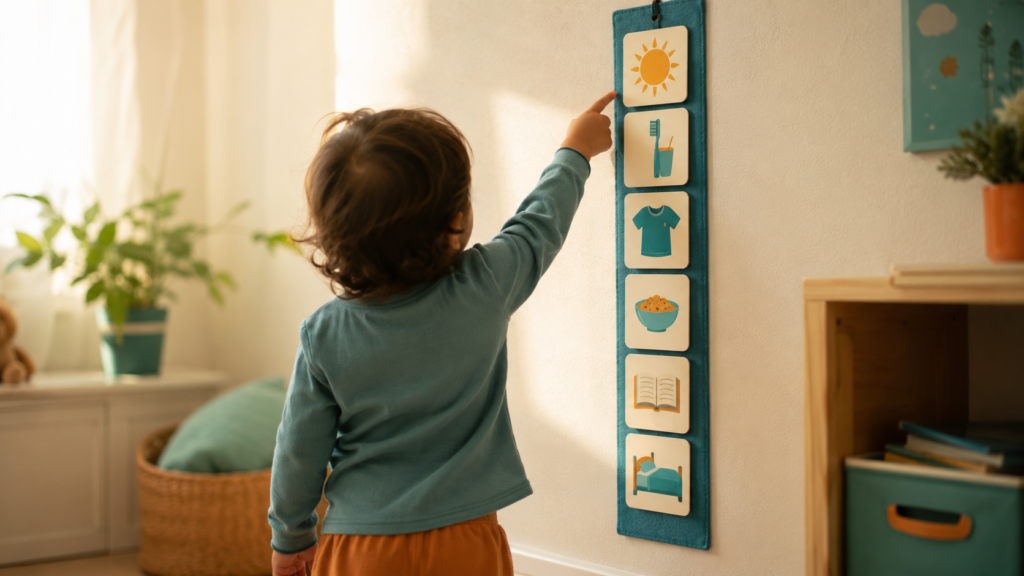
Then there’s the control piece. Toddlers are wired to assert independence, and a visual schedule hands them a healthy slice of it. Instead of you being the voice that issues every instruction, the schedule becomes the authority. You shift from “get your shoes on” to “let’s check your schedule — what’s next?” Your child looks, sees shoes, and does it. They’re following the schedule, not surrendering to you, which sidesteps the power struggle entirely. That move — from you-versus-them to both of you following the picture — is the quiet genius of the whole approach.
This isn’t a fringe parenting hack. Visual supports are a recognized, evidence-based practice in early childhood education and developmental therapy. Occupational therapists, speech-language pathologists, and preschool teachers reach for them constantly, because they work with the way young brains actually process information — visually and concretely rather than through abstract language. They’re widely used to support autistic and other neurodiverse children, for whom predictability and visual processing can be especially important, but they help essentially every toddler. If your child has specific developmental needs, a professional who knows them can tailor a schedule far better than any general guide — but the core tool belongs to all kids.
One more reason it sticks: it engages the visual channel, which is dominant for toddlers. A spoken instruction is gone the second you finish saying it. A picture stays put. Your child can return to it again and again, which is exactly why a schedule on the wall outperforms a reminder in the air.

Big feelings & big school, calmed.
5 calm guides + 20 printables on emotions, discipline, bedtime, screens & school-ready.
See The Preschool Years · $27 →The 3 types of visual schedules (and which to use)
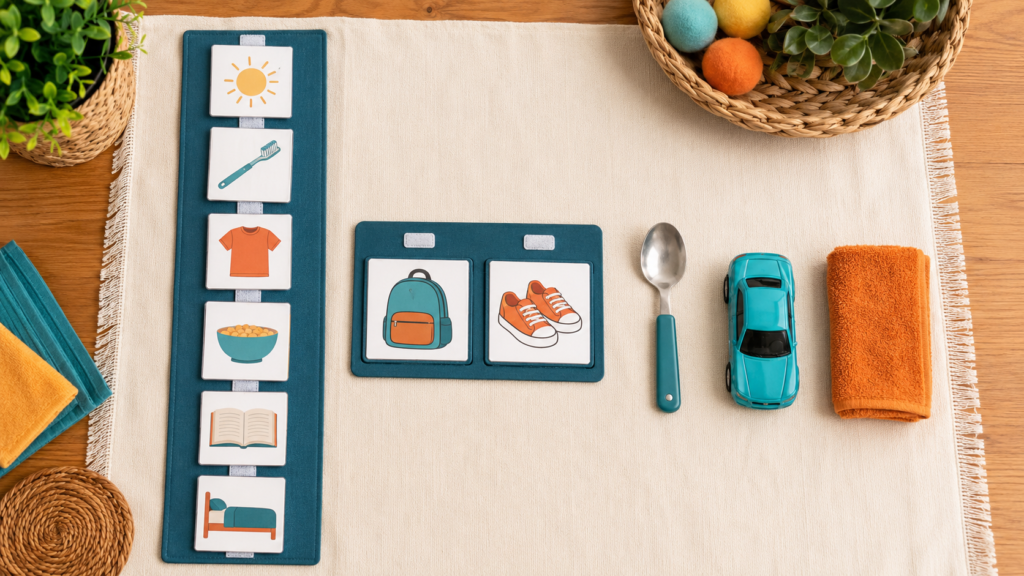
There are three main formats, and choosing the right one comes down to your child’s age, attention span, and how much they can handle at once. You don’t have to pick just one — many families run a couple side by side.
The linear (or sequential) schedule shows several steps in order, top to bottom or left to right. It’s the classic routine chart: the full morning or bedtime sequence laid out so your child can see the whole arc and work through it. Best for toddlers around three and up who can track a series of steps without feeling overwhelmed.
The first–then board strips it down to two pictures: what’s happening now, and what’s happening next. “First shoes, then park.” It’s the gentlest entry point and the best tool for tough transitions or for younger toddlers who can’t yet handle a long sequence, because it only ever asks them to focus on one upcoming thing. Pair the less-preferred task (“first”) with something motivating (“then”) and you’ve got a remarkably effective little nudge.
The object schedule uses real, physical objects instead of pictures — a spoon for mealtime, a nappy for changing, a toy car for the drive. It’s the most concrete format and suits the very youngest toddlers, children still developing the understanding that a picture represents a real thing, and kids who respond strongly to touch.
| Type | How it works | Best for | When to use |
|---|---|---|---|
| Linear / sequential | A full row or column of ordered steps | Toddlers ~3+ who can follow a sequence | Whole routines (morning, bedtime) |
| First–Then board | Just two pictures: now and next | Younger toddlers; hard transitions | Single tough moments; gentle start |
| Object schedule | Real objects represent each step | Youngest toddlers; very concrete thinkers | Before pictures click; sensory needs |
If you’re starting out, the first–then board is the easiest win — it’s nearly impossible to overwhelm a child with two pictures. Once your toddler is comfortable, graduate them to a linear schedule for full routines.
"Most days don't matter. The hard ones do — and you don't have to wing them."
The School-Age Years is five calm, practical guides for the 6–12 stage — big feelings, homework, friendships, screens, and raising a capable kid.
Read more about The School-Age Years →How to make a visual schedule in 5 steps
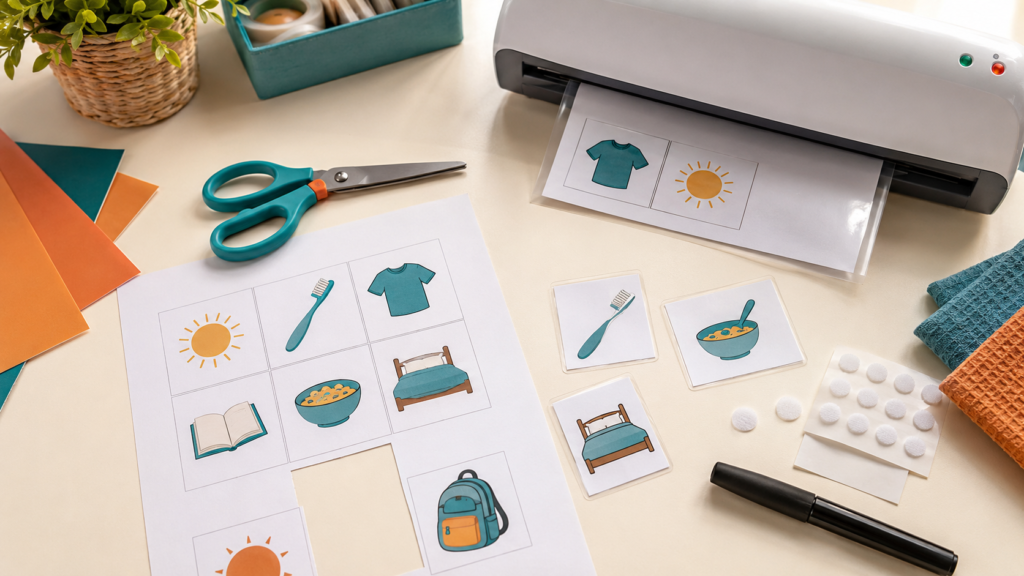
Building a visual schedule takes about an hour, and getting these five steps right is the difference between a tool your toddler uses daily and a craft project that ends up in a drawer. Work through them in order.
1. Pick one routine or part of the day. Don’t map the whole day at once — start with your single hardest moment, usually the morning rush or bedtime. One small schedule that works beats a sprawling all-day version that overwhelms everyone. You can add more later.
2. List the real steps — watch your day first. For a couple of days, just notice the actual steps your routine takes, in the real order they happen. Parents tend to design the routine they wish they had, then wonder why the schedule doesn’t match reality. The schedule has to mirror what genuinely occurs, including the unglamorous bits.
3. Choose images your child connects with. Real photographs win, and the best are photos of your own child doing each step, because kids are fascinated by themselves. No photos? Simple, clear icons work fine. Avoid busy, detailed clip-art that distracts more than it directs. Keep one clear image per step.
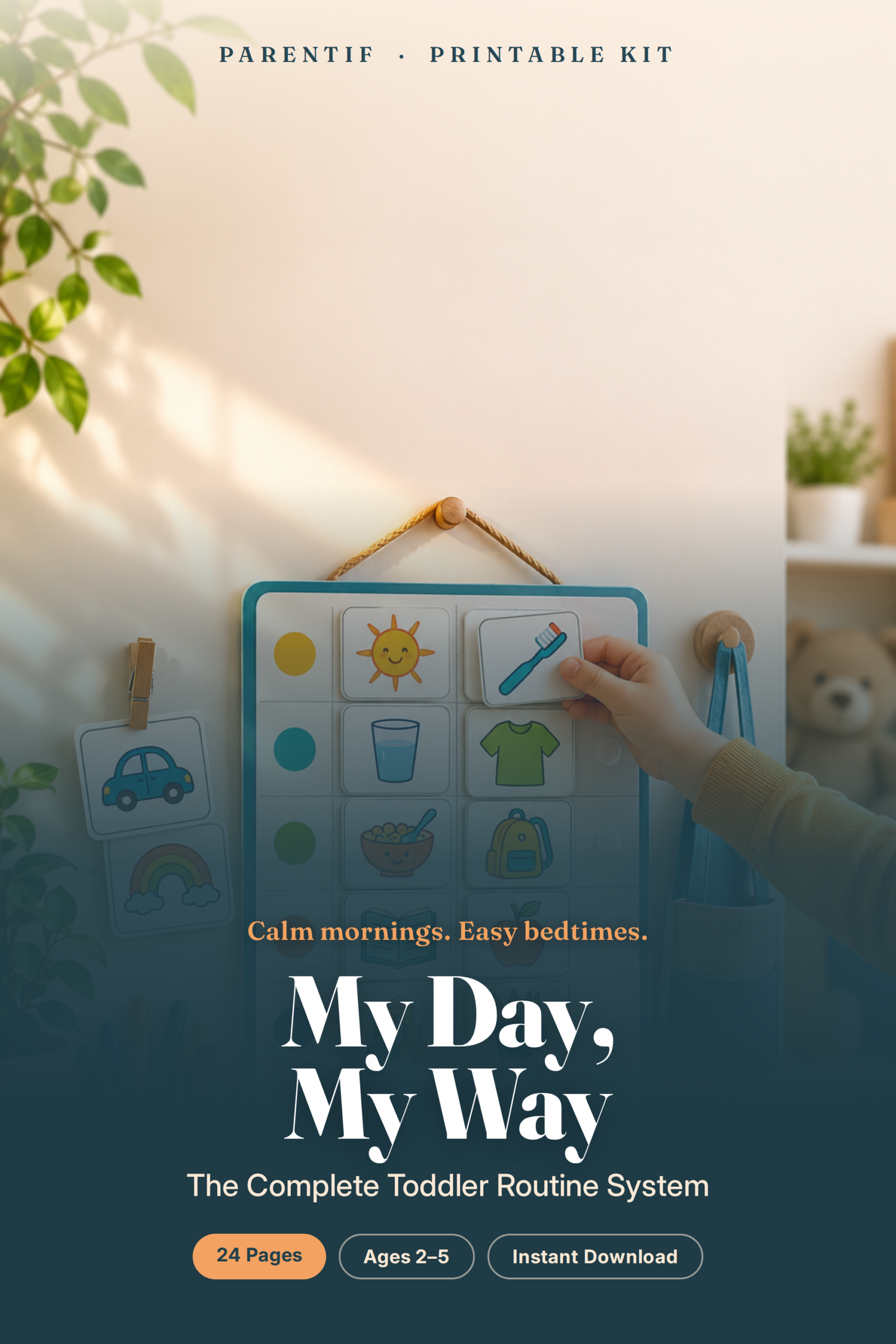
My Day, My Way — The Complete Toddler Routine System
6 ready-made picture charts, 36 cut-out cards, a First–Then board, trackers & a parent guide — everything to help your toddler run their own day. 24 pages, instant download.
4. Make it physical. A schedule your child only looks at is a poster; one they operate is a tool. Build in a way to mark progress — a clip that slides down, laminated cards that flip or move into a “done” pocket, velcro pieces they pull off. That small hit of “I finished that” is what keeps a toddler coming back to it.
5. Place it where the routine happens, at their eye level. The morning schedule goes where mornings happen; the bedtime one in the bedroom. And it must hang low enough for your toddler to see and touch without you lifting them. A schedule at adult eye level is a schedule for adults.
The hard talks don't have to be a war.
Five short, practical guides — phones, moods, risks, independence, and letting go. The words to say when it counts, minus the lecture.
Explore The Teen Years →Instant PDF set · read on any device · yours forever
Build it together wherever you can — a child who helped choose the photos and place the cards feels ownership, and ownership is most of the battle. If the cutting, laminating, and photographing sounds like more than you have time for, a ready-made printable kit gives you the charts, picture cards, and a first–then board already designed — so you can skip straight to using it.
Using a visual schedule day to day
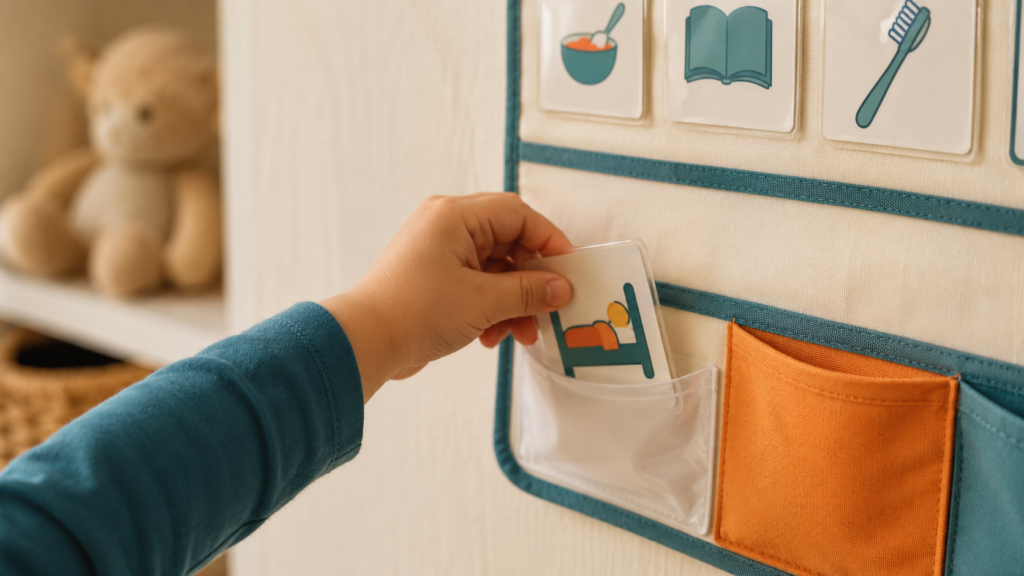
Making the schedule is the easy part; using it consistently is what turns it into a habit your toddler relies on, and a few small practices make all the difference. The goal throughout is to let the schedule lead and to keep yourself out of the nagging role.
Refer to the schedule instead of issuing the instruction. When your toddler stalls, resist barking the next step. Point and ask: “What does your schedule say is next?” You’re handing the authority to the pictures and keeping your relationship out of the power struggle. Say it the same calm way every time, especially on the rough mornings.
Let your child do the marking. Have them move the clip, flip the card, or drop the finished step into the “done” pocket themselves. That physical act cements the progress and gives them the satisfaction that keeps the system alive. Narrate lightly and warmly — “you finished breakfast, look how far you’ve gotten” — without turning it into a performance.
Expect to adjust it. Toddlers grow, routines change, and a schedule that fit a month ago goes stale. When you notice your child glazing over, refresh it: new photos, a new marker, an added “big kid” step. A small update re-engages a bored toddler far faster than nagging. And reach for the first–then board within the bigger routine whenever a single transition gets sticky — it narrows the focus to just the next thing.
Above all, use it every day, not only when things go wrong. A schedule that appears only during meltdowns becomes associated with conflict. A schedule that’s simply how your family does mornings becomes invisible scaffolding your child leans on without even noticing.
Common mistakes parents make with visual schedules
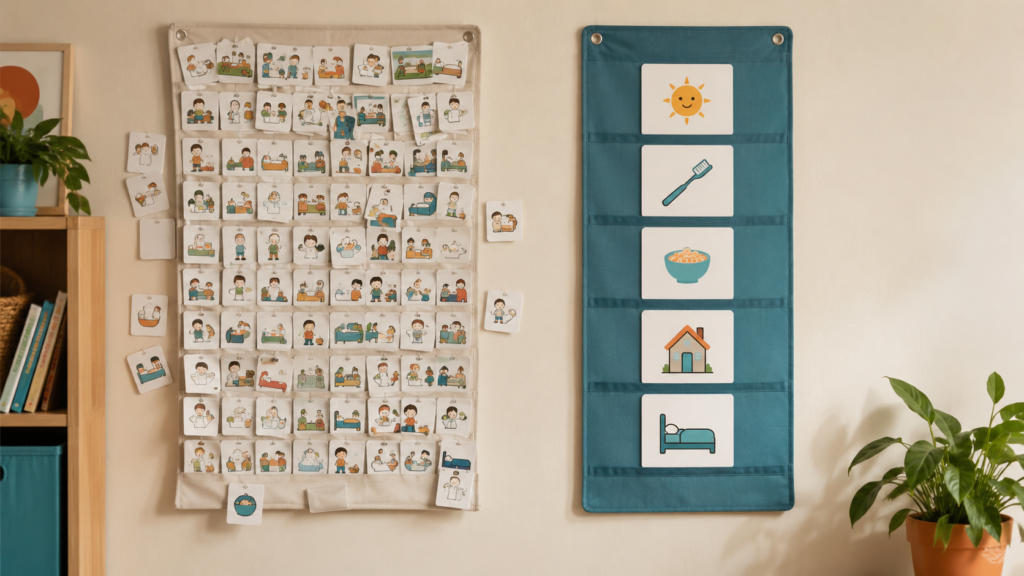
These are the errors that quietly sink a visual schedule even when the idea is sound.
Cramming the whole day onto one schedule. It feels efficient to map the entire day top to bottom, but a fifteen-item wall of obligation overwhelms a toddler into doing none of it. Build small, separate schedules for the two or three moments that actually need help, and leave the rest of the day off entirely.
Using words for a child who can’t read. A schedule that says “Get Dressed” in tidy letters is meaningless to a pre-reader, no matter how nice it looks. Your toddler needs to decode it at a glance, and that means pictures lead. If you want words, put them under the image as a bonus, never instead of it.
Building it, then still narrating every step. This is the subtle one. Parents make a lovely schedule and then stand over it repeating each instruction out loud — which turns the schedule into wallpaper for the same old nagging. The entire point is to transfer the prompting from your voice to the pictures. If you’re still saying every step, the schedule isn’t doing its job and your toddler knows it.
Treating it as a behavior reward chart. A visual schedule shows what happens next; it’s not a system for earning stars or losing privileges. Blurring the two turns a calm, predictable communication tool into a source of pressure and bargaining. Keep the schedule about the sequence of the day, and handle motivation separately if you need to.
Making it once and never touching it again. A laminated, lovingly designed schedule becomes something parents are reluctant to change — so it slowly stops matching the child and loses relevance within a couple of months. Treat it as editable. The best schedule is the one you’ve revised three times, not the one that’s survived untouched since you made it.
FAQ
At what age can a toddler use a visual schedule? Most children can start following a simple visual schedule around age two, though at that age it should have just two or three pictures — a first–then board is ideal. By three, kids can manage a linear schedule of five or six steps. For younger toddlers under two, an object schedule using real items often works better than pictures, since they’re still learning that an image represents a real thing.
Do visual schedules work for all toddlers or just autistic children? They work for essentially all toddlers. Visual schedules are strongly associated with autism support because predictability and visual processing can be especially helpful for autistic children, and therapists use them widely. But the underlying reason they work — toddlers think visually and crave predictability — applies to every young child. Plenty of neurotypical kids calm down and cooperate far better once they can see their day laid out.
Should a visual schedule use photos or drawings? Real photos usually win, especially pictures of your own child doing each step, because toddlers connect strongly with familiar images of themselves. Clear, simple icons or drawings are a fine alternative if photos aren’t practical. What you want to avoid is busy, detailed clip-art that distracts more than it directs. Whichever you choose, keep one clean, obvious image per step so your child can read it instantly.
How many pictures should be on a toddler’s visual schedule? Keep it short — four to six pictures for most toddlers, and just two or three for kids under three. Each extra step past six sharply raises the odds your child gives up partway through. If your routine genuinely has more steps, group several small ones under a single picture, or split it into two separate schedules, like one for the morning and one for bedtime, rather than one long overwhelming list.
What’s the difference between a visual schedule and a first-then board? A first–then board is actually a type of visual schedule — the simplest one. It shows only two pictures: what’s happening now and what comes next. A full (linear) visual schedule shows the whole sequence of a routine or day. Use a first–then board for younger toddlers or for single hard transitions, and a linear schedule once your child can comfortably follow several steps in a row.
How do I get my toddler to actually use the visual schedule? First, make sure you’re pointing to it rather than repeating instructions yourself — if you’re still nagging, the schedule never gets a real chance. Then make it interactive, so your child physically moves or marks each step. Use real photos they connect with, hang it at their eye level, and refresh it when it goes stale. Consistency over a week or two usually makes it routine.
The bottom line
The real power of a visual schedule for toddlers is that it stops the day from feeling like a series of ambushes — your child can finally see what’s coming, so they spend less energy fighting it. Start with one routine and a handful of clear pictures, hang it where your toddler can reach it, and let the schedule do the prompting while you step back into the calmer role of guide. Build your first one this week, and pay attention to how much smoother the transitions get once your child can read the day for themselves.

Get The Calm Parent Roadmap — free.
The whole journey, from "I do" to "they're grown." 8 stages, one calm method, 13 beautiful pages. Drop your email and it's yours.
Instant PDF download · no spam · unsubscribe anytime.