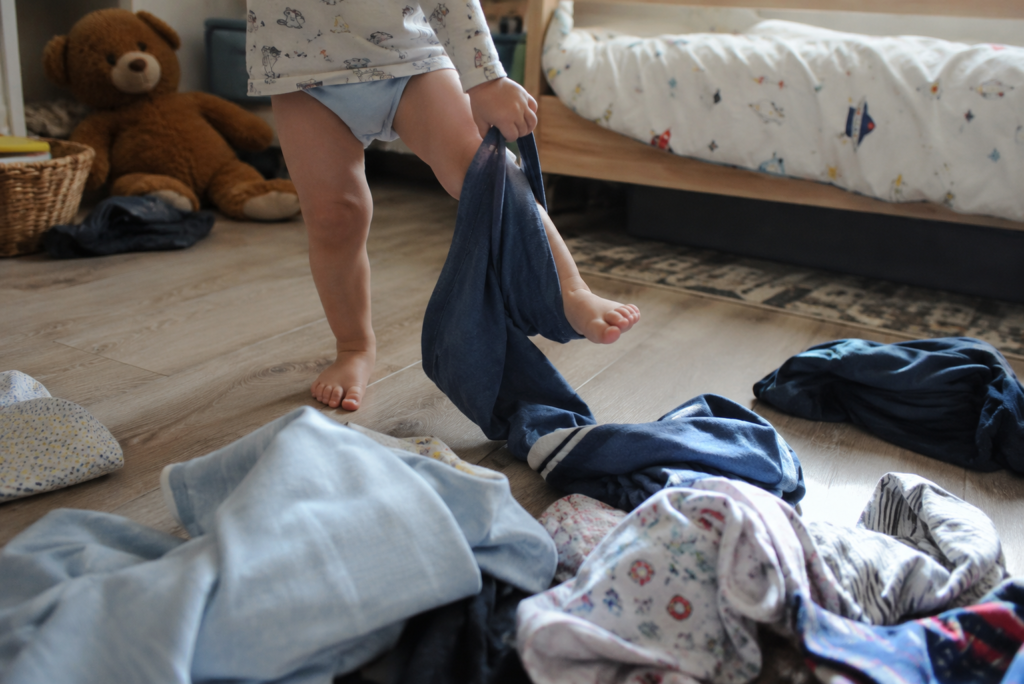
It’s 7:40. You need to leave by 7:55. Your toddler is lying face-down on the bedroom floor in nothing but underwear, refusing every single item of clothing you offer, and this isn’t a one-time thing — it’s basically every morning. Here’s why getting dressed specifically turns into the fight, and the setup that ends it without anyone winning or losing.

The whole first year, calmed.
5 calm guides + 20 printables on sleep, feeding, milestones & your recovery.
See The First Year · $27 →A toddler who won’t get dressed is almost never actually fighting about the clothes. Getting dressed happens to be one of the only daily moments where a toddler can say no and make it stick, which makes it a magnet for the control-and-independence struggle that defines this whole age. The fastest fix isn’t more patience in the moment — it’s a night-before setup and a simple choice structure that prevent most of the standoff before it ever starts.
✓ Key Takeaways
- ✓Getting-dressed battles are almost always about control, not the actual clothes.
- ✓A night-before setup prevents most fights before the morning even starts.
- ✓A simple 2-choice structure ends the negotiation without you losing control of the outcome.
- ✓Ongoing refusal tied to specific fabrics or tags is often sensory, not defiance, and needs a different response.
- ✓Fighting back harder in the moment almost always extends the standoff rather than ending it.
Why Getting Dressed Becomes a Battlefield (It’s Rarely About the Clothes)
Somewhere between the ages of two and four, most toddlers hit a stretch of development that the psychologist Erik Erikson described as “autonomy versus shame and doubt” — a stage where a child’s whole job is figuring out what they can control in a world mostly run by someone else. Bedtime is negotiable in their mind. What’s for dinner is negotiable. Whether they wear pants is, unfortunately for your morning schedule, also negotiable, and it’s one of the very few negotiations they can actually win, because you genuinely can’t force a limb into a sleeve against real resistance without it becoming a much bigger scene than either of you wants.
That’s the part that makes dressing different from, say, brushing teeth or getting in the car seat. Those moments usually resolve because a parent can physically manage them even through protest. Getting dressed can’t, not really — not without a fight nobody enjoys — which means it becomes the arena where a toddler’s need for control finds the least resistance. The clothes themselves are almost never the actual issue. The issue is “who decides,” and dressing is one of the only rooms in the house where that question is genuinely up for grabs.
Knowing this doesn’t make the floor tantrum less exhausting at 7:40 on a Tuesday. But it does change what you’re solving for. You’re not trying to win a fight about a shirt. You’re trying to give your toddler a real, contained way to exercise control, so the fight never has to happen in the first place.

The No-Fight Bedtime
The five-step routine, the exact words for the eight stalls every parent hears, and a fourteen-night plan that takes you from tonight to a bedtime that runs itself.
Get the guide — $1770 pages · instant PDF · yours forever
You can usually see this same pattern show up in other corners of the day too — which shoe goes on first, which cup they drink from, who closes the car door. Dressing just tends to be the loudest version because it happens under real time pressure, twice a day, with an audience of exactly one very tired parent. A toddler who negotiates hard over a shirt at 7:40 AM but happily lets you pick their lunch at noon isn’t being inconsistent. They’re responding to how much pressure is in the room, and mornings are where the pressure lives.
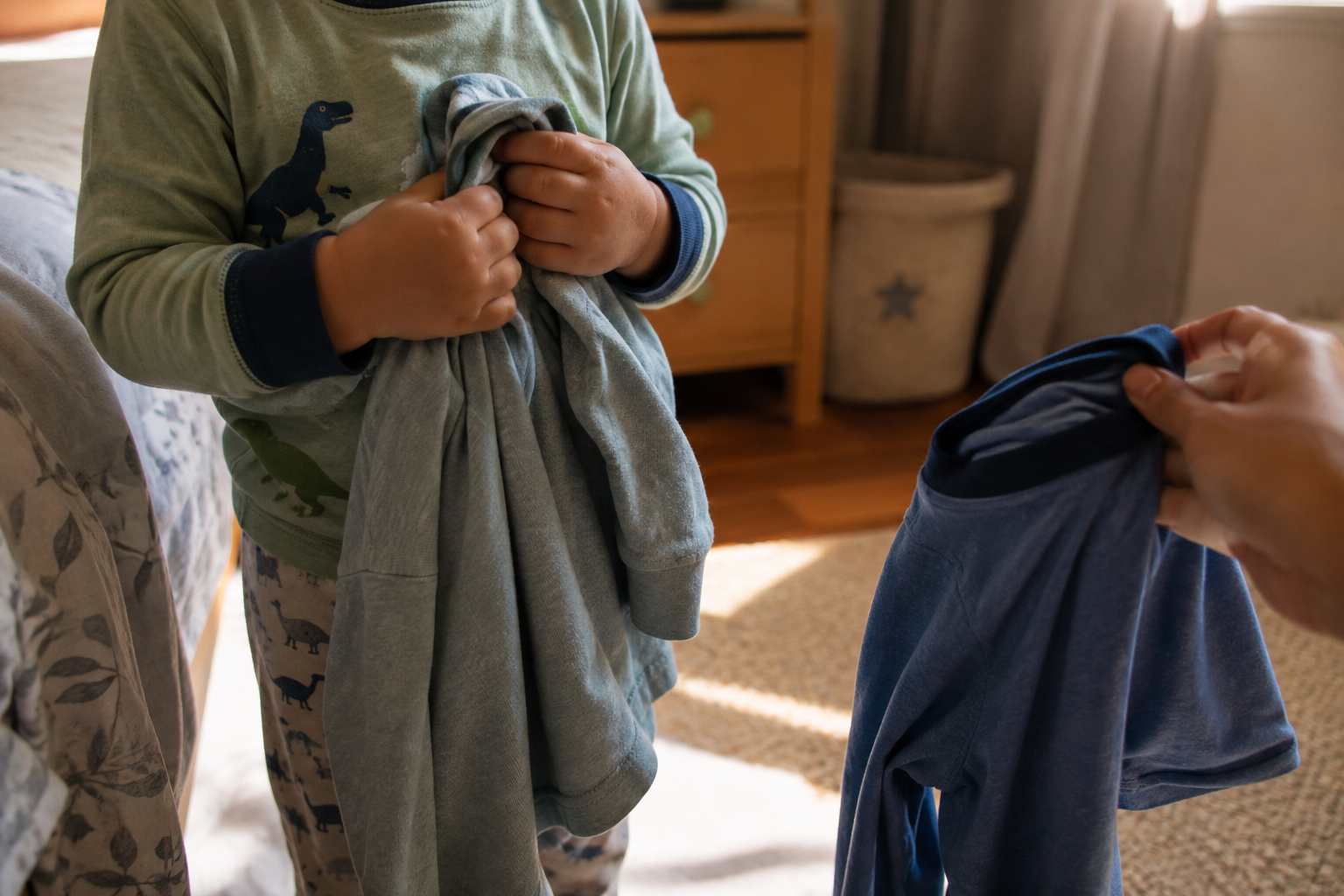
Tip: If dressing has suddenly become a fight after months of being fine, check the calendar before you check your parenting. New sibling, recent move, a parent traveling, starting daycare — any of these can turn a previously easy routine into a new battleground, and it’s rarely permanent.
The Independence Trap: Why Fighting Back Makes It Worse
The instinct, understandably, is to meet resistance with more authority. “We do not have time for this. Put your arm in the sleeve. Right now.” Sometimes that works, in the narrow sense that the shirt eventually goes on. What it also does, reliably, is teach your toddler that dressing is a fight worth having — because fights, even losing ones, are still a form of the control they’re chasing. A toddler who gets a big, dramatic reaction out of you over a shirt has just learned that shirts are a reliable lever. Tomorrow, they’ll pull it again.
Fewer battles. More calm.
Five calm guides + 20 printables — for tantrums, sleep, food, potty & talking.
Get The Toddler Years · $27 →The way out isn’t giving up all authority over the outcome — you still decide that clothes are happening today, weather-appropriate ones, before you leave the house. What changes is where you spend your authority. Instead of controlling every micro-decision (this shirt, right now, put your arm here), you control the boundaries (clothes are happening, here are your options) and hand your toddler the actual choices inside those boundaries. That’s not permissiveness. It’s picking the fight you can actually win — getting dressed happens — and giving up the fight you can’t — controlling exactly how it looks in the moment.

The No-Fight Table
Every meal, without the battle. The setup that works without you saying anything, word-for-word scripts for the eight refusals, and a fourteen-day plan.
Get the guide — $1770 pages · instant PDF · yours forever
In practice, that sounds less like “put your arm in the sleeve right now” and more like “clothes are happening — blue shirt or red shirt?” The first version is a command about a specific action, which invites a specific refusal. The second is a boundary with a choice folded inside it, and there’s genuinely nothing left to refuse except the boundary itself, which most toddlers, most of the time, won’t bother contesting once they’ve gotten to pick something.

The Public Meltdown Field Guide
One four-step response that works anywhere, six script tables you can scan in seconds, and full sections on the supermarket, the restaurant, the car seat and the plane.
Get the guide — $1770 pages · instant PDF · yours forever

This is also where letting the outcome be a little imperfect earns its keep. A toddler who pulls their own sock on crooked, or picks stripes with plaid, is practicing exactly the skill you want them to have by kindergarten — the ability to manage their own body and make their own small decisions. Let the mismatched socks happen. Nobody at daycare is grading the outfit.
The Night-Before Setup That Gets Your Toddler Dressed Without a Fight
Pediatric guidance on building independence in young kids makes a simple, practical point: if the clothes are already chosen and laid out, the morning routine involves only the act of getting dressed, instead of getting dressed and making a decision under time pressure at the same time.1 Two separate tasks, done separately, are almost always easier than the same two tasks collapsed into one rushed moment.
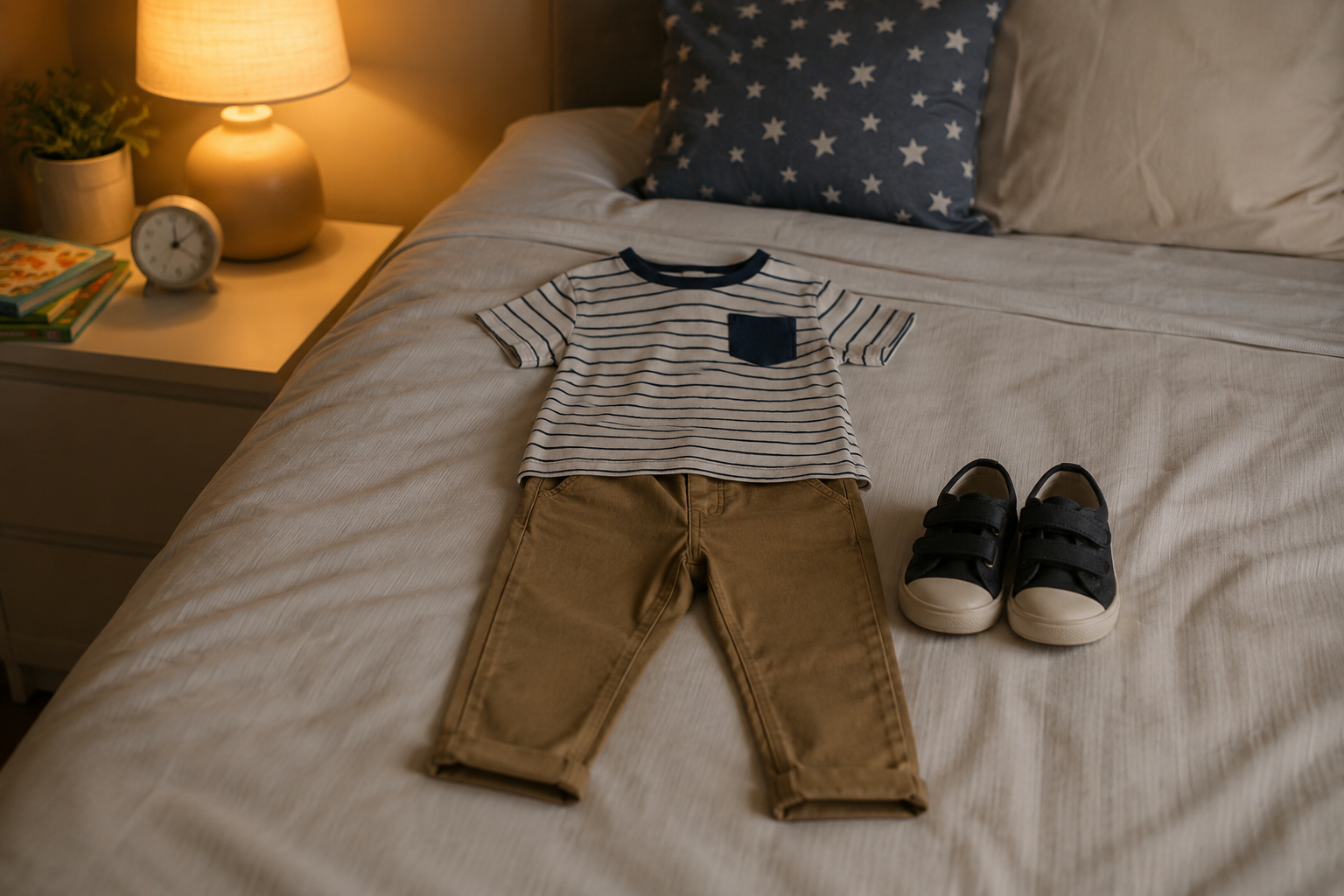
The setup itself takes about three minutes the night before, ideally right after bath or during the wind-down part of the bedtime routine, when your toddler is calmer and more cooperative than they’ll be at 7 AM tomorrow.
All feelings are allowed. Some behaviors aren't. That line is the whole method.
Explore The Preschool Years bundle →5 calm ebooks + 20 printables · $27
- Lay the outfit out in order. Underwear, then top, then bottom, left to right or top to bottom on the bed — the sequence itself becomes part of the visual cue, so there’s no decision left to make in the morning.
- Let your toddler help pick it the night before, not the morning of. Same choice, completely different stakes — a decision made calmly at 6:30 PM rarely gets re-litigated at 7:30 AM.
- Keep a rotating “easy” pile for hard mornings. A few outfits with no buttons, no tight waistbands, no scratchy tags — pulled out on days when you can already tell it’s going to be a fight regardless.
None of this guarantees a fight-free morning every single day. What it does is remove one entire layer of friction — the decision-making — from a moment that’s already working against the clock.
Weekends are worth handling a little differently. Without the clock pressure of daycare drop-off, there’s more room to let the choosing happen in the morning instead of the night before, or to hand over a slightly wider set of options since a wrong guess doesn’t cost you a late arrival anywhere. Some families keep the structured, night-before version strictly for weekday mornings and let Saturday be genuinely looser — which, notably, also gives your toddler a clear signal that today is different, calmer, less scheduled, without you having to say a word about it.
From the parentif library
Mornings get easier with a system, not more willpower
The Toddler Years bundle covers tantrums, independence, and the daily power struggles that eat up your patience — five calm, practical guides for exactly this stage.
See The Toddler Years →The 2-Choice Trick That Ends the Negotiation
“What do you want to wear today?” is a trap, even though it sounds respectful. It hands a toddler an open-ended decision they don’t actually have the judgment to make well — every option in the entire closet, no constraints — and open-ended power at this age tends to produce more conflict, not less, because there’s no natural stopping point to the negotiation.
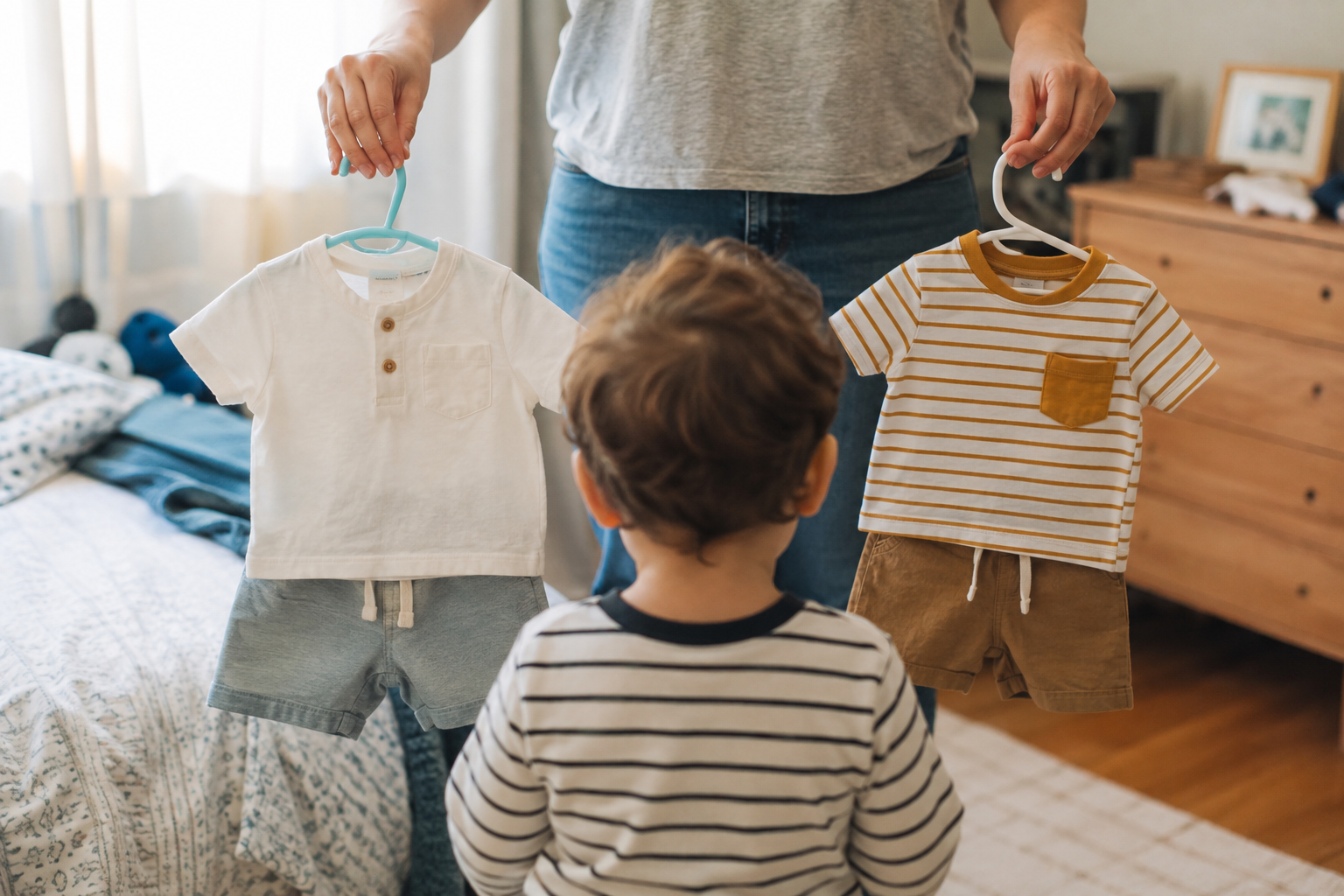
“Do you want the blue shirt or the red one?” is a completely different offer. It’s still a real choice — your toddler gets genuine control over the outcome — but it’s bounded, both options are ones you’ve already approved, and there’s nowhere for the negotiation to expand into. Hold up two items, ask the question once, and count silently to five. If there’s no answer by five, pick one yourself, say it out loud (“okay, blue it is today”), and move forward without re-opening the question. The count isn’t a threat. It’s just a clear, predictable end point that keeps the decision from stretching into a ten-minute standoff.
The trick scales with age. For a younger two-year-old, physically holding up the two items usually works better than describing them, since the visual is easier to process than the words under pressure. For a four or five-year-old, you can widen it slightly — “pick any two things from your top drawer” still bounds the decision while handing over more real choice, which matters more as your child gets closer to genuinely dressing themselves without any input from you at all.
"Most days don't matter. The hard ones do — and you don't have to wing them."
The School-Age Years is five calm, practical guides for the 6–12 stage — big feelings, homework, friendships, screens, and raising a capable kid.
Read more about The School-Age Years →Warning: If your toddler rejects both options, resist the urge to add a third on the spot. Expanding the choice mid-negotiation teaches that refusing works. Hold the original two, or move to the “I’ll choose” step — consistently, even on the hard mornings.
When It’s Actually About the Fabric, Not the Fight
Every so often, the resistance isn’t about control at all. Some toddlers are genuinely, physically bothered by certain fabrics, seams, or tags in a way that has nothing to do with testing limits — their nervous systems process touch differently, and a scratchy label or a tight waistband can feel like a real, ongoing irritation rather than a minor annoyance they should just push through. Sensory-related dressing resistance tends to show a different pattern than a control-based one: it’s usually specific to particular items rather than dressing in general, it doesn’t respond to the 2-choice trick the way a power-struggle refusal does, and it often comes with other clues — pulling at collars all day, avoiding certain textures at the table too, discomfort with tags on other items like towels.
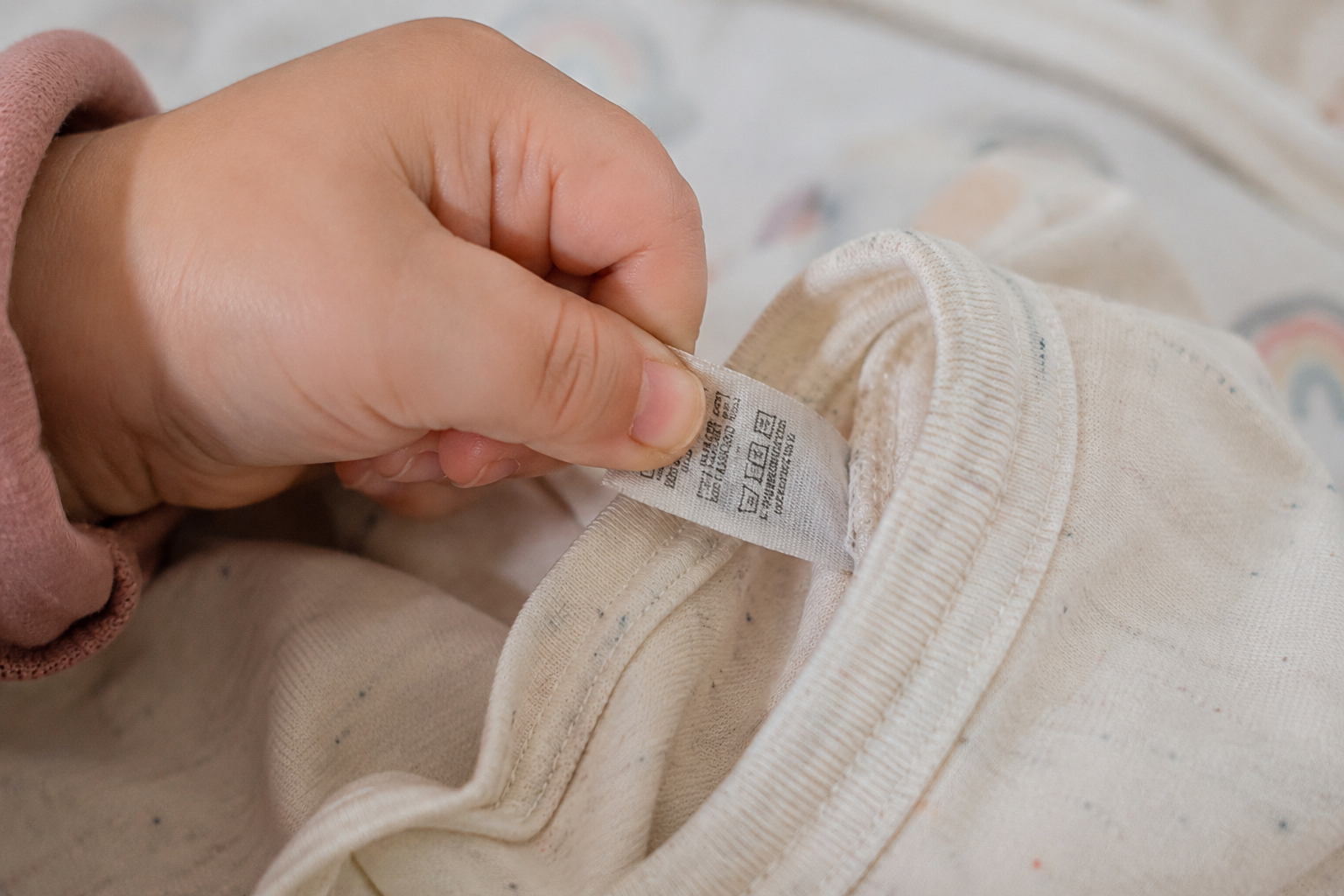
If that pattern sounds familiar, the fix isn’t more patience or a firmer boundary — it’s different clothes. Tagless shirts, socks turned inside-out to hide the seam, soft knit waistbands instead of anything stiff, and washing new clothes before the first wear to soften them all remove the actual trigger instead of asking a toddler to tolerate something genuinely uncomfortable. If this pattern is intense, frequent, and affects more than just clothing, it’s worth mentioning to your pediatrician — they can help you figure out whether it’s a passing sensitivity or something that would benefit from more targeted support.
Seasonal clothes are a common trigger point worth watching for specifically. Wool sweaters, stiff new jeans, and turtlenecks all introduce sensations a toddler hasn’t dealt with for months, right as the weather turns — which is exactly why “but you wore this fine last winter” doesn’t land the way it seems like it should. Washing new seasonal items a couple of times before the first wear, and reaching for softer alternatives (a fleece instead of wool, a zip-up instead of a pull-over turtleneck) during the transition weeks, often quietly resolves what looks like a sudden new battle.
What to Do When You’re Already Running Late and They Won’t Budge
All of the above works best as prevention. Some mornings, prevention has already failed and you’re standing over a half-dressed toddler with six minutes until you needed to be in the car. A few things that help in that exact moment, without turning it into a bigger fight.

My Day, My Way — The Complete Toddler Routine System
6 ready-made picture charts, 36 cut-out cards, a First–Then board, trackers & a parent guide — everything to help your toddler run their own day. 24 pages, instant download.
Lower the bar to “safe and weather-appropriate,” not “fully matching.” A coat over pajama bottoms gets you out the door. You can finish dressing in the car or once you arrive. This isn’t losing — it’s triage, and it’s available to you exactly because you’re the parent and the rules are yours to bend when it counts.
Narrate the real stakes plainly, once. “We need shoes on in one minute or we’ll be late and I’ll carry you to the car in your socks.” Then follow through, calmly, without repeating the warning five more times. Toddlers learn from what actually happens, not from how many times a consequence gets threatened. Say it once, mean it, and follow through calmly — the follow-through is what teaches the lesson, not the warning itself.
"You can't control the teen years. You can stay close through them."
The Teen Years is five calm, practical guides for ages 13–18 — pulling away, the hard talks, independence, moods, and letting go.
Read more about The Teen Years →Physically carry the situation forward if you truly have to. Scooping up a half-dressed toddler and finishing the shirt in the car isn’t a parenting failure — it’s a Tuesday. Save the full routine and the patience for tomorrow, when you’re not also nine minutes late.
And afterward, resist replaying the morning in your head as evidence of anything. A single chaotic dressing battle doesn’t undo the night-before setup, doesn’t mean the 2-choice trick has “stopped working,” and doesn’t say anything about your patience as a parent. It means today had less margin than usual. Reset the outfit on the bed tonight, run the same routine tomorrow, and let one hard morning stay exactly that — one morning, not a trend.

Common Mistakes Parents Make With Dressing Battles
Offering the open-ended choice. “What do you want to wear?” invites a negotiation with no natural edges. Two pre-approved options end the decision before it can expand.
Re-litigating the same battle every morning from scratch. If yesterday’s fight ended with you giving in on a third option, expect today’s toddler to start there instead of at option one. Consistency compounds — inconsistency does too, just in the wrong direction.
Assuming it’s always defiance. A toddler who fights the same specific shirt every time, but not clothes in general, is telling you something concrete. Check the tag and the seams before you assume it’s a willpower issue.
Turning it into a bigger conversation than it needs to be. Long explanations about why we wear clothes, or why we need to hurry, mostly add words for a toddler to push back against. Short and matter-of-fact beats thorough and reasoned at this age.
Forgetting to praise the mornings that go fine. It’s easy to only engage with dressing when it’s a fight. A quick, genuine “you got dressed all by yourself, nice job” on the easy mornings reinforces the behavior you actually want more of.
Doing the dressing for them out of pure time pressure, every single day. On a genuinely late morning, stepping in and finishing the job is fine. Done as the default instead of the exception, it quietly removes the practice a toddler needs to actually get faster and more independent at dressing over time — which means tomorrow’s rushed morning starts from the same place today’s did.
FAQ
Note: This article covers general, typical toddler development. It isn’t a substitute for advice from your pediatrician, particularly if dressing resistance is intense, affects many areas of daily life beyond clothing, or doesn’t ease with a consistent routine over time.
Before you go
Fewer battles, same amount of love
The Toddler Years bundle includes calm, practical guides for the daily power struggles that make up this stage — dressing, tantrums, and everything in between.
Explore The Toddler Years →Your toddler won’t get dressed without a fight forever — this is a phase built around a specific developmental need for control, and it fades as they find other, bigger ways to be independent. Until then, the night-before setup and the 2-choice trick won’t make every morning perfect, but they’ll make most of them boring in the best possible way. Boring mornings are the goal. Not because the fight doesn’t matter, but because a morning with nothing memorable in it means the system is doing its job quietly, exactly the way it’s supposed to.
Related reading: Toddler Routine Chart: How to Build One That Sticks · Child Psychology-Backed Tips for Teaching Toddlers to Share · More Toddler Guides
Sources: 1 American Academy of Pediatrics, “Growing Independence: Tips for Parents of Young Children,” HealthyChildren.org. This article offers general, practical guidance and isn’t a substitute for advice from your child’s pediatrician, especially if dressing resistance is severe, persistent, or tied to broader sensory sensitivities.

Get The Calm Parent Roadmap — free.
The whole journey, from "I do" to "they're grown." 8 stages, one calm method, 13 beautiful pages. Drop your email and it's yours.
Instant PDF download · no spam · unsubscribe anytime.