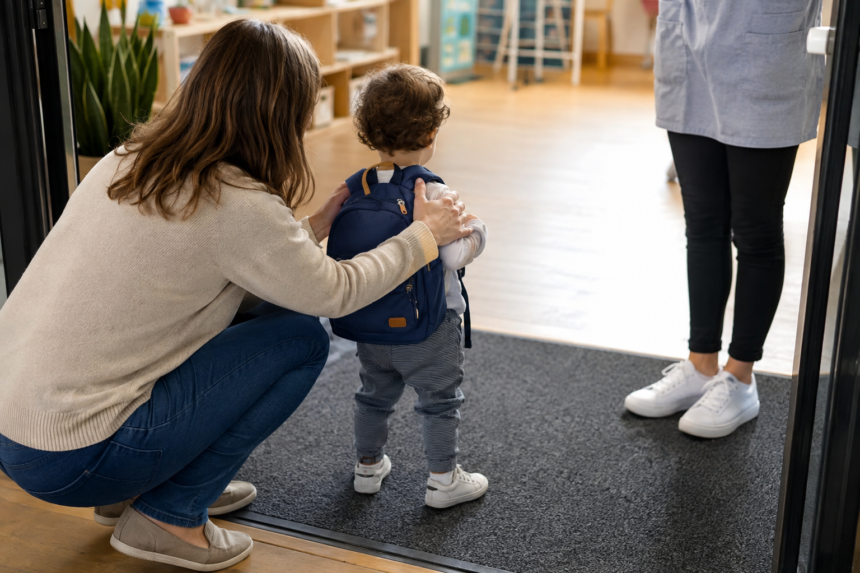
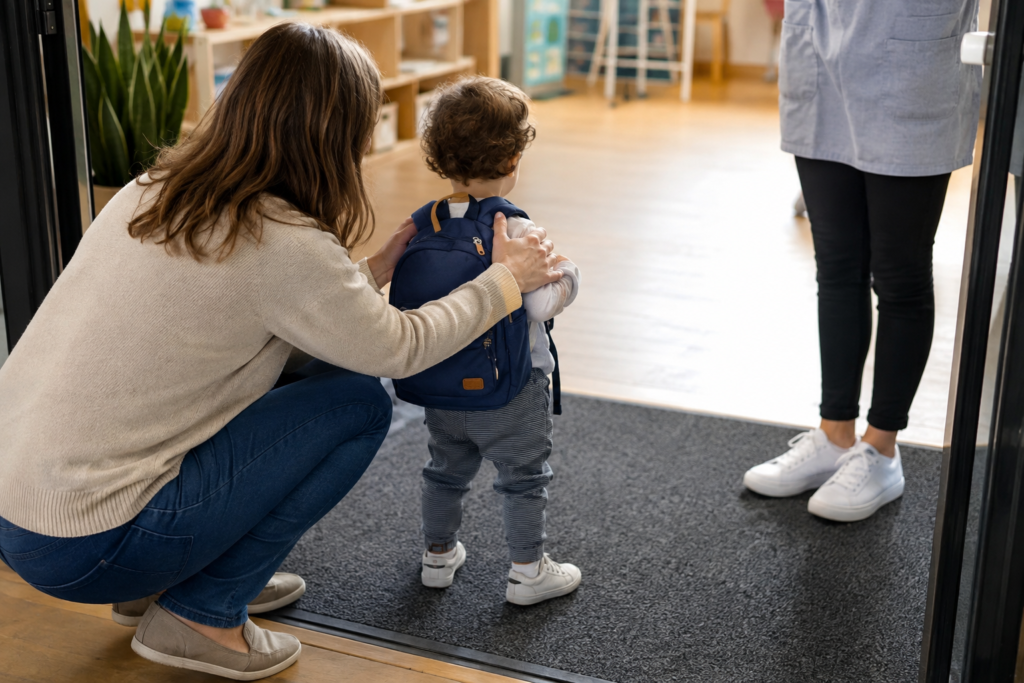
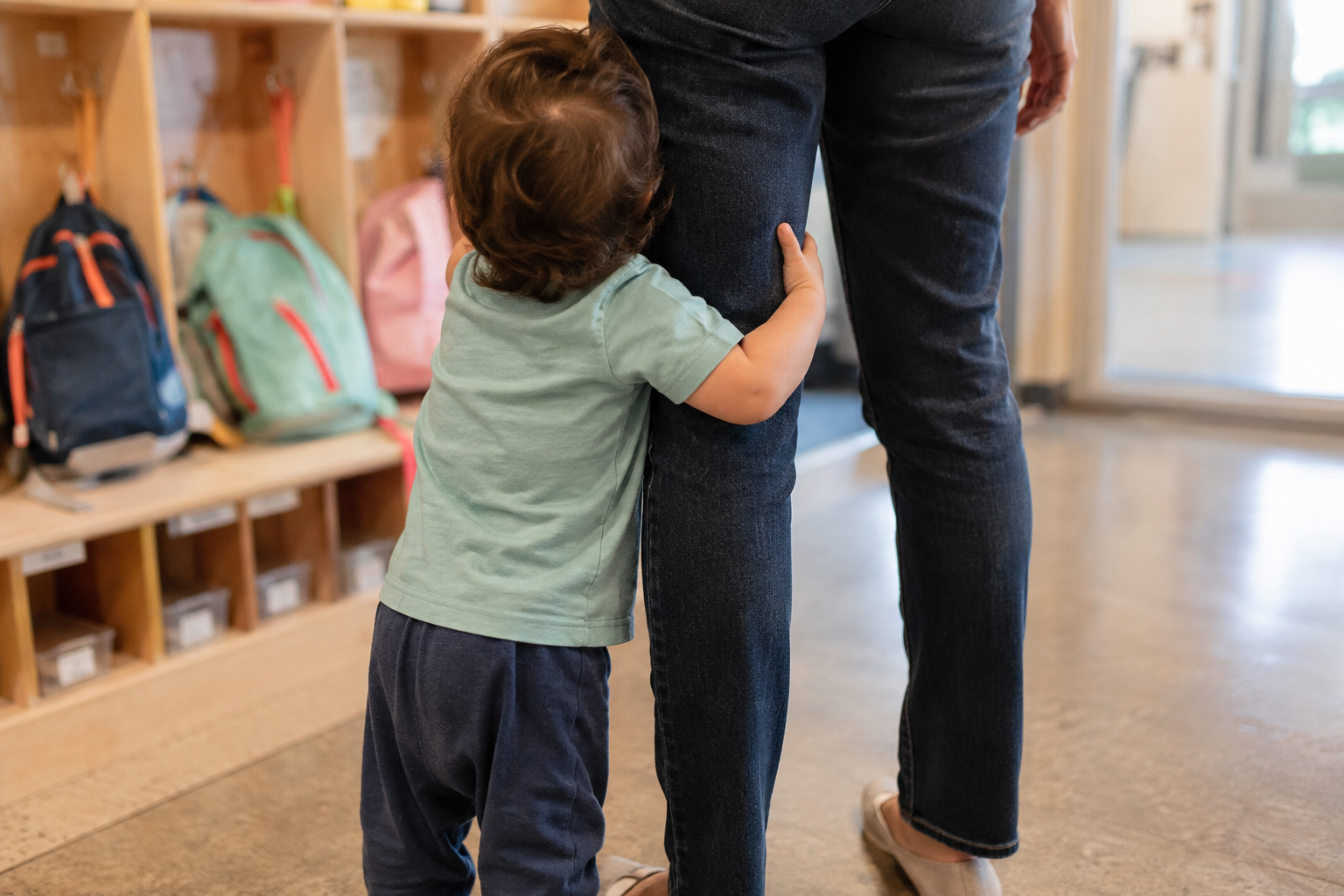
Every morning goes the same way. The drive over is fine. The walk to the door is fine. Then you try to hand your toddler to their teacher, and the crying starts — the kind that makes you feel like the worst parent in the parking lot. You’re not. Here’s what’s actually going on, and the routine that makes it shorter.
Every safe, sufficient feeding method is a full success. The whole first year, without the guilt.
Explore The First Year bundle →5 calm ebooks + 20 printables · $27
A toddler crying at daycare drop-off is one of the most common, and most misread, parts of early childhood. It’s rarely about the daycare itself — it’s a normal reaction to a hard transition that typically peaks between 12 and 24 months and eases with time and consistency. A short, predictable goodbye routine is the biggest lever you have. Most toddlers stop crying within minutes of you leaving, even when it doesn’t feel that way in the moment.
✓ Key Takeaways
- ✓Drop-off crying usually peaks between 12 and 24 months and eases with consistency, not with avoidance.
- ✓A short, predictable goodbye routine works better than a longer or more drawn-out one.
- ✓Sneaking out without saying goodbye tends to make the next drop-off harder, not easier.
- ✓Most toddlers settle within 5 to 10 minutes of you leaving — the crying rarely lasts as long as it feels like it does.
- ✓If intense daily crying hasn’t eased after about a month, it’s worth a specific conversation with the teacher, not just more patience.
Why Your Toddler Cries at Daycare Drop-Off (It’s Not About the Daycare)
Here’s the thing nobody tells you before the first day: the crying is a good sign. Not a fun one, but a good one. Your toddler cries at drop-off because they’ve built a real attachment to you, and their brain has just recently developed enough to understand something unsettling — that when you walk out that door, you actually leave. Before about 8 months old, out of sight genuinely meant out of mind. Somewhere in the second half of the first year, kids develop what psychologists call object permanence, the understanding that people and things keep existing even when they can’t be seen. That’s a milestone worth celebrating most of the time. At 8:15 on a Tuesday, it feels like the opposite of a gift.
According to the American Academy of Pediatrics, this kind of separation anxiety is a completely normal stage of development, and it tends to hit hardest between 12 and 24 months old, when a child understands you’re leaving but doesn’t yet have the reasoning skills to trust that you’re definitely coming back.1 Some toddlers barely blink at drop-off. Others fall apart every single day for months. Both are within the range of normal, and neither one is a review of your parenting or your daycare’s quality.
What it usually isn’t about: the teachers, the room, the other kids, or whether you made the right choice sending them there at all. What it usually is about: this exact moment, this exact transition, happening at an age where your child’s whole job is figuring out that goodbyes aren’t the same as gone-forever. That distinction takes practice. Lots of it. You’re not failing to teach it fast enough — there’s no fast version.

A bedtime that's finally
boring.
Fix the room, build the routine, learn the eight scripts. No sleep training, no crying it out — just a sequence that stops needing your patience.
Get The No-Fight Bedtime$17 · 70 pages · instant PDF · yours forever
There’s also a reframe worth sitting with here, even if it doesn’t make the mornings feel any shorter: a toddler who protests loudly at goodbye is often showing you a secure attachment working exactly as it should, not a fragile one. Kids who’ve learned that a parent is reliable and worth missing are, somewhat counterintuitively, often the ones who cry the hardest when that parent walks away — because the relationship matters enough to fight for. The toddlers who separate instantly and never look back aren’t necessarily more “resilient.” Some genuinely have an easygoing temperament, but for others it can simply mean they haven’t yet made the connection between this new place and the parent who’s about to leave it. Neither pattern is a verdict on your bond with your kid.
Tip: If your toddler seems totally fine at drop-off some days and inconsolable on others, look at what happened the night before. Short sleep, a skipped nap, or a new food at breakfast can all lower the threshold for a hard goodbye — it’s rarely random.
The Timeline: What’s Normal and What’s Worth a Second Look
There’s no single “adjustment day” where a switch flips. But there is a general shape to how this tends to go, and knowing it helps you tell the difference between “this is week one, of course it’s rough” and “this has gone on long enough that it’s worth a conversation.” Treat the ranges below as a compass, not a countdown — some toddlers move through this in ten days, others take two months, and both are fine.
Warm on the feeling. Firm on the limit. Boring on the drama.
Explore The Toddler Years bundle →5 calm ebooks + 20 printables · $27
A few things tend to move a toddler toward the faster or slower end of that range. Kids who’ve already spent regular time away from a parent — with a grandparent, a babysitter, a partner on solo bedtime duty — often adjust faster, simply because “you’ll come back” is already a proven pattern rather than a new claim. A recent change at home (a new sibling, a move, a parent’s schedule shifting) can slow things down, even if that change seems unrelated to daycare on the surface; toddlers don’t compartmentalize stress the way adults try to. And plain temperament matters as much as either of those. A toddler who takes a while to warm up to new foods, new relatives, or new toys will likely take a while to warm up to a new room full of unfamiliar routines too — that’s not a daycare problem, it’s just how that particular kid is wired.
You decide what and when.
They decide whether and how much.
Almost every mealtime fight is one person doing the other's job. The No-Fight Table turns that one idea into the exact words for every refusal you'll hear.
Read what's inside$17 · 70 pages · instant download


| Timeframe | What’s typical | What to do |
|---|---|---|
| Week 1 | Crying is common and can be intense — this is genuinely the hardest week for most families. | Keep the goodbye routine identical every single day. Don’t linger, don’t skip it. |
| Weeks 2–3 | Tears may still show up but tend to be shorter and less intense than week one. | Notice the trend, not the daily result. A bad Tuesday after five good days isn’t a setback. |
| Weeks 3–4 | Most toddlers begin separating with minimal or no tears most mornings. | Start easing the routine back to a slightly quicker version if it’s gone smoothly for several days straight. |
| After ~1 month | The majority of toddlers have adjusted, though some need longer — temperament matters here. | If daily crying is still intense and hasn’t budged at all, it’s worth a direct conversation with the teacher. |
12–24mo
typical peak age for separation anxiety
5–10 min
typical time to settle after you leave
~4 wks
rough average for a full adjustment
The 90-Second Goodbye Routine That Stops the Daycare Drop-Off Crying
This is the part that actually moves the needle. Not a longer goodbye. Not a more emotional one. A shorter, more predictable one, done the same way every single day until it stops needing to be thought about at all. Here’s the sequence.

The Public Meltdown Field Guide
One four-step response that works anywhere, six script tables you can scan in seconds, and full sections on the supermarket, the restaurant, the car seat and the plane.
Get the guide — $1770 pages · instant PDF · yours forever
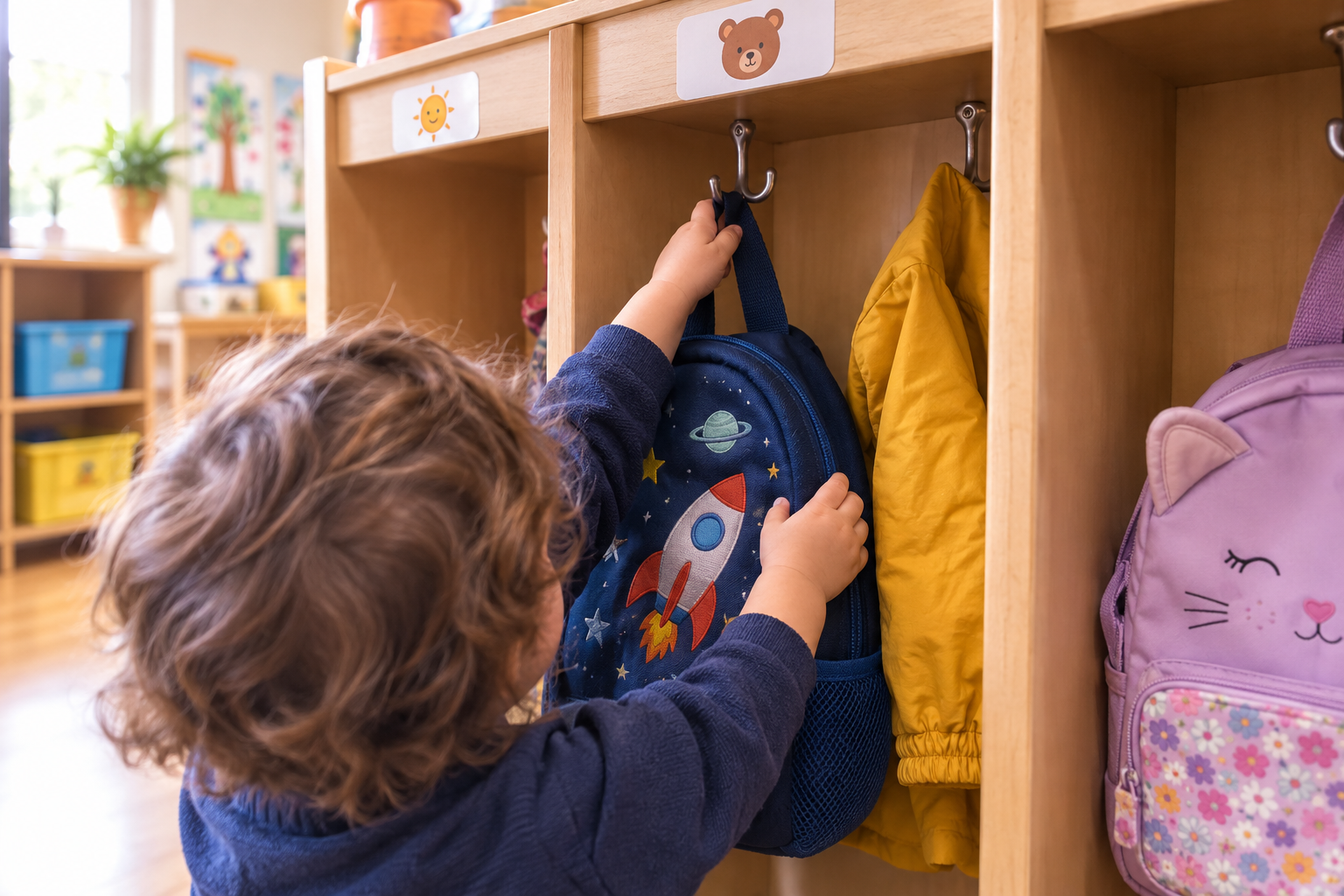
Narrate the plan on the way in. “We’re going to walk in, hang up your backpack, give one big hug, and then I’m going to work.” Same script every day. It’s boring on purpose — predictability is the entire point.
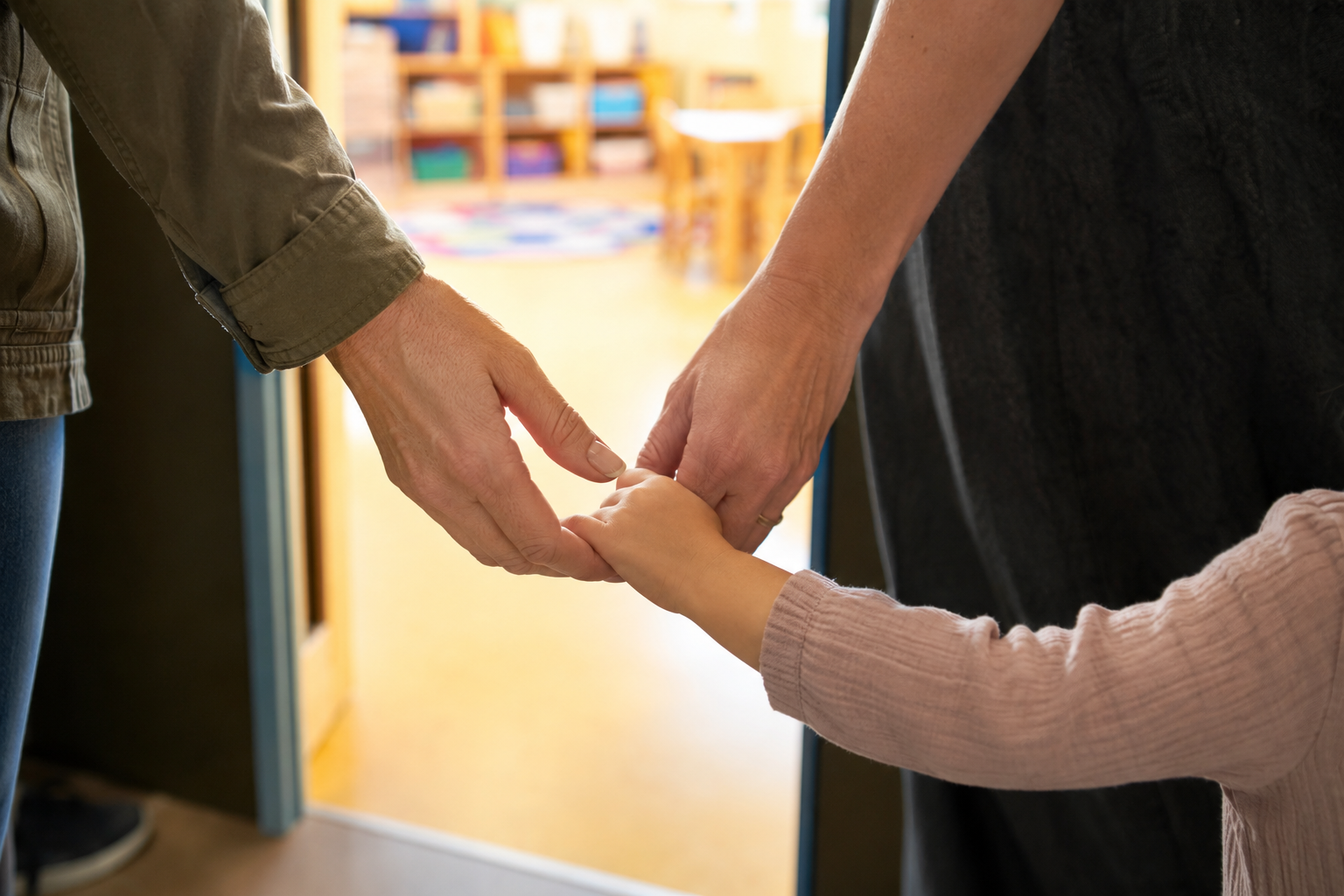
Hand off to a person, not a void. Wait until a teacher is ready to receive your toddler — physically, not just verbally. A hand-to-hand transfer works better than “okay, go find your friends” from across the room.
One hug, one phrase, every time. “I love you, I’ll be back after nap time, have a great day.” The exact wording matters less than the fact that it never changes.
Leave. Actually leave. Not a slow backing-away. Not “one more hug.” A confident, unhurried exit. You can absolutely cry in the car. Just not in front of the door.
Ninety seconds, start to finish, is the rough target. It feels short. It’s supposed to. A goodbye that drags on gives your toddler more time to sense your own hesitation, and toddlers are remarkably good at reading that — better than they are at reading almost anything else at this age.
You don’t have to save this routine for daycare mornings only. Run a “dry version” of it a few times a week when you’re just stepping out for groceries or a quick errand — same phrase, same hug, same confident exit. By the time it matters most, it’s already familiar instead of brand new, which takes one more variable off the table on an already hard morning. For toddlers who aren’t talking much yet, the exact words matter far less than the consistency of the physical sequence: the same hug, in the same spot, followed by the same short wave, works as its own kind of language. Some families add a single hand sign — a squeeze of the hand, a specific wave — that means “goodbye, I’ll be back” even before their toddler has the words to say it back.

Why “Sneaking Out” Backfires Every Time
It’s tempting. Your toddler gets absorbed in a puzzle for four seconds, and you think: this is my window. You slip out without a goodbye, relieved, and for one morning it actually works. Here’s the problem — it only works once. Once your toddler realizes you can disappear without warning, every single future goodbye now carries the possibility that this is another disappearing act, and they respond by clinging harder, watching you more closely, and trusting the process less.
Name the feeling. Hold the limit.
Five calm guides + 20 printables — for emotions, discipline, bedtime, screens & school.
Get The Preschool Years · $27 →Pediatric guidance is consistent on this point: say goodbye, then leave, and once you’ve left, don’t reappear unless you’re prepared to stay.2 That second part matters as much as the first. A parent who leaves, comes back because the crying got loud, then leaves again has just taught their toddler that crying loudly enough works. Not because the toddler is manipulative — two-year-olds aren’t strategists — but because that’s genuinely how learning works at this age. Consistent input produces consistent behavior.
There’s a simple mechanism underneath this worth understanding, because it explains why the first few mornings of any new routine are often the loudest. Protest that consistently gets the same, unchanging response tends to fade over days, even if it spikes briefly before it does. Protest that occasionally works — even once — tends to get louder and last longer the next time, because it just paid off. That’s not a character flaw in your toddler; it’s how all of us, at any age, learn what actually changes an outcome and what doesn’t. The goal isn’t a goodbye with zero tears. It’s a goodbye where the tears reliably shrink over the following one to two weeks, because nothing about the routine ever gives them a reason to escalate.
Warning: If you do slip out once, don’t panic about undoing months of trust. One inconsistent morning won’t derail things. It’s the pattern that matters, not a single exception on a genuinely chaotic day.

What to Do in the Car Before You Even Walk In
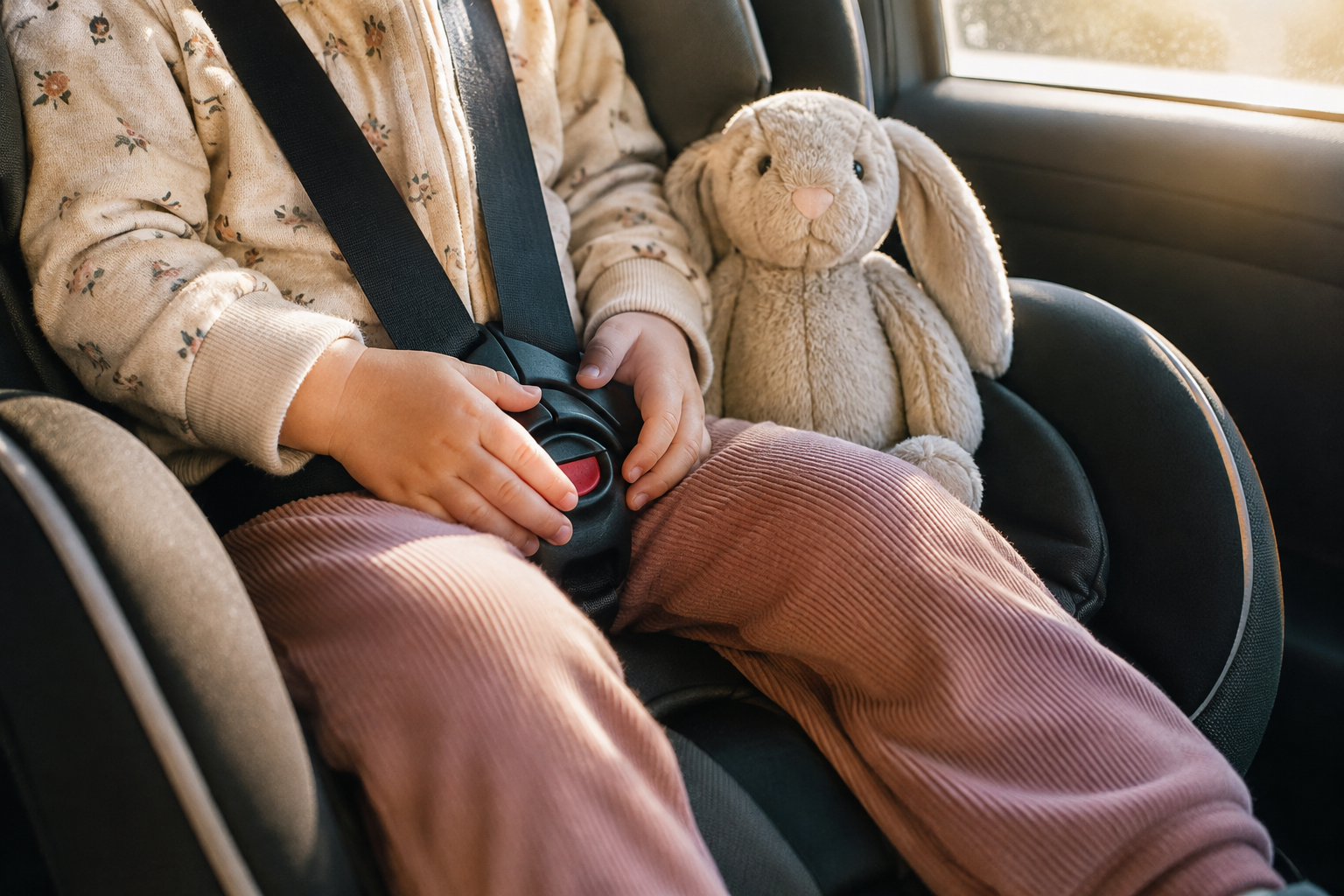
Most of the work happens before you’re anywhere near the door. Three things worth checking before you unbuckle the car seat.
- Are they hungry? A snack in the car, even a small one, takes hunger off the table as a hidden contributor. Hard goodbyes get much harder on an empty stomach.
- Are they overtired? If bedtime slipped the night before, expect drop-off to be harder than usual — and don’t read too much into it as a step backward.
- Do they have their comfort object? A small stuffed animal or blanket that stays in their cubby all day gives them something familiar to hold onto that isn’t you.
Narrate the plan here too, in the parking lot, before you’re in the thick of it: what room they’re going to, roughly when you’ll be back (“after your nap”), and that you’re excited to hear about their day later. It sounds small. It gives your toddler’s brain a few extra minutes to prepare for a transition that’s coming, instead of springboarding straight from car seat to goodbye with zero warning.
If you’re managing a sibling or a baby in the other arm at the same time, the ninety-second routine still works — it just means the toddler’s goodbye happens first and gets your full attention for those ninety seconds, even if that means the baby waits in the carrier for one more minute. Splitting your attention across two kids during the actual goodbye is one of the fastest ways to stretch it out and lose the “quick and confident” part that makes it work. And on the timing side: arriving five or ten minutes earlier than the absolute last possible moment gives you room to run the full routine without rushing it, which matters more than it sounds like it should. A goodbye that’s rushed because you’re already late reads as chaotic no matter how calm your voice is.
From the parentif library
Mornings don’t have to run on hope
The Toddler Years bundle covers tantrums, sleep, and the daily transitions that eat up your patience — five calm, practical guides built for exactly this stage.
See The Toddler Years →Talking to Your Toddler’s Teacher: What to Ask For
You don’t need to become a daily interrogator. But three specific questions to a teacher will tell you more than a week of guessing on your own.
“How long does the crying actually last after I leave?” This is the single most useful question you can ask, because the gap between what you witness (the worst thirty seconds) and what actually happens (usually settled within ten minutes) is enormous. Most parents are shocked by the answer.
“Is there a consistent person who can greet them at the door?” A familiar face doing the handoff every morning, rather than whoever happens to be closest, adds a layer of predictability that compounds with the goodbye routine you’re running at home.
“Can I get a quick photo or text once they’re settled?” Not every daycare offers this, but many will if you ask directly. A single photo of your toddler playing twenty minutes after drop-off does more for your morning than any amount of reassurance from a stranger in a parking lot.

My Day, My Way — The Complete Toddler Routine System
6 ready-made picture charts, 36 cut-out cards, a First–Then board, trackers & a parent guide — everything to help your toddler run their own day. 24 pages, instant download.
Most of the time, the teacher’s answer will match what’s typical: some tears, settled within minutes, back to normal well before snack time. Occasionally it won’t, and that’s useful information too. Crying that continues on and off for most of the morning, a toddler who goes quiet and withdrawn rather than upset, or a sudden change after weeks of things going smoothly are all worth a slightly deeper conversation — not panic, just a closer look together with the teacher at what might be different. Sometimes it’s something simple, like a classroom change or a new staff member. Sometimes it’s worth mentioning to your pediatrician at the next visit. Either way, you’re not overreacting by asking; you’re doing exactly what a good goodbye routine is built on in the first place — paying attention and staying consistent.
Note: This article covers general, typical patterns in toddler separation anxiety. It isn’t a substitute for advice from your pediatrician, and if crying is intense, daily, and shows no improvement after a month or more, that’s a reasonable thing to bring to your child’s doctor rather than something to keep managing alone.
Common Mistakes Parents Make at Drop-Off
Lingering “for just five more minutes.” It feels kind. It usually backfires — every extra minute gives your toddler more time to escalate, not calm down, because your continued presence signals that leaving is still negotiable.
"You can't control the teen years. You can stay close through them."
The Teen Years is five calm, practical guides for ages 13–18 — pulling away, the hard talks, independence, moods, and letting go.
Read more about The Teen Years →Changing the goodbye script depending on the morning. A rushed, different goodbye on a hectic Monday and a long, drawn-out one on a calm Thursday sends mixed signals about what to expect. The routine only works if it’s actually a routine.
Bringing your own anxious energy to the door. Toddlers are remarkably tuned in to a parent’s tension, even when nothing is said out loud. A tight jaw and a rushed hug read as “something is wrong here” far more clearly than any words do.
Comparing your toddler’s timeline to someone else’s. The kid who separated easily on day one isn’t doing daycare “right” and yours isn’t doing it “wrong.” Temperament varies enormously, and a slower adjustment says nothing about your parenting.
Asking too many questions in the moment. “Are you okay? Do you want another hug? Should mommy stay a little longer?” — each question reopens the decision you already made in the car. State the plan, don’t re-litigate it at the door.
Judging the whole week by the worst morning. One rough Wednesday after four smooth days isn’t evidence the routine stopped working — toddlers have off days for reasons that have nothing to do with daycare at all, from a skipped nap to a new tooth coming in. Look at the trend across two or three weeks, not any single morning in isolation.
FAQ
Before you go
Build the routine once, use it every morning
The Toddler Years bundle includes calm, practical guides for the exact daily struggles behind mornings like this one.
Explore The Toddler Years →The crying at drop-off is real, and so is how hard it feels to walk away from it. But it’s rarely a sign that anything is wrong — it’s a sign your toddler loves you enough for goodbyes to matter. Build the same ninety-second routine, run it every morning without exception, and give it a few weeks before you judge whether it’s working. It almost always is, even on the days it doesn’t feel like it.
Related reading: Toddler Routine Chart: How to Build One That Sticks · Child Psychology-Backed Tips for Teaching Toddlers to Share · More Toddler Guides
Sources: 1 American Academy of Pediatrics, “How to Ease Your Child’s Separation Anxiety” and “Making Baby Drop Off at Child Care Easier,” HealthyChildren.org. 2 American Academy of Pediatrics, HealthyChildren.org. This article offers general, practical guidance and isn’t a substitute for advice from your child’s pediatrician, especially if separation distress is severe or ongoing.
Become a calmer parent at every age.
- All 8 stages — newborn to adult children
- One calm method that scales the whole way
- Checklists & "you're now expert" takeaways
- 13 beautiful, print-ready pages — free
Instant PDF · no spam · unsubscribe anytime.