
A toddler waking up at 5am can make a whole family feel jet-lagged. You go to bed tired, you wake up tired, and the day starts with a tiny person bouncing on your chest while it’s still dark. The good news: most 5am starts have a cause you can find and change. This guide gives you a quick way to spot yours, nine calm fixes, the exact words to use at the bedroom door, and a 14-day plan you can print tonight.
The short answer
A toddler waking up at 5am is usually reacting to one of four things: early light or noise, a bedtime that is too early or too late, naps that are off for their age, or a morning that “rewards” waking (screens, milk, play). So start by blacking out the room and checking the bedtime math. Then make 5am dull and add a wake-up clock. Finally, hold the same plan for about two weeks before judging it.
Key takeaways
- ✓Early waking is common in toddlers, and it is usually a timing or environment problem, not a behavior problem.
- ✓Light is the most common hidden cause, so a fully dark room is the first fix to try.
- ✓Both an overtired toddler and an under-tired toddler can wake at 5am, so the bedtime math matters.
- ✓A wake-up clock works best when 5am stays boring: dim light, quiet voice, same words.
- ✓Change one thing at a time and give each change about 14 days before you decide.
Why Your Toddler Wakes Up at 5am (The 4 Usual Causes)
Early waking almost always comes from one of four places. Light, sleep pressure, naps or the morning routine. Once you know which one is yours, the fix gets much easier.
Here’s the thing most advice misses. Toddler sleep gets lighter in the early morning hours. So a small trigger at 5am, like a bird, a car door or a thin line of light, is enough to end the night. At 1am, the same noise would barely register.

The No-Fight Bedtime
A calm, repeatable system for ending the nightly bedtime battle in fourteen nights.
Instant download · Digital download · All sales final| Cause | What it looks like | First thing to try |
|---|---|---|
| Light or noise | Wakes at sunrise, earlier in summer, or when the heating clicks on | Blackout blinds, tape over gaps, white noise |
| Bedtime too late | Overtired, wild at bedtime, still wakes early | Move bedtime 20–30 minutes earlier |
| Bedtime too early | Falls asleep fast, wakes rested and chatty at 5am | Move bedtime 15 minutes later every 3 nights |
| Naps off for age | Long or late nap, or a dropped nap too soon | Adjust the nap window (see below) |
| Morning reward | Gets milk, TV or your bed the moment they wake | Make the early wake-up dull and predictable |
💡 Tip
Write down three things for 5 nights: bedtime, nap times and the exact wake-up time. Patterns show up fast on paper, even when they feel random at 5am.
Fix 1: Make the Room Truly Dark (Darker Than You Think)
Light is the most common reason a toddler wakes early. Even a small glow at the edges of a blind can signal “morning” to a young body clock.
So stand in the room at sunrise with the door closed. If you can read a book, it’s too bright. Then cover every gap: blackout blinds, painter’s tape around the edges, a towel at the bottom of the door. Also switch off bright night lights. If your child needs one, choose a dim, warm one placed low and away from the bed.
✨ Quick win
A cheap fix that works tonight: tape black bin bags or foil to the window glass behind the curtains. It’s not pretty, but it tells you in 3 nights whether light is your cause.
Fix 2: Check the Bedtime Math (Too Early and Too Late Both Cause 5am Starts)
This feels backwards, but it’s true. A toddler who goes to bed too late often wakes early because they are overtired. Meanwhile, a toddler who goes to bed too early simply runs out of sleep by 5am.
Most toddlers need roughly 11 to 14 hours of sleep in 24 hours, naps included, according to the American Academy of Sleep Medicine guidance that the American Academy of Pediatrics endorses. The Raising Children Network toddler sleep guide has a helpful overview of typical patterns too.
How to read your toddler’s signs
- Overtired signs: wild energy at bedtime, crying over small things, falling asleep in the car at 4pm, short naps.
- Under-tired signs: happy and chatty at bedtime, takes ages to fall asleep, wakes at 5am cheerful and ready to party.
If you see overtired signs, move bedtime 20 to 30 minutes earlier for a week. If you see under-tired signs, push bedtime 15 minutes later every three nights. Either way, keep the toddler bedtime routine exactly the same so only the clock changes.
Fix 3: Get the Naps Right for Their Age
Naps and early mornings are linked. A nap that is too long, too late or dropped too early can all lead to a toddler waking up at 5am.
| Age | Typical nap pattern | Watch for |
|---|---|---|
| 12–18 months | Moving from 2 naps to 1 | Dropping the morning nap too soon causes overtired evenings |
| 18 months–3 years | 1 midday nap | A nap starting after 3pm can push bedtime too late |
| 3–4 years | Nap shortening or fading | A long nap can leave too little sleep need for the night |
A simple rule helps here. Try to end the nap at least four hours before bedtime. If your toddler still naps for three hours, try gently capping it at two and see what happens over a week. Our toddler nap time routine chart and these gentle fixes for a toddler who won’t nap can help you find the right window.
The No-Fight Days Bundle
Bedtime battles, public meltdowns and rushed mornings, in one calm bundle.

Fix 4: Make 5am the Most Boring Time of Day
What happens at 5am teaches your toddler whether 5am is worth waking for. So if early waking brings milk, cartoons, your bed or lots of chat, the body clock learns that morning starts now.
Instead, keep it dull. Use a dim light, a quiet voice and the same short sentence every time. Then walk them back to bed and leave the room calmly. You are not punishing them. You are simply showing that night is still night.
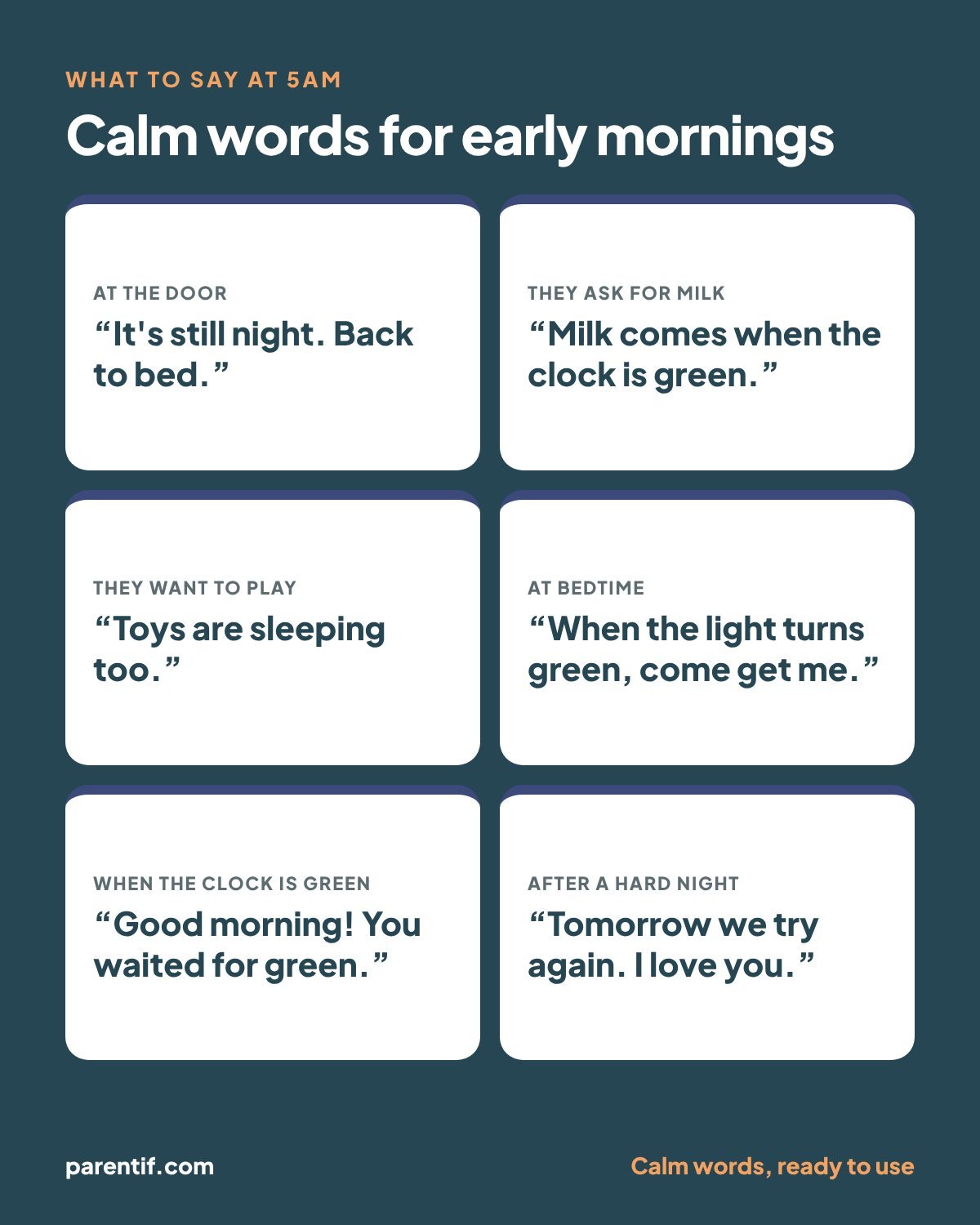
At the door at 5am
Say: “It’s still night. Back to bed.”
Skip: “Why are you up again?! It’s way too early!”
They ask for milk
Say: “Milk comes when the clock is green.”
Skip: “Fine, here’s a bottle, just go back to sleep.”
They want to play
Say: “Toys are sleeping too. I’ll see you at green.”
Skip: “Okay, ten minutes of the tablet.”
⚠️ Watch out
Consistency matters more than any single trick. If 5am sometimes means TV and sometimes means bed, the early wake-ups usually get worse, not better.
Fix 5: Use a Wake-Up Clock the Smart Way
A wake-up clock (sometimes called an “ok to wake” clock) changes color when it’s time to get up. It gives a toddler a clear rule they can see, which works much better than “it’s too early” in the dark.
However, the clock only works if you introduce it well. First, set it to the time your toddler wakes now, for example 5:15. Then, when they wait for green, celebrate loudly. Next, move it 10 minutes later every two or three days until you reach your goal. Starting at 7am on day one usually fails, because the gap is too big to win.
Introduce it at bedtime
Show the clock and say: “When it turns green, it’s morning and you can come get me.”
Start where they are
Set green 5–10 minutes after their current wake-up time so they win on day one.
Celebrate green
Big smile, a high five, and open the curtains together like it’s a little party.
Move it slowly
Push green 10 minutes later every 2–3 good mornings.
Keep 5am dull
Before green, it’s still night: same words, back to bed, no screens.
Fix 6: Move Breakfast, Light and Screens Later
The body clock follows daylight and food. So if breakfast happens at 5:30, the body starts expecting food at 5:30. That keeps the early wake-up in place.
Therefore, pick a “real morning” time, such as 6:30, and hold it. Breakfast, open curtains, bright light and screens all wait for that time. Afterwards, get outside early in the day if you can. Morning daylight helps set a steady rhythm, and a bright evening does the opposite, so dim the house in the last hour before bed.
Night is still night until the clock says morning. Calm, boring and the same every time.
Fix 7: Check Room Temperature and Noise
Many homes get coldest in the early morning hours. A toddler who kicks off their blanket can wake chilly at 5am, especially in winter.
So check the room right before you go to bed and again early in the morning if you are up. A wearable blanket or sleep bag can help, because it can’t be kicked off. Also think about noise. The heating clicking on, a partner leaving for work, or the garbage truck can all cut the night short. A steady white noise machine at a low, safe volume, placed away from the cot or bed, can soften those sounds.
Fix 8: Look at the Whole Day, Not Just the Night
Sometimes the cause of a toddler waking up at 5am is hiding in the daytime. Big changes, such as a new sibling, starting daycare, travel, a move or the clocks changing, often shake up sleep for a while.
Then again, some toddlers wake early because their day is very busy and very stimulating right up to bedtime. A calm hour before bed helps. Think bath, books, songs and low light. Our guide to toddler sleep routines shows how to build that wind-down, and a visual schedule for toddlers makes it easier for them to follow.
💡 Tip
After a big change, expect about two weeks of messy sleep. If your toddler is adjusting to something new, this guide on how long toddlers take to adjust to a new routine explains what is normal.
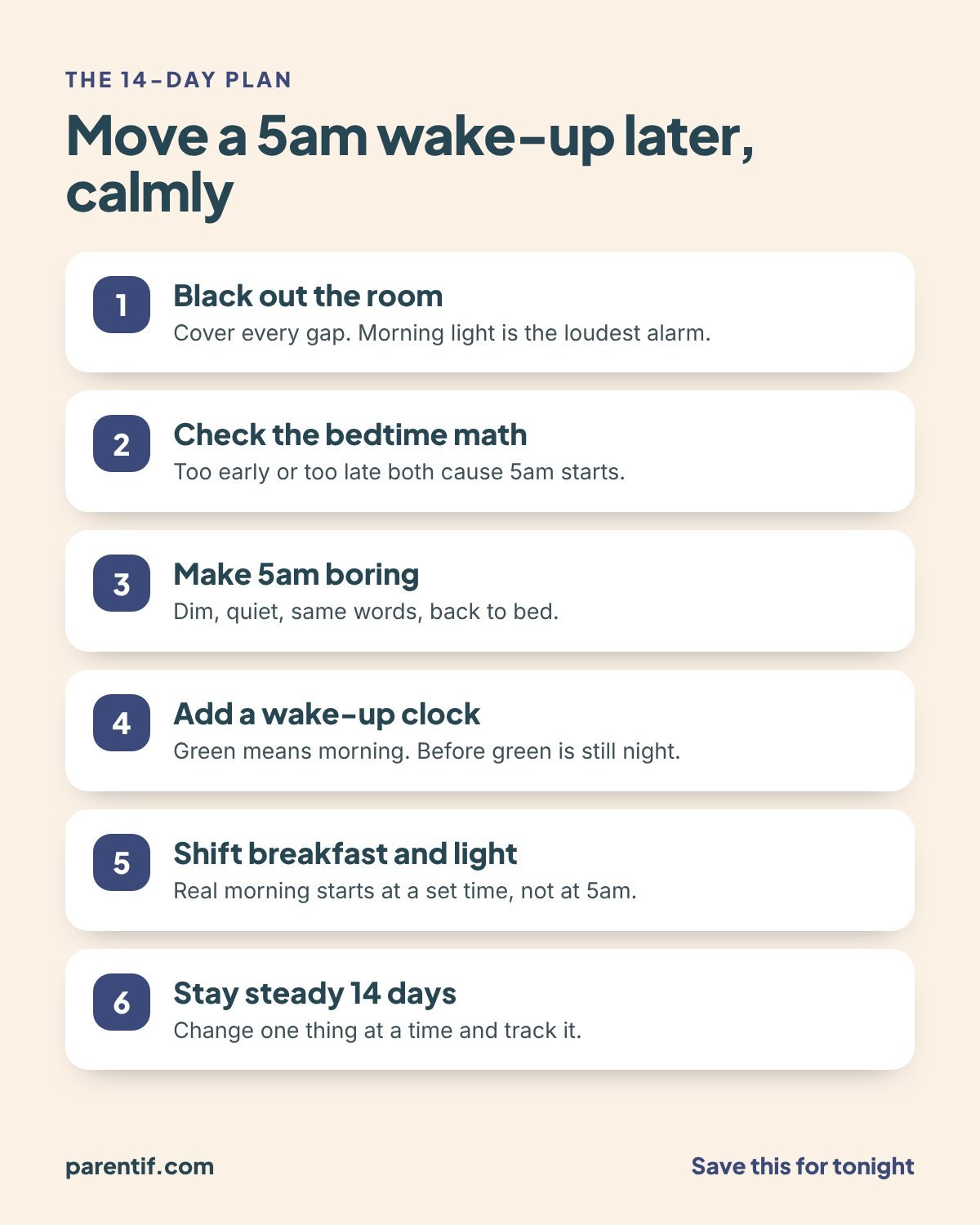
Fix 9: Run a 14-Day Plan and Track It
Early waking changes slowly. Most families give up on day four, right before things start to shift. So pick a plan, write it down and give it two full weeks.
- Days 1–3: black out the room, fix temperature and noise, and write down sleep times.
- Days 4–7: adjust bedtime or naps based on the signs above. Change only one thing.
- Days 8–14: add the wake-up clock, keep 5am dull, and move green 10 minutes later every few good mornings.
- Day 15: look at your notes. If the average wake-up time moved later, keep going. If not, try the next likely cause.
If you want the plan done for you, The No-Fight Bedtime walks you through the whole evening and early morning, with scripts and a companion planner. The printable Bedtime Routine Pack gives your toddler picture cards to follow.
Common Mistakes With a Toddler Waking Up at 5am
These are the traps that keep early mornings going. Most of them come from love and exhaustion, so be kind to yourself if you see your own family here.
- Moving bedtime later straight away. It sounds logical, but an overtired toddler often wakes even earlier. Check the signs first.
- Changing five things at once. Then you can’t tell what worked. Instead, change one thing and wait.
- Starting the clock at 7am. The gap is too big. Start where your child is now.
- Letting 5am be fun some days. Mixed messages keep the habit alive. Keep it dull every time.
- Judging the plan after three nights. Body clocks shift slowly. Give it two weeks.
When Should You Worry About Early Waking?
Most early waking is a normal phase. Still, some signs are worth a chat with your pediatrician.
🩺 When to talk to your pediatrician
- Loud snoring most nights, pauses in breathing, or gasping during sleep.
- Your toddler seems very tired or unwell during the day, every day, despite plenty of time in bed.
- Early waking comes with pain, itching, ear pulling or other signs your child is uncomfortable.
- Sleep suddenly changes a lot and stays that way, or you are worried for any reason.
Trust your gut: if something feels off, a quick call is always fine.
The Raising Children Network page on sleep problems also explains when sleep issues need extra help.
FAQ: Toddler Waking Up at 5am
Is it normal for a toddler to wake up at 5am?
Yes, it’s common, especially between 1 and 3 years old. Toddler sleep is lighter in the early morning, so light, noise, hunger or a bedtime that is off can end the night early. Usually it’s a phase you can shift. A dark room, the right bedtime and a dull, predictable response at 5am help most families move mornings later within a few weeks.
Should I put my toddler to bed later if they wake up at 5am?
Not always. If your toddler is overtired, a later bedtime often makes early waking worse. First look at the signs. If bedtime is wild and naps are short, try an earlier bedtime. If your child falls asleep fast and wakes cheerful at 5am, push bedtime 15 minutes later every three nights and watch what happens.
How long does it take to fix early waking?
Most families see change in about two weeks, as long as they keep the plan steady. The first few days can feel worse, because toddlers test whether the new rule is real. Write down wake-up times each morning. Progress is often 10 or 15 minutes at a time, so notes help you see it when you are tired.
Do wake-up clocks actually work for toddlers?
They can work well, especially from around age two, because toddlers understand a color rule better than a time. The trick is starting the green light close to their current wake-up time, then moving it later slowly. If you start at 7am straight away, your child can’t win, and the clock loses its meaning.
Should I give my toddler milk when they wake up at 5am?
If your toddler eats well during the day, early milk often becomes a habit that keeps the 5am wake-up going. Many families move milk to the “real morning” time instead. If you have any questions about your child’s eating, growth or nutrition, check with your pediatrician before changing feeds.
Can daylight saving time cause a toddler to wake up at 5am?
Yes. When the clocks change, a toddler’s body clock doesn’t change with them, so a 6am riser can suddenly become a 5am riser. Treat it like any other shift. Keep the room dark, hold breakfast and light until your chosen morning time, and move the wake-up clock 10 minutes later every few days.
A toddler waking up at 5am is exhausting, but it is rarely permanent. Start with the dark room and the bedtime math, keep 5am calm and boring, and give one change two full weeks. Soon enough, you’ll be the one waking up first again.
Calm help for the hard parts of family life
Seven bundles of guides, planners and printables. Six products each, $37 per bundle.
 No-Fight Days Bundle
 Family Organizer Bundle
 Family Table Bundle
 Family Money & Home Bundle
 Family Adventures Bundle
 Parent Reset Bundle
 Bump-to-Birth Bundle