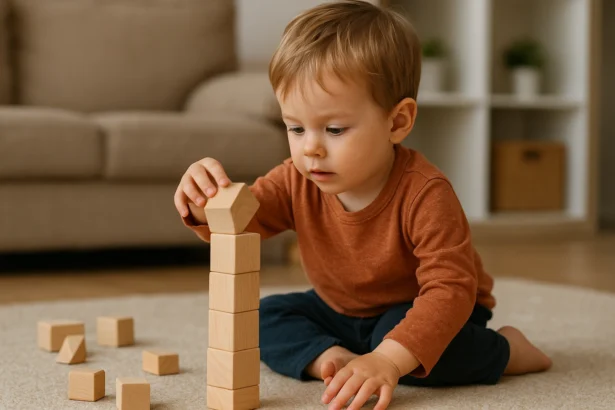
The show ends. You reach for the tablet. And in about four seconds flat, your living room turns into a courtroom drama starring one very small, very furious judge. You’ve tried the warning. You’ve tried the countdown. Somehow it still ends in tears — yours or theirs. Here’s what’s actually happening in that moment, and the exact routine that stops it before it starts.
Every safe, sufficient feeding method is a full success. The whole first year, without the guilt.
Explore The First Year bundle →5 calm ebooks + 20 printables · $27
The fastest way to end screen time without a meltdown is to swap verbal warnings for a visual timer, tie the ending to a routine instead of a request, and use the same two or three words every single time the screen goes off. Toddlers rarely fight the ending itself — they fight the abruptness and the sudden loss of control. Give them something they can watch counting down and a predictable next step, and most transitions stop needing a fight at all.

Key Takeaways
- ✅A University of Washington study found the classic “two-minute warning” made screen time transitions worse for most toddlers, not better.
- ✅A visual timer works because toddlers can watch time run out — they can’t yet imagine it the way “five more minutes” asks them to.
- ✅The biggest predictor of a smooth ending isn’t a warning at all — it’s a routine the child’s body already expects.
- ✅What you say in the final thirty seconds matters more than anything you said five minutes earlier.
- ✅A meltdown after the screen goes off isn’t proof your routine failed — around one transition in five goes rough even when everything is done right.
- ✅Screen time itself isn’t really the problem here. The ending is a specific, learnable transition, no different from leaving the park or getting out of the bath.
Why Screen Time Endings Trigger Bigger Meltdowns Than Almost Anything Else
There’s a reason turning off a tablet produces a different kind of meltdown than, say, running out of crackers. When a toddler is deep in a show or a game, their brain is getting a steady drip of dopamine — a chemical tied to pleasure and reward, the same one that fires when we eat something we love or win a small game. The moment the screen goes dark, that drip stops. For an adult, the drop is barely noticeable; we’ve spent years learning to manage it. A two-year-old hasn’t. The feeling shows up as something closer to a physical loss than a simple disappointment, which is why the reaction is often so much bigger than the situation seems to call for.
There’s a second layer to it, and it’s easy to miss. Sometimes a child isn’t glued to the screen because it’s fun — they’re using it to avoid something uncomfortable: boredom, a transition they don’t want to make, a feeling they don’t have words for yet. Take the screen away in that case, and the discomfort it was covering comes rushing back all at once. It can look exactly like a tantrum about the show, but it’s really about whatever the show was helping them dodge in the first place.
None of this means screens are dangerous or that using them makes a meltdown inevitable. It means the ending of screen time is doing double duty: stopping a pleasurable activity, and asking a toddler to self-regulate a feeling most adults still find genuinely hard. Once you see it that way, the meltdown stops looking like defiance and starts looking like exactly what it is — a kid whose brain chemistry just changed faster than his coping skills can keep up with.

The No-Fight Bedtime
The five-step routine, the exact words for the eight stalls every parent hears, and a fourteen-night plan that takes you from tonight to a bedtime that runs itself.
Get the guide — $1770 pages · instant PDF · yours forever

The Study That Found Warnings Make It Worse (And What Researchers Found Instead)
Most parents use some version of the same trick: “two more minutes, then we’re done.” It feels fair. It gives a heads-up. It should, in theory, soften the landing.
A University of Washington research team decided to actually test that assumption. They interviewed 27 families about how they handled screen time with kids between one and five, then ran a two-week diary study with 28 more families, logging exactly what happened every time a device got put away — what triggered the ending, and how the child reacted.
The loud years, calmed.
5 calm guides + 20 printables on tantrums, sleep, picky eating, potty & talking.
See The Toddler Years · $27 →59%
Neutral reaction when screen time ended
19%
Positive reaction — genuinely fine with it
22%
Negative reaction — an actual meltdown
The results surprised the researchers themselves. Most transitions weren’t dramatic at all. But here’s the part that mattered most: kids who got the classic two-minute warning from a parent were more upset when the screen went off, not less. The warning that’s supposed to soften the blow was, on average, making it worse.
You decide what and when.
They decide whether and how much.
Almost every mealtime fight is one person doing the other's job. The No-Fight Table turns that one idea into the exact words for every refusal you'll hear.
Read what's inside$17 · 70 pages · instant download


What actually helped had nothing to do with warnings at all. Endings tied to something situational — reaching the car, a friend arriving, needing to leave for school — worked well, accounting for close to 40 percent of smooth transitions. Endings tied to the child simply losing interest were the second most common smooth ending, at a quarter of cases, even though most parents assumed that almost never happened. Pre-agreed rules and natural stopping points in the content itself — the end of an episode, not a warning mid-scene — also beat a spoken countdown.
Breathe out.
Get down.
Two sentences.
That's the four-step response — and it works in the supermarket, the restaurant, the car park and the departure gate. The Public Meltdown Field Guide gives you the exact words for each one.
Read what's inside$17 · 70 pages · instant download


The researchers’ best theory: a two-minute warning from a parent reminds a toddler that someone else is in control of the ending. Letting the child in on setting the limit — or letting the routine itself do the announcing — takes that power struggle off the table before it starts.

How to End Screen Time Without a Meltdown, Step by Step
Here’s the version that actually holds up on a hard Tuesday, not just in theory.
Set the limit before the screen turns on, never during. Decide the show, the app, or the number of episodes before you hand over the device. A limit set in the moment always looks like it’s coming out of nowhere to a toddler, because it is.
Use a visual timer, not a verbal one. A sand timer on the arm of the couch, a lit-up countdown, even a paper clock with a moving hand — anything the child can actually watch running down. More on why this step matters so much just below.
Give one heads-up, tied to the content, not the clock. “After this episode” beats “in five minutes,” because it’s concrete. A child can see an episode ending. They can’t see five minutes passing.
Use the same closing phrase every single time. Not a paragraph — two or three words, said the same way whether it’s a good day or a hard one. “Screen time’s done” works. So does “all finished now.” A phrase a toddler has heard fifty times stops sounding like a negotiation and starts sounding like weather.
End it together, hand over hand, instead of calling it out from across the room. Kneel down, put your hand near theirs on the device, and close it out as a shared action rather than something being taken from them.
Have the next thing already out and visible before the screen goes off, not something you’ll go find once the crying starts. A basket of blocks by the door, a snack already on the table. The gap between “screen off” and “next thing happening” is where most meltdowns actually live.
💡 Tip: Practice the shutdown routine once during a calm moment, with no meltdown happening — narrate it like a game (“timer’s almost done, let’s turn it off together!”). Toddlers learn the shape of a routine faster when it’s rehearsed outside the heat of the actual transition.

Why a Visual Timer Beats “Five More Minutes”
Here’s the part that trips up a lot of well-meaning parents: a verbal countdown asks a toddler to do something they’re not developmentally equipped to do yet, which is picture a stretch of time they can’t see. Most two- and three-year-olds are still working out what “in a minute” even means, let alone five of them. Telling a toddler “five more minutes” is a little like telling an adult “we’ll land in roughly a while” — technically information, functionally useless.

Big feelings & big school, calmed.
5 calm guides + 20 printables on emotions, discipline, bedtime, screens & school-ready.
See The Preschool Years · $27 →A visual timer sidesteps the whole problem. Sand falling, a dial turning, a number counting down on a screen-free timer — all of it converts an abstract idea into something a toddler can watch happening in real time. They don’t have to trust you that time is passing. They can see it.
| Ending method | What it requires the toddler to already know | Result |
|---|---|---|
| Verbal warning (“five more minutes”) | Understanding abstract units of time they haven’t developed yet | Feels sudden no matter how much warning was given |
| Visual timer (sand, dial, countdown) | Nothing except watching something empty out | Time feels like it ran out on its own, not because a parent said so |
| Natural stopping point (end of episode) | Recognizing a “the end” they already know from stories | One of the smoothest triggers in the research — no timer needed |
The other advantage: a visual timer takes you out of the equation. When the sand runs out, it wasn’t Mom or Dad being mean — it was just what happens. That small shift, from “you’re stopping me” to “the timer stopped,” is often the entire difference between a shrug and a scream.

For the tantrums timers don’t fix
The Public Meltdown Field Guide — $19
A calm, practical guide for the meltdowns that happen anyway — in the living room, the car, or the middle of the store — with exactly what to do while it’s happening and how to help everyone reset afterward.
Get the Field Guide →What to Do Once the Meltdown Has Already Started
Sometimes every piece of the routine is in place and the meltdown happens anyway — usually because a child is also tired, hungry, or already stretched thin before the screen ever came out. When that happens, the goal isn’t to prevent it anymore. It’s to get through it without making it bigger.
Stay calm first, even though that’s the hardest instruction in this whole article. A parent who raises their voice at a screaming toddler is adding a second meltdown to the first. A few slow breaths before you speak buys you more than anything you could actually say.
Skip the lecture. A child mid-meltdown cannot process reasoning, rules, or your very good point about screens and developing brains. Use as few words as you can: “I know. It’s hard. We’re still done.” Then stop talking.
Stop white-knuckling the after-school hours.
Five short, practical guides — the calm response, the homework truce, friendships, screens, and independence. The words to say, minus the lectures.
Explore The School-Age Years →Instant PDF set · read on any device · yours forever

Give space instead of closeness, if your child is the type who needs it. A designated calm corner — a beanbag, a quiet spot in their room — works better than hovering over them mid-storm. If your child is younger and needs a body nearby, sit close without trying to talk the feeling away.
Skip the negotiation entirely. Any deal struck mid-meltdown teaches a toddler that screaming is a bargaining tool, and the next ending gets harder, not easier, because of it. If the meltdown turns physical, redirect the energy rather than the object — something like tossing a soft pillow back and forth burns off the same physical charge as hitting or throwing, without keeping the fight going over the device itself.
⚠️ Warning: Threatening to take screens away “forever” in the middle of a meltdown almost never gets followed through on, and toddlers learn fast which limits are real and which are just heat-of-the-moment noise. Hold today’s limit calmly instead — save any bigger rule change for a quiet conversation later.
One meltdown is not a verdict on your parenting or your routine. It’s one hard transition on one hard day, and it will be forgotten by dinner.

The Screen-Off Routine That Makes Tomorrow Easier Than Today
A routine doesn’t work because of any single clever trick inside it. It works because a child’s body starts to expect it, the same way it comes to expect a bath before bed or a car seat before a drive. That expectation is the entire mechanism, and it takes roughly one to two weeks of real consistency to build.

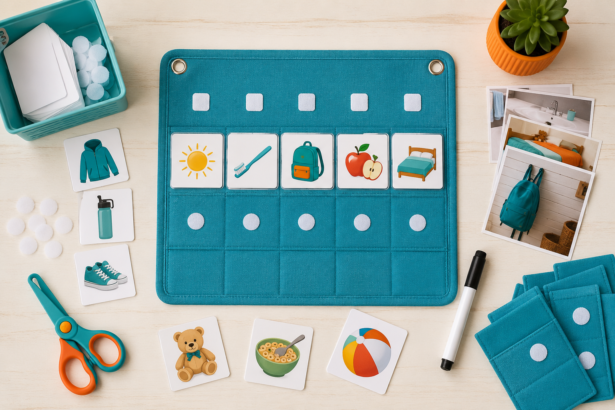
My Day, My Way — The Complete Toddler Routine System
6 ready-made picture charts, 36 cut-out cards, a First–Then board, trackers & a parent guide — everything to help your toddler run their own day. 24 pages, instant download.
Build it in this order: same closing phrase, every time, regardless of mood. Same physical action — timer, hand-over-hand shutdown, device goes in the same spot. Same next step, visible before the screen turns off. Once those three things repeat enough times, the ending stops requiring a decision from your toddler at all. It just happens, the way getting out of the bath just happens once it’s part of the evening shape.
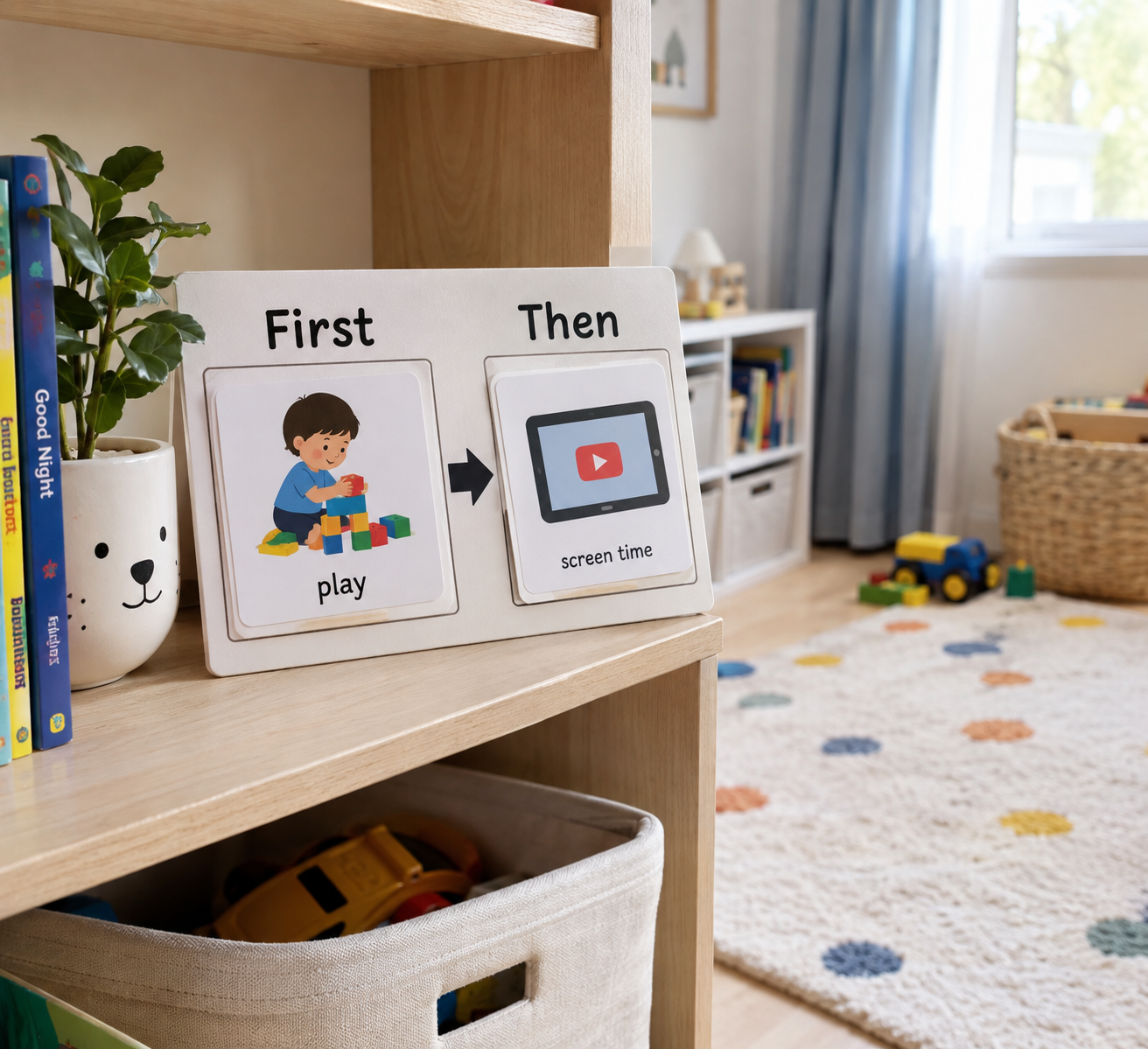
A simple “first, then” visual — a small board or two picture cards showing “screen time, then snack” — does a lot of the negotiating for you before it even starts, because the child can see what’s coming rather than having to take your word for it.
The hard talks don't have to be a war.
Five short, practical guides — phones, moods, risks, independence, and letting go. The words to say when it counts, minus the lecture.
Explore The Teen Years →Instant PDF set · read on any device · yours forever
✨ Quick win: Even two hand-drawn pictures taped to the wall — a screen and a plate of food, an arrow between them — work almost as well as a store-bought board. The visual is what matters, not how polished it looks.
The same child who melts down over a Friday-night treat show can be completely fine turning off the TV during a normal weekday breakfast, and the difference usually isn’t willpower. It’s whether the ending is part of an established shape or a one-off exception. Treat exceptions as exceptions, keep the daily routine boring and identical, and the boring part is exactly what makes it work.
What’s Realistic at 2, 3, 4 and 5 Years Old
Every strategy in this piece works differently depending on where your child actually is developmentally, and expecting a two-year-old to handle an ending the way a five-year-old can is a setup for frustration on both sides. These are general patterns, not a checklist — many children move through them at their own pace, and that’s completely normal.
| Age | What’s realistic | What helps most |
|---|---|---|
| Around 2 | Almost no sense of time passing; frequent meltdowns even with a strong routine | Visual timer + hand-over-hand ending; expect this to still be hard some days |
| Around 3 | Starting to grasp “after this”; can wait through a short countdown | Natural stopping points (end of episode) work especially well now |
| Around 4 | Can often watch a timer and announce it themselves (“almost out!”) | Let them help set the limit before the screen goes on |
| Around 5 | Can participate in the actual rule-making, not just the ending | Family media agreements start to make sense; give them a real vote |
If your child is still having a hard time with endings well past what feels typical for their age, or the meltdowns are getting more intense rather than less over several weeks, that’s a good conversation to bring to your pediatrician rather than something to keep troubleshooting alone.

“The warning that’s supposed to soften the blow was, on average, making it worse.”
5 Mistakes That Turn a Screen Time Ending Into a Meltdown
- Ending mid-content instead of at a stopping point. Cutting off a video mid-scene, especially with autoplay queuing up the next one before you can stop it, is one of the single biggest triggers researchers found. Turn off autoplay in the settings if your child’s app has it — it removes a fight before it starts.
- Giving unlimited “just one more” extensions. One extra minute occasionally isn’t the problem. A pattern of extensions teaches a toddler that the stated limit is actually just an opening offer, which makes every single ending a negotiation from here on out.
- Negotiating once the meltdown is already happening. A mid-tantrum deal feels like mercy in the moment and teaches escalation for next time. Hold the line calmly, then move on — the negotiating window was before the timer started, not during the crying.
- Using the screen as the only tool for calming a hard moment. If a device is the sole way a child settles down, taking it away raises the stakes of every single ending, because losing the screen also means losing their one coping tool.
- Threatening to take screens away forever, in the heat of the moment. An empty threat undermines every future limit you try to set, and a real one is usually more punishment than the moment calls for. Hold today’s limit, and save the bigger conversation for later.
The words that end it, every time
The Parent Scripts Deck — $19
60 printable cards with the exact words for the moments that go wrong — including the one you just read about. Screen time ending, the supermarket floor, bedtime stalling, and 57 more, each with what to say, what to do next, and what not to do.
See the Scripts Deck →FAQ: How to End Screen Time Without a Meltdown
None of this makes the screen disappear from your evenings, and it doesn’t need to. What changes is the ending — visual instead of verbal, routine instead of reminder, the same few words every time instead of a fresh negotiation. That combination is really what it takes to end screen time without a meltdown most nights of the week. The nights it doesn’t work aren’t proof you did it wrong. They’re just Tuesday.
📝 This article offers general parenting strategies drawn from published research and is not medical or developmental advice. If meltdowns around screen time are frequent, intense, or paired with other concerns you’ve noticed, talk with your child’s pediatrician — they know your child’s history and can rule out anything this kind of general guidance can’t.
The Calm Parent Roadmap
Your whole journey — from "I do" to "they're grown." 8 stages, one calm method, 13 beautiful pages. Free when you join the Sunday Note.
📥 Instant PDF · no spam · unsubscribe anytime