1:15 PM comes around and your toddler turns into a different kid — running circles around the living room, negotiating for one more show, anything but lying down. Twenty minutes later you’re standing outside a closed door listening to crying that started the second you left the room. A toddler nap time routine chart — a short, repeatable sequence of calming steps — is what actually gets a resistant toddler from full speed to asleep, and it doesn’t take a new sleep method to build one. Here’s exactly how.
The whole first year, calmed — in one bundle.

Key Takeaways
- ✓A nap routine should take 8–15 minutes total — long enough to calm down, short enough that it doesn’t become its own stalling tactic.
- ✓The exact steps matter less than the order staying identical every day, weekends included.
- ✓Most toddlers can start following a picture-based routine chart by 18–24 months.
- ✓Nap resistance that’s fine at daycare but falls apart at home usually isn’t about the routine — it’s about the setting.
- ✓Somewhere between 3 and 4, nap time should shift into quiet time rather than disappear outright.
- ✓A routine that only works on perfect days isn’t a routine yet — build a travel version from the start.
Why Nap Time Turns Into a Daily Battle
Nap time picks fights that bedtime usually doesn’t. By evening, most toddlers are genuinely worn down, so bedtime protest tends to be about delay tactics more than real resistance. At 1 PM, though, your toddler might not feel tired at all, even if their body badly needs the rest. That gap between how they feel and what they actually need is where most naptime battles start.
There’s a developmental piece too. From around 8 or 9 months and well into toddlerhood, kids build a much stronger grasp of object permanence — they know you’re still out there somewhere in the house, doing interesting things without them. Naptime protest at this age often has less to do with sleep and more to do with a toddler trying to make something happen: cry loud enough, and someone comes back. It’s the same instinct behind a lot of toddler tantrums — a strong feeling with no other outlet yet.
Most advice about naptime resistance treats it like a discipline problem, something to fix with a firmer boundary. That gets it backwards. A toddler who fights naptime for weeks isn’t testing you specifically — they’re missing the predictable signal that tells their body what’s coming next. Adults get that signal for free; we notice we’re tired and decide to lie down. Toddlers need it built, the same way, every single day. Research from ZERO TO THREE backs this up directly: consistent pre-sleep routines are one of the strongest predictors of better sleep outcomes across the toddler years, regardless of what the individual steps are.

A bedtime that's finally
boring.
Fix the room, build the routine, learn the eight scripts. No sleep training, no crying it out — just a sequence that stops needing your patience.
Get The No-Fight Bedtime$17 · 70 pages · instant PDF · yours forever
That’s the entire argument for a nap time routine chart. It isn’t a reward system and it isn’t a negotiation tool. It’s the missing signal — made visible, so a toddler who can’t yet tell time can still tell what’s next.
There’s also a physical piece that makes the fighting worse the longer it goes on. A toddler who skips or shortens naps for several days in a row doesn’t get less tired — they get more wired. The nervous system releases stress hormones to push through the tiredness, and that surge can look a lot like energy right up until it collapses into a meltdown an hour before dinner. Parents often read that late-day burst as proof their toddler “doesn’t need the nap anymore,” when it’s usually the opposite: the resistance is a symptom of needing it more, not less.
Warm on the feeling. Firm on the limit. Boring on the drama.
Explore The Toddler Years bundle →5 calm ebooks + 20 printables · $27

“The routine isn’t the reward. It’s the signal.”
What a Nap Time Routine Chart Actually Fixes
A routine chart doesn’t make a toddler sleepier. What it does is remove the guessing. Instead of naptime announcing itself out of nowhere — “okay, nap time!” — the chart breaks it into small, visible steps a toddler can watch themselves complete. Tidy the toys. Go potty. Read one book. Get into bed. Each step is a small, doable win, and by the time they’ve finished the last one, they’ve walked themselves calmly into the transition instead of being dropped into it.
Seventy pages. Two script tables.
Every meal, without the battle — the setup, the scripts, and exactly what to say when they won't eat it.


Instant PDF · 26 photographs · yours forever
8–15
minutes — ideal wind-down length
18–24
months — when chart-following usually starts
3–4
years — typical quiet-time transition
The chart works differently depending on where your toddler is developmentally, and it’s worth adjusting your expectations accordingly. A pre-verbal one-year-old won’t follow the chart independently — you’re narrating each step as you go, and the value is entirely in the repetition of language and order. A verbal three-year-old, on the other hand, can often run most of the sequence themselves once it’s familiar, which is exactly the independence that makes the chart worth building in the first place. Somewhere in between, most toddlers start pointing at the next picture before you even ask — that’s usually the first real sign it’s working.
Seventy pages. Six script tables.
What to do, and exactly what to say, when it happens in the supermarket, the restaurant, the car, or in front of everyone.


Instant PDF · 24 photographs · yours forever
The chart also does something less obvious: it takes you out of the role of enforcer. When your toddler is following steps on a chart instead of following your instructions one by one, the friction shifts from “you vs. me” to “us vs. the chart.” That small reframe matters a lot to a two- or three-year-old who’s constantly looking for ways to assert control. It’s the same principle that makes visual routines work so well for other rough parts of the day, which is why it pairs naturally with a full toddler routine chart covering mornings and bedtime too.
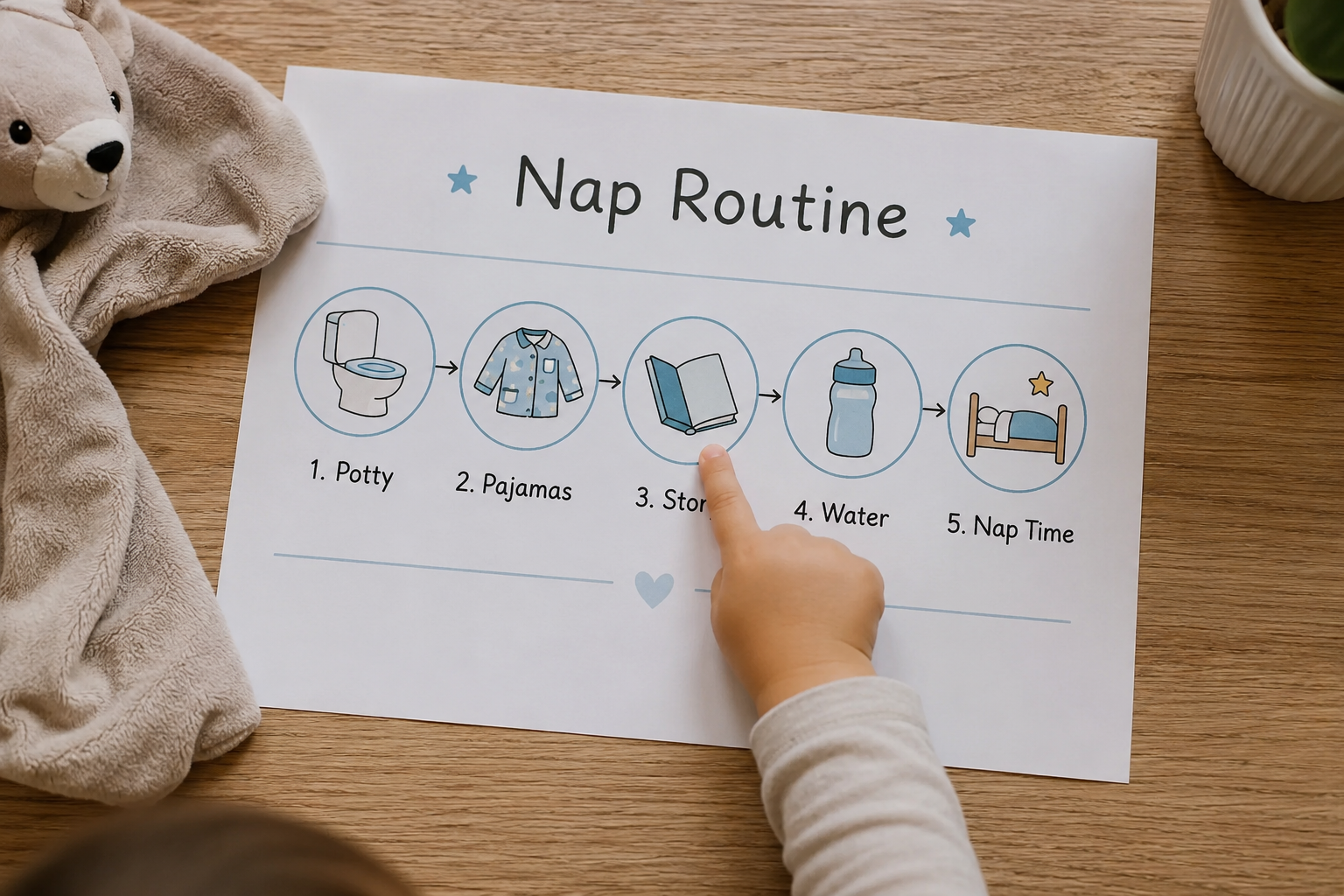
💡 Tip: Use real photos or simple icons instead of words on the chart. A toddler who can’t read yet can still “read” a picture of a book or a potty — that’s the whole point of a visual routine.
Build the Nap Time Routine Chart: A Step-by-Step Sequence
Keep it short. A nap routine should be noticeably shorter than your bedtime routine — five steps at most, done in around 10 minutes. The American Academy of Pediatrics recommends the same core idea for bedtime — a quiet, consistent routine before sleep — and that logic carries over directly to naps. Here’s a sequence that works for most toddlers between 1 and 4, that you can copy exactly or adjust to your own house.
Tidy the toys together. A quick, shared clean-up signals that play time is ending — and doing it together (not as a solo chore) keeps it from feeling like a punishment.
Diaper change or potty stop. Building this in now — rather than mid-routine when they call out for it — prevents it from becoming a stalling tactic later. If you’re mid-potty training, this step also reinforces the habit at a low-stakes moment.
One short book. Not three, not “just one more” — one. Pick the same one or two books for naptime specifically, separate from bedtime books, so the story itself becomes a cue.
Settle in with a comfort object and white noise. Same lovey, same sound machine, same order, every time. This is what your toddler’s body starts to associate with actual sleep, not just quiet time.
A short goodnight phrase, then leave. Use the exact same words every day — “nap time, see you when you wake up” — and don’t linger. Lingering is often what turns a smooth handoff into a ten-minute negotiation.
Timing the routine matters as much as the steps themselves. Start it 20–30 minutes after lunch — a heavy meal right before lying down can make settling harder, which is worth keeping in mind if you’re planning toddler meals around the nap window. And keep the whole sequence in the same room, at the same time, as close to daily as your schedule allows.

Big feelings & big school, calmed.
5 calm guides + 20 printables on emotions, discipline, bedtime, screens & school-ready.
See The Preschool Years · $27 →Where you keep the chart matters too. Tape it at your toddler’s eye level, not yours — a chart mounted at adult height might as well not exist to a two-year-old. Laminate it or slide it into a plastic sleeve so it survives sticky fingers, and keep it in the same spot every day rather than carrying it room to room. A chart that moves loses part of what makes it work: the fact that walking up to it, in the same place, is itself part of the cue.

Getting a Resistant Toddler to Buy Into the Chart
Some toddlers take to a routine chart in a few days. Others fight the chart itself, treating each step as one more thing to negotiate — stalling on the book, refusing the potty stop, asking for “one more thing” right as you reach the door. If that’s your kid, the fix usually isn’t more explanation. Toddlers this age don’t reason their way into cooperation the way a six-year-old might; what actually shifts behavior is giving them a sense of control inside a structure that doesn’t otherwise change.
Let them “drive” the chart. Instead of you announcing each step, point to the picture and ask, “what’s next?” Toddlers who feel like they’re the one running the routine resist it far less than toddlers who feel like it’s being run on them. Small choices help too — which book, which stuffed animal goes on the chart’s last picture — as long as the sequence itself never changes.
❗ Important: Resist the urge to add a step or extend the routine on a hard day. A toddler who successfully stalls once will test that same stall again tomorrow, and the routine gets longer every day instead of staying short.
Watch for “chart drift” — the slow creep where one extra hug turns into two, then a second book sneaks in, then a glass of water becomes part of the routine every single day. None of these individual additions feels like a big deal in the moment, which is exactly why they’re worth catching early. A routine that’s grown from five steps to nine over three months isn’t more thorough; it’s just given your toddler nine opportunities to stall instead of five. If you notice the routine has quietly gotten longer, it’s fine to reset back to the original chart and explain the shorter version is what’s happening from now on.
Praise the process, not just the outcome. “You checked off every step on your chart” lands better than “good job going to sleep,” especially on days when they follow the whole routine but still don’t actually nap. That distinction protects the routine from feeling like a pass/fail test they can lose.

The Toddler Years Bundle
Five calm guides for ages 1–3 — tantrums, sleep, picky eating, potty training, and the language leap. Including a full sleep and routine system that goes beyond just naps.
See The Toddler Years Bundle →Nap Time vs. Quiet Time: When (and How) to Switch
Most toddlers don’t drop naps overnight — they get inconsistent first, napping some days and lying awake staring at the ceiling on others. That inconsistency, usually somewhere between ages 3 and 4, is your cue to shift the routine from “nap time” to “quiet time” rather than cutting it entirely.
| Signal | Nap Time | Quiet Time |
|---|---|---|
| Falls asleep most days | Yes, within 20 min | Rarely or never |
| Bedtime affected | No impact from nap | Nap pushes bedtime later |
| Typical age | 1–3 years | 3–5 years |
| Routine goal | Fall asleep | Rest independently, sleep optional |
| Where it happens | Crib or bed, room dark | Bed or reading nook, some light okay |
If you have more than one child at different stages — a toddler dropping the nap while a younger sibling still needs one — try to keep the older child’s quiet time happening in the same window as the baby’s nap, even if it’s in a different room. That overlap protects the one block of predictable downtime you’re likely to get in the middle of the day, for everyone in the house, not just the child who’s transitioning.
The routine chart doesn’t need to change much for this shift — keep the same tidy-up, potty, and book steps. What changes is what happens after: instead of insisting on sleep, you’re offering quiet, low-stimulation options like books, a puzzle, or soft music for a set amount of time, usually 30–45 minutes. Some days they’ll fall asleep anyway. That’s fine. The goal of quiet time isn’t sleep — it’s a predictable reset in the middle of the day, for them and for you.

Troubleshooting: Travel, Daycare, and Off Days
A routine that only survives at home isn’t finished yet. Here’s how to handle the situations that break most nap routines.

My Day, My Way — The Complete Toddler Routine System
6 ready-made picture charts, 36 cut-out cards, a First–Then board, trackers & a parent guide — everything to help your toddler run their own day. 24 pages, instant download.
Illness and short-term disruptions. A cold, teething, or a new sibling in the house can throw the routine off for days or weeks — that’s expected, not a sign the chart has failed. Keep running the same steps even if the outcome is worse than usual; a toddler who’s sick or overwhelmed still benefits from the predictability, even on nights when it doesn’t end in sleep. Once the disruption passes, most toddlers settle back into the routine within a few days, without needing to rebuild it from scratch.
Daycare naps fine, home doesn’t. This is one of the most common complaints parents raise, and it’s rarely about the chart itself. Daycare providers manage naptime for a group, which naturally means more structure and less room for negotiation than one-on-one time with a parent. The fix isn’t a stricter home routine — it’s asking your provider exactly what their sequence looks like (lunch, then diaper change, then a story, for example) and mirroring that same order and rhythm at home as closely as you can.
Travel and unfamiliar rooms. Build a stripped-down “travel version” of the routine now, before you need it — same three or four steps, just without the usual room or crib. Bring the same lovey and sound machine every time; those two objects can carry most of the routine’s signal even when everything else around your toddler is unfamiliar.
Weekends and off days. Naps that hold up perfectly Monday through Friday often fall apart on Saturday, simply because the rest of the day’s structure is different. Keeping naptime itself anchored to roughly the same time and the same short routine — even if everything else about the day is looser — protects it from the ripple effect of a less structured schedule.
✨ Quick win: Photograph your toddler’s actual routine chart on your phone. It becomes an instant travel-size version and a backup for whoever’s babysitting.
If your toddler’s sleep problems go beyond naptime resistance — frequent night waking, very short naps for months on end, or visible exhaustion that doesn’t improve — a consistent routine is still worth building, but it’s also worth a conversation with your pediatrician. Sleep patterns vary widely between individual kids, and a chart can’t substitute for that check-in when something feels off.

📝 Note: This article covers general routine-building strategies and isn’t a substitute for medical or sleep-training advice. If you have specific concerns about your toddler’s sleep or development, talk with your pediatrician.
Common Mistakes
- Making the routine too long. A 25-minute wind-down gives a toddler 25 minutes of opportunities to stall. Trim it to the shortest version that still works.
- Changing the routine on weekends. A different order on Saturday teaches your toddler that the routine is optional, which undoes a lot of the consistency you built during the week.
- Skipping it when you’re short on time. Skipping the routine on a rushed day, then wondering why nap falls apart, is one of the most common patterns parents describe — the routine only works if it runs even on the days it’s inconvenient.
- Treating quiet time as a demotion. Framing the shift away from napping as a loss (“you’re not a baby who naps anymore”) makes a toddler resist a transition that’s actually developmentally normal and expected.
- Ignoring what daycare already does. Building a totally different home routine from scratch, instead of matching what already works during the week, creates two competing systems instead of one reinforcing one.
FAQ
Ready for the whole routine system?
The Toddler Years bundle covers naps, bedtime, tantrums, potty training, and picky eating — five calm guides built for ages 1–3, with printable charts included.
Explore The Toddler Years →A toddler nap time routine chart won’t make every nap perfect — some days your toddler still won’t sleep, and that’s normal. What it does is take naptime out of the daily negotiation and turn it into something predictable for both of you. Build it once, run it the same way every day, and give it a couple of weeks before judging whether it’s working.
Become a calmer parent at every age.
- All 8 stages — newborn to adult children
- One calm method that scales the whole way
- Checklists & "you're now expert" takeaways
- 13 beautiful, print-ready pages — free
Instant PDF · no spam · unsubscribe anytime.