
If you’re wondering how to tell grandparents no more toys without starting a family cold war, you’re in good company. The playroom is full, the holidays are coming, and you love that they love your child. You just can’t fit another singing plastic truck in the house. This guide gives you the exact words to send, a yes-list of gifts grandparents actually enjoy giving, and a calm plan for when they buy the pile anyway.
The short answer
To tell grandparents no more toys, talk early (4 to 6 weeks before a birthday or holiday), keep it about your child rather than your house, and always pair the “no” with a clear “yes”. Ask for one toy at most, then hand over a short list of things they can give instead: an outing with them, books, a savings gift or a bigger toy that lives at their house. Thank them warmly, and rotate any extras quietly.
Key takeaways
- ✓Grandparents hear “no more toys” as “no more love” unless you give them another way to show it.
- ✓Timing matters more than wording: a calm text weeks ahead works far better than a talk at the front door.
- ✓Explain the effect on your child, because too many toys at once can overwhelm a small child and shorten their play.
- ✓A yes-list of experiences, books and one wish keeps grandparents generous without filling your home.
- ✓When extra toys still arrive, say thank you, then store and rotate them instead of arguing.
Why “No More Toys” Feels So Hard to Say
Saying no to gifts feels rude because, for many grandparents, the gift is the love. They grew up when a toy was a treat. Now they can finally afford to give the thing they never had, and your child’s happy face is the reward.
So when you say “please stop”, what they often hear is “your way of loving my child is wrong”. That’s why the conversation goes sideways so fast. Most advice tells you to be firm. Firm matters, but it’s the second step. The first step is making sure the grandparent still has a job: a clear, special way to spoil your child that you are happy about.
The Family Money Guide
A simple family budget that works on a real income, with kids in the picture.
Instant download · Digital download · All sales final
There’s also a quieter reason this is hard. You’re asking your own parent, or your partner’s parent, to change. That old parent-child dynamic shows up even when you’re 35 with a mortgage. Keep that in mind and be kind to yourself if your voice shakes a little.
💡 Tip
Before you talk, decide what you actually want. “Fewer toys” is vague. “One toy each at birthdays and holidays, and nothing that needs batteries” is a limit you can repeat.
What Too Many Toys Really Does to Young Children
Before you plan your words, it helps to know you’re not just being fussy. The number of toys in a room changes how young children play.
In a study from the University of Toledo, published in Infant Behavior and Development, 36 toddlers aged 18 to 30 months played in two set-ups: a room with 4 toys and a room with 16. With fewer toys, the toddlers played with each toy for longer and found more ways to use it. With 16, they flitted from toy to toy. You can read the University of Toledo summary of the fewer-toys study yourself.
The American Academy of Pediatrics says something similar from another angle. Its advice on choosing toys is that the best ones are simple and support playing together, not flashy or expensive. The AAP’s guidance on the best toys for young children is a useful page to share with a grandparent who loves the newest gadget.
4 vs 16
toys in the University of Toledo toddler play study
18–30 months
ages of the 36 toddlers who took part
Simple > flashy
the AAP’s advice on the best toys for young children
This gives you an honest, child-centered reason, and it’s the backbone of how to tell grandparents no more toys without blame. You’re not saying “your gift is clutter”. You’re saying “a smaller pile helps her play better”. Grandparents can get behind that, and it’s true.
If your child already melts down when the wrapping paper flies, you’ll recognize this from big family days. Our guide to a toddler overstimulated at family gatherings explains why piles of noise, people and presents tip small children over the edge.
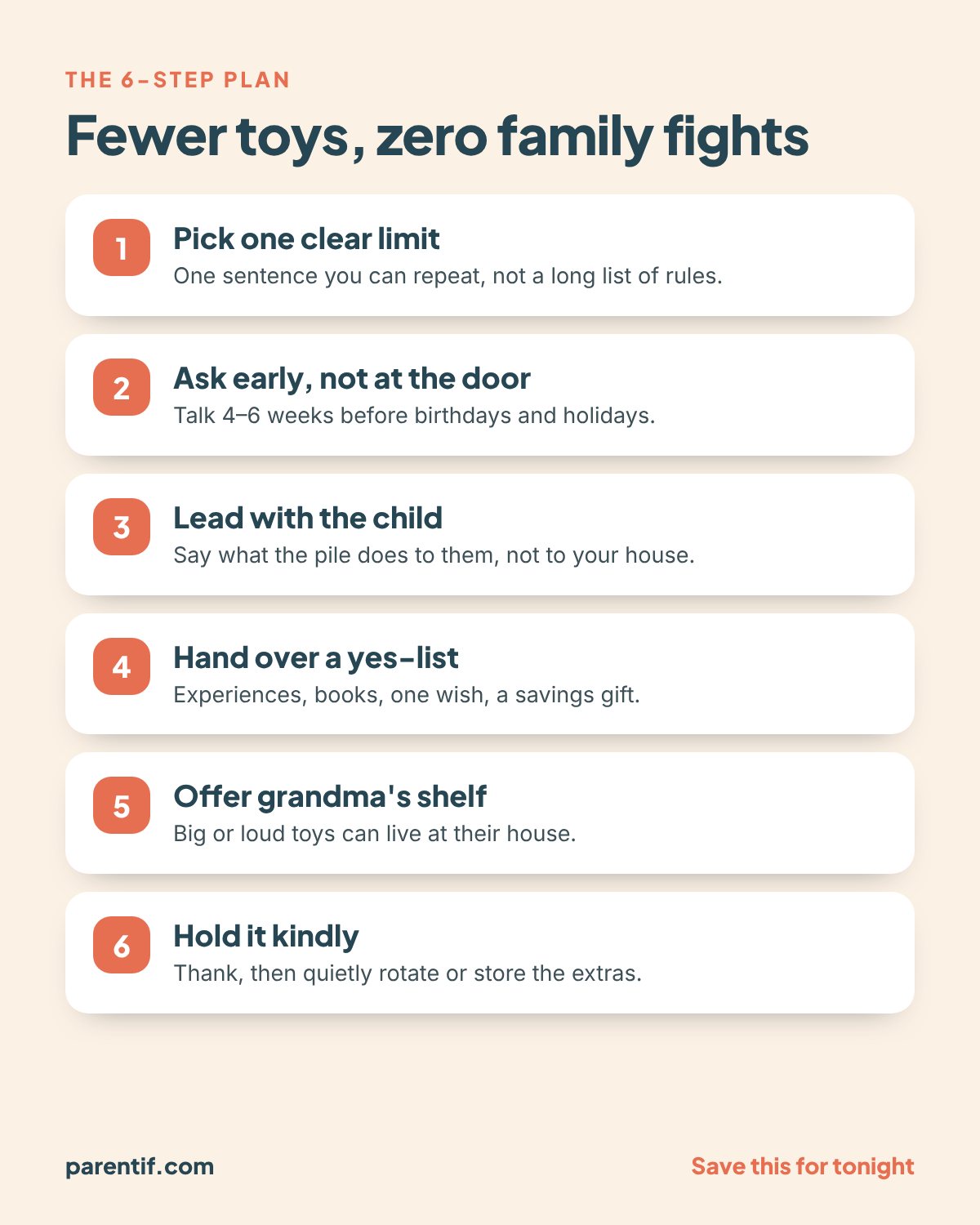
How to Tell Grandparents No More Toys: The 6-Step Plan
Here’s the order that works best for most families learning how to tell grandparents no more toys. Each step makes the next one easier, so try not to skip ahead to the “no”.
The Family Money & Home Bundle
The family budget, the kids' money, celebrations and childcare costs, under control.

Pick one clear limit
One sentence you can repeat: “One gift each, and no big or noisy toys.” Short limits are easier to remember and harder to argue with.
Talk early, not at the door
Bring it up 4 to 6 weeks before a birthday or holiday, before anything is bought. A request after the gift is wrapped feels like a rejection.
Lead with your child
Explain what a big pile does to them: overwhelmed, tired, playing with nothing. Keep your house, your budget and your stress out of the first sentence.
Hand over a yes-list
Give them 4 to 6 things they can give instead, so their generosity has somewhere to go. This is the step most parents skip.
Offer “grandma’s shelf”
Big, loud or messy toys can live at their house. Your child gets the toy, the grandparent gets the visits, and your living room stays yours.
Hold it kindly
If extra toys still arrive, say thank you, then rotate or store them later. No lectures in front of your child.
❗ Important
Who should say it matters. Usually the adult child does the talking to their own parents. So you talk to yours, and your partner talks to theirs. It lands softer and keeps in-law tension out of it.
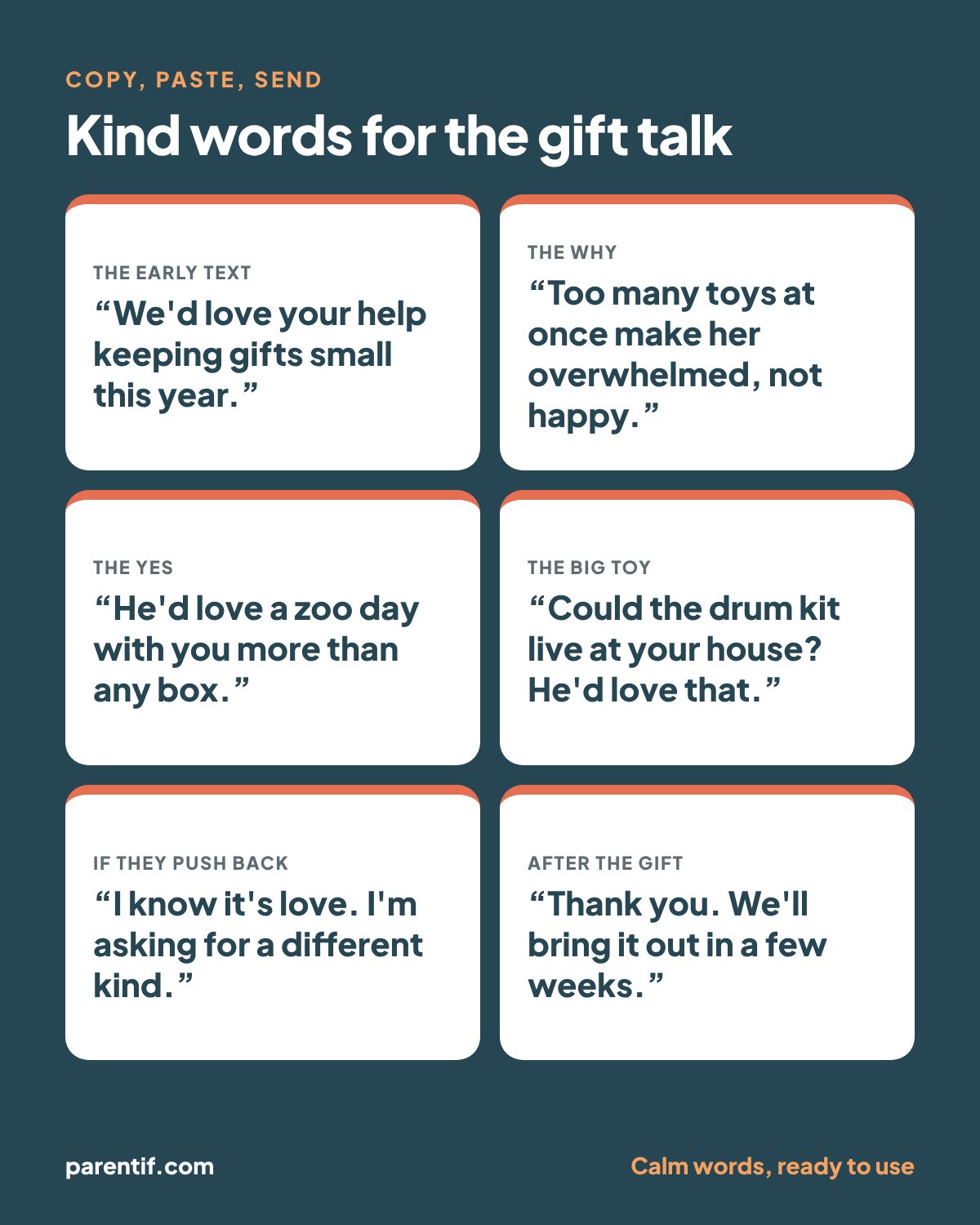
Word-for-Word Texts for Telling Grandparents No More Toys
You don’t need a big sit-down. For many families, a warm text or a short phone call works better, because nobody has to react on the spot. Here are scripts for the moments that come up most, with what to say and what to skip.
The early heads-up
Say: “”We’d love your help keeping gifts small this year. She has so many toys that she gets overwhelmed and ends up playing with nothing.””
Skip: “”Please stop buying so much stuff. We don’t have room.””
Explaining the why
Say: “”When there are fewer toys out, he plays longer and gets more creative. It’s actually better for him.””
Skip: “”Experts say too many toys are bad for kids.””
Giving the yes
Say: “”What he’d love most is a day out with you. The zoo, the library, pancakes. He talks about those for weeks.””
Skip: “”Just don’t get him anything.””
The big or loud toy
Say: “”Could the drum kit live at your house? Then it’s his special thing when he visits you.””
Skip: “”We’re not having that in our house.””
When they push back
Say: “”I know it’s love, and we feel it. I’m asking you to show it in a different way this year.””
Skip: “”You never listen to what we want.””
They’re not trying to fill your house. They’re trying to fill your child’s heart. Give them another way in.
A ready-to-send message for the holidays
Here’s a full message you can copy and change to fit your family. It works by text, email or as a note in the family group chat.
📋 Copy and send
Hi Mom! The holidays are coming, and we’d love to plan gifts together this year. Little one has more toys than she can play with, and we’ve noticed she gets overwhelmed when there are too many out at once. Would you be up for one small toy, plus something from this list? A zoo or museum day with you, a book you loved as a child, or a gift towards her savings. She talks about days with you for weeks. Thank you for loving her so much. ❤️
How to Tell Grandparents No More Toys, Grandparent by Grandparent
Not every grandparent hears the same message the same way. So when you work out how to tell grandparents no more toys, adjust the reason you lead with.
| Grandparent type | Lead with | Example line |
|---|---|---|
| The generous shopper | A yes-list and one wish item | “Her one big wish this year is a scooter. Would you like to be the one to give it?” |
| The traditional one | Family memories and heirlooms | “Would you give her a book you read to me? With a note inside, it’ll be a keepsake.” |
| The far-away one | Experiences you can share by video | “A monthly book you read together on video would mean more than any toy.” |
| The competitive one (with the other side) | Fairness and one gift each | “We’re asking everyone for one gift each, so it’s the same for all the grandparents.” |
| The one who gets hurt easily | Gratitude first, request second | “You’ve been so generous. This year we’d love to try something a bit different.” |
The Yes-List: Gifts Grandparents Love Giving
Knowing how to tell grandparents no more toys only works if you also say yes to something else. In our experience, grandparents give fewer toys the moment they have a better idea. So make their job easy and send the list before they go shopping.
| Gift idea | Why it works | Rough cost |
|---|---|---|
| A day out together (zoo, farm, museum, pool) | Time with them is the gift, and it builds a memory | Ticket price |
| A membership or class (swim, music, gym) | One gift that lasts all year, with their name on it | Medium |
| Books with a handwritten note | Grows with the child, small to store, becomes a keepsake | Low |
| A savings or “first bank account” gift | Grows up with the child, nothing to store | Any amount |
| One wish item, chosen together | Keeps the excitement of a big present without the pile | Medium |
| Consumables (paint, play dough, stickers) | Gets used up, so it never adds to clutter | Low |
| Something for grandma’s house (a bike, a craft box) | Stays at their place for visits | Medium |
✨ Quick win
Ask grandparents to “own” one category each year. Grandpa does the swim lessons, Grandma does the birthday book. A role feels special, and it stops two sides from buying the same toy.
Our guide on how many gifts a child should get has a simple gift rule and a budget plan you can share with the whole family, so the grandparents aren’t the only ones asked to cut back.
From the Parentif library
Celebrations on a Budget
Want the holiday plan done for you? This calm guide gives you a family gift rule, ready-made wish lists and planner pages, so you can send grandparents a clear plan instead of a complaint.
What to Do When Grandparents Ignore You
Sometimes you know exactly how to tell grandparents no more toys, you do everything right, and a mountain of boxes still arrives. That’s okay. It doesn’t mean the talk failed. Habits that took 60 years to form don’t change in one holiday.
Here’s the calm way through it:
- Say thank you, warmly, in the moment. Your child is watching how you treat their grandparents. A lecture next to the wrapping paper teaches the wrong thing.
- Let your child open everything. Then, after a day or two, let them choose a few favorites to keep out.
- Store the rest quietly. Put extras in a box in a cupboard. Bring one out on a rainy day, or when an old toy gets boring.
- Talk again later, not on the day. A week after the holiday, mention it lightly: “She loved the puzzle. We had to put a lot away, though, so next time one gift is plenty.”
- Keep the “grandma’s shelf” offer open. If the same grandparent keeps buying big toys, keep asking for those to stay at their house.
⚠️ Watch out
Avoid regifting or donating a grandparent’s gift where they might see or ask about it, at least in the first months. Rotate first. Decide later, once your child has moved on.
If the pile is already out of control, our step-by-step plan on how to declutter toys shows how to sort, store and rotate in one afternoon without tears.
Toy rotation: the quiet fix for extra gifts
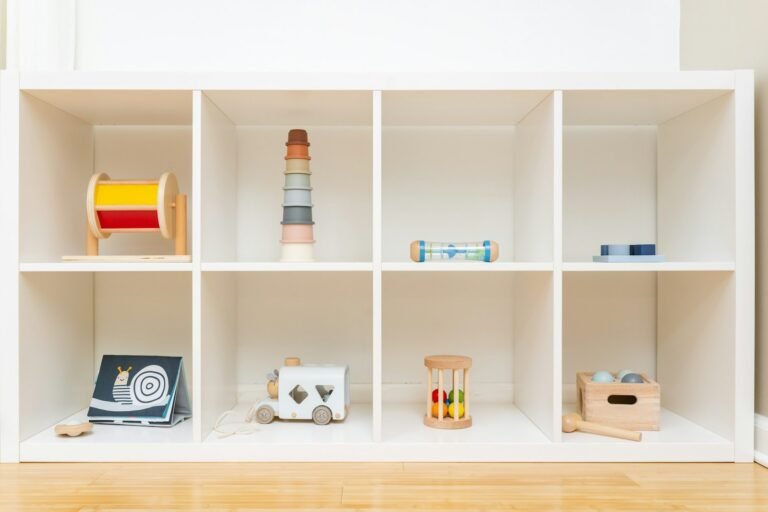
Toy rotation means keeping most toys stored away and putting out a small set at a time, then swapping every week or two. It’s simple, and it fits the research above: fewer toys out, longer play.
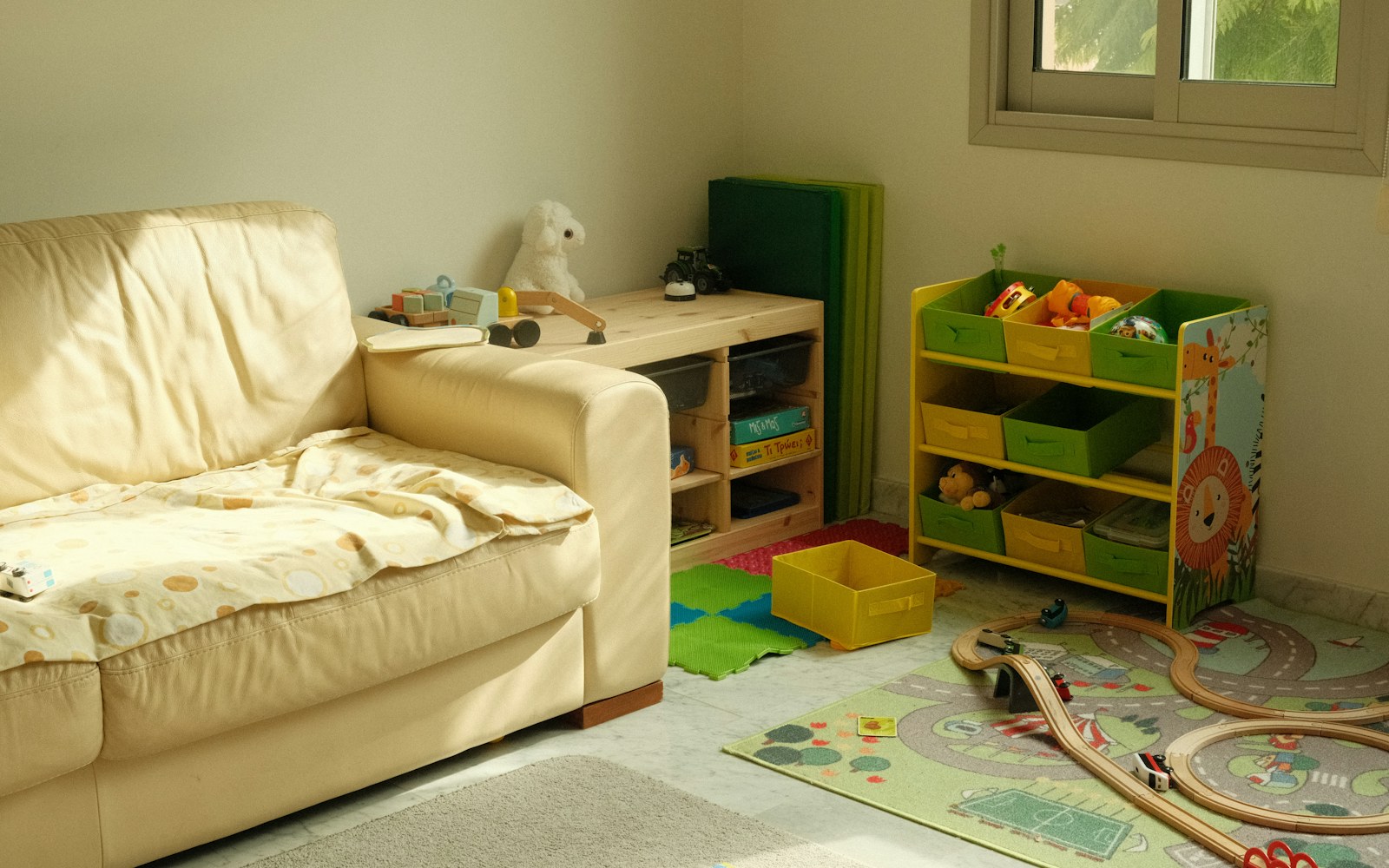
- Out: 6 to 10 toys for a toddler, a few more for older children.
- Stored: everything else, in labeled boxes out of sight.
- Swap: every 1 to 2 weeks, or when play starts to fade.
- Bonus: gifts from grandparents get a “comeback” months later, which feels like a new present.
When Grandparents Live With You (or Visit Every Week)
If grandparents are a big part of daily life, how to tell grandparents no more toys is really a house-rules question. Small gifts every visit add up faster than one big holiday.
So agree on a simple visit rule instead of arguing about each toy. For example: “Visits are for playing together, not for presents.” Or: “One small treat on Fridays, and that’s it.” Put it in the weekend routine for toddlers or on your toddler routine chart so it feels like part of the week, not a rule aimed at Grandma.
Children also cope better when gifts are predictable. If every visit brings a toy, your child may start greeting Grandpa with “What did you bring me?”. That’s a hard moment for everyone. A clear rule protects the relationship.
💡 Tip
If a grandparent is your regular childcare, thank them often and out loud. People accept limits much more easily from someone who clearly notices how much they do.
Common Mistakes When Asking for Fewer Toys
These are the traps that turn a kind request into a family argument, even for parents who already know how to tell grandparents no more toys. Most of them come from tiredness, so go easy on yourself if you’ve made one already.
1. Waiting until the presents are bought
Once a gift is wrapped, any request feels like a rejection of that gift. So talk early. Six weeks before a holiday is ideal, and two weeks before a birthday is the latest.
2. Saying only what you don’t want
“No more toys” with nothing after it leaves a loving grandparent with nowhere to go. Many then buy anyway, just “something small”. Always give the yes-list in the same message.
3. Making it about your house, not your child
“We don’t have space” invites “then get a bigger cupboard”. “She plays better with fewer toys” is about the grandchild they adore, and it’s much harder to argue with.
4. Correcting them in front of your child
Saying “we told you no toys” during a gift opening embarrasses the grandparent and confuses your child. Thank them in the moment. Talk later, in private.
5. Asking only one side of the family
If one set of grandparents is asked to cut back and the other isn’t, it feels like a judgement. Send the same message to everyone, at the same time.
FAQ: How to Tell Grandparents No More Toys
How do I politely ask grandparents not to buy so many toys?
Talk early, keep it kind and make it about your child. Try: “She has so many toys that she gets overwhelmed. Would you like to give her a day out with you instead?” Then send a short list of gift ideas they can choose from. A clear yes makes the no much easier to hear, and it keeps their generosity in the picture.
What can grandparents give instead of toys?
Good options are experiences with the grandparent (zoo, museum, swim day), a membership or class, books with a handwritten note, a gift towards savings, art supplies that get used up, or one bigger toy that stays at their house. The best gifts include time together, because that’s what children remember long after the toy is forgotten.
Is it rude to ask grandparents for no gifts?
It isn’t rude to ask for fewer gifts, but asking for none at all can feel harsh to a loving grandparent. Most families do better asking for one small gift plus an experience. If you do want no physical gifts, explain the reason warmly and suggest another way for them to celebrate with your child, such as a special day out together.
How many toys should a toddler have out at once?
There’s no official number, but many families keep about 6 to 10 toys out for a toddler and store the rest. A University of Toledo study found toddlers played longer and more creatively with 4 toys than with 16. Rotating stored toys every week or two keeps play fresh without buying anything new.
What do I do with extra toys from grandparents?
Say thank you, let your child open everything, then keep a few favorites out and store the rest for toy rotation. Bring stored gifts back out on a rainy day or when interest fades. Wait several months before donating a grandparent’s gift, and only once your child has clearly moved on from it.
How do I tell my in-laws to stop buying toys?
In most families, your partner should talk to their own parents. It sounds like a normal family request from their child, not criticism from you. Agree on the words together first, send the same message to both sets of grandparents, and include a yes-list so everyone has a clear and happy way to give.
The Bottom Line on Fewer Toys and Happy Grandparents
The secret of how to tell grandparents no more toys is giving their love a new place to go: talk early, keep it about your child, and hand them a yes-list in the same breath. Send your heads-up text this week, before the shopping starts. For more money-and-home ideas, browse our home and budget hacks or start with how many gifts a child should get.
From the Parentif library
Celebrations on a Budget
Birthdays and holidays with less stuff and more joy: a simple gift rule, wish lists to send the grandparents, and a budget planner you can start any week.
General information, not medical advice. Talk to your pediatrician, midwife or doctor about your child. Written by the Parentif editorial team.
Sources
Calm help for the hard parts of family life
Seven bundles of guides, planners and printables. Six products each, $37 per bundle.
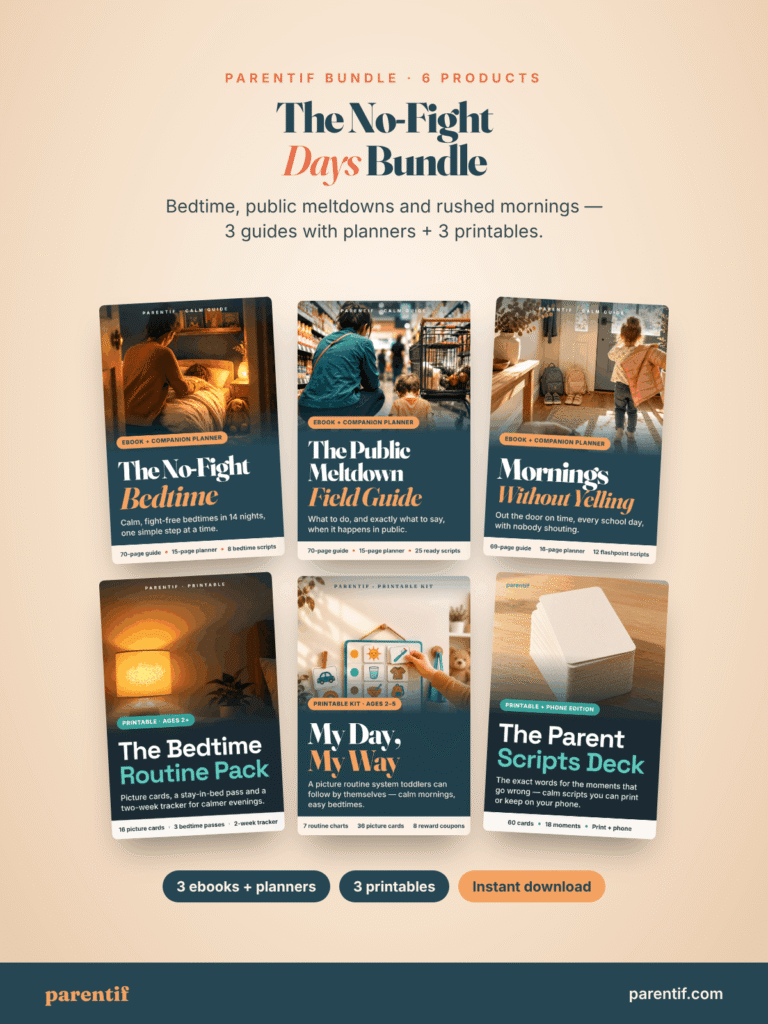
 No-Fight Days Bundle
 Family Organizer Bundle
 Family Table Bundle
 Family Money & Home Bundle
 Family Adventures Bundle
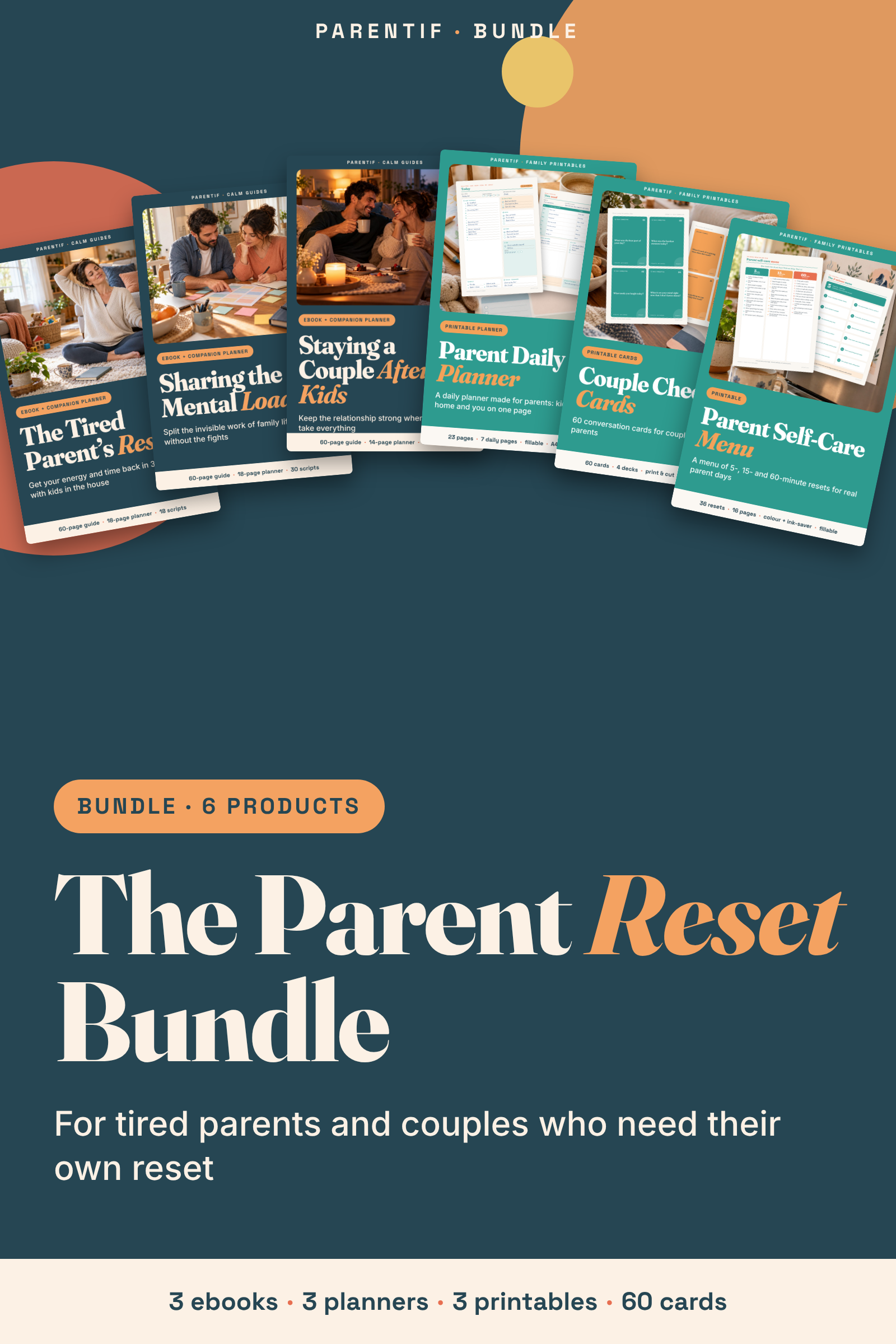 Parent Reset Bundle
 Bump-to-Birth Bundle






Leave a Reply