It’s the fourth time they’ve called you back in. They need water, then a different stuffed animal, then to tell you something urgent about a dinosaur. A predictable toddler bedtime routine is the single most powerful tool you have for ending the nightly negotiation — and it works far better than bribes, threats, or just hoping tonight goes smoother. This article gives you the exact wind-down sequence, the right timing, and how to make it stick when your child keeps moving the goalposts.

My Day, My Way — The Complete Toddler Routine System
6 ready-made picture charts, 36 cut-out cards, a First–Then board, trackers & a parent guide — everything to help your toddler run their own day. 24 pages, instant download.
A toddler bedtime routine is a short, predictable sequence of calming steps done in the same order every night — usually bath, pajamas, teeth, books, then bed. It works by signaling to your child’s brain and body that sleep is coming, which lowers resistance and helps them settle. Keep it to four to six steps, start it 30 to 45 minutes before lights-out, and end in the same place every night so the routine itself becomes the cue for sleep.
Key takeaways
- A consistent toddler bedtime routine works because the repeated sequence itself becomes your child’s cue that sleep is coming — predictability does the heavy lifting, not willpower.
- Start winding down 30 to 45 minutes before lights-out; rushing the routine is the fastest way to wire a tired toddler back up.
- Dim the lights and cut screens at least an hour before bed, because bright light suppresses the body’s sleep signal at exactly the wrong moment.
- Keep the routine to four to six calm steps in the same order, ending in the same spot every single night.
- Plan for the “curtain calls” — the water, the extra hug — by building them into the routine so they can’t be used to stall.
- A picture chart hands the routine to your toddler, turning “go to bed” from a fight into a sequence they follow themselves.
Why your toddler bedtime routine falls apart

If bedtime keeps unraveling, it’s almost never because your toddler is being difficult on purpose — it’s because one of a few predictable forces is working against the wind-down, and each has a clear fix. Spotting which one you’re dealing with is the whole game.
The biggest culprit is overtiredness. It sounds backwards, but a toddler who’s been kept up too long doesn’t get sleepier — they get a second wind. When a child pushes past their natural sleep window, the body releases cortisol and adrenaline, stress hormones that produce a wired, giggly, bouncing-off-the-walls state that looks like energy and is actually exhaustion. An overtired toddler is far harder to settle, takes longer to fall asleep, and wakes more overnight. Most “won’t go to bed” battles are really “missed the window” problems.
The second is a too-stimulating evening. Screens, roughhousing, bright overhead lights, and a chaotic last hour all pour fuel on a brain you’re trying to power down. Screen light in particular tells the body it’s daytime — exactly the wrong message 30 minutes before you want sleep. You can’t slam a toddler from full-throttle play straight into a dark, quiet room and expect a smooth landing.
The third is inconsistency. If bedtime looks different every night — different time, different order, a surprise here and there — your child can’t anticipate what’s coming, and the unpredictability itself breeds resistance. The routine works precisely because it’s the same. Break the pattern and you lose the cue.
The fourth is the control piece, and it’s worth understanding. Bedtime is separation, and separation is hard for a toddler who’d rather stay where the people and the fun are. Stalling — the water, the one more book, the sudden deep questions about death — is often less about any single request and more about a child reaching for control over a transition they don’t want. That’s not manipulation. It’s a developmentally normal bid for autonomy, and the fix is structure, not a power struggle.
Notice the pattern: none of these is solved by being firmer in the moment. They’re solved upstream — by better timing, a calmer runway, and a routine your toddler can predict.
The ideal toddler bedtime routine, step by step

The best bedtime routine is short, calm, and identical every night, moving steadily from active to still so your child’s body has time to downshift — here’s the sequence that works for most families and why the order matters. Adapt the specifics, keep the structure.
Step 1 — The transition signal. Mark the end of the day with a small, consistent cue: tidying up the toys together, turning off the main lights, or a “five more minutes, then bath” warning. This tells your toddler the day is closing before you ask them to stop playing, which heads off the abrupt-stop meltdown.
Step 2 — Bath (or a warm wipe-down). A warm bath is a powerful sleep cue. Beyond getting clean, the slight drop in body temperature afterward actually nudges the body toward sleepiness. Keep it calm — this isn’t the splash-fest hour. On no-bath nights, a warm flannel and the same ritual still works.
Step 3 — Pajamas and teeth. Group these together so it’s one calm stop. Keep a stool at the sink. Let your toddler do as much as they can themselves; independence here builds cooperation.
My Day, My Way — The Complete Toddler Routine System
6 ready-made picture charts, 36 cut-out cards, a First–Then board, trackers & a parent guide — everything to help your toddler run their own day. 24 pages, instant download.
Step 4 — Books in the bedroom. Move into the room where they’ll sleep and read one or two stories in soft light. Books are the bridge between the busy day and the quiet of sleep, and reading together delivers the connection a toddler needs before separating for the night.
Step 5 — Into bed and the goodnight ritual. End the same way every night — a specific phrase, a song, a particular order of “goodnights,” lights out. That closing ritual becomes the final, unmistakable cue. Same words, same order, every night.
The whole sequence should run 20 to 40 minutes. The magic isn’t in any single step — it’s in doing the same calm steps in the same order until your toddler’s body learns to power down on autopilot. Predictability is the active ingredient.
Timing: the 30–45 minute runway

Bedtime is won or lost on timing, and the two numbers that matter most are when you start the routine and how much total sleep your child actually needs — get these wrong and the best routine in the world won’t save you. Most toddlers need a wind-down runway of 30 to 45 minutes, started before they hit the overtired wall.
Work backwards from your target lights-out. The American Academy of Sleep Medicine, endorsed by the American Academy of Pediatrics, puts toddler sleep needs at roughly 11 to 14 hours per 24 hours (ages one to two) and 10 to 13 hours (ages three to five), including naps. Use that to set a realistic bedtime, then start the routine 30 to 45 minutes ahead. Light is your other lever: dim the lights and switch off screens at least an hour before lights-out, because bright and blue light suppress the body’s natural sleep signal.
Here’s a sample runway for an 7:30pm lights-out:
| Time | Step | Why it’s here |
|---|---|---|
| 6:45pm | Dinner done, screens off, lights dimmed | Removes the daytime “stay awake” signals |
| 6:55pm | Tidy-up / transition cue | Closes the day before you ask them to stop |
| 7:00pm | Bath | Warm-then-cool nudges sleepiness |
| 7:15pm | Pajamas + teeth | One calm bathroom stop |
| 7:20pm | Books in the bedroom | Connection + the bridge to sleep |
| 7:30pm | Into bed, goodnight ritual, lights out | The final, repeated sleep cue |
Adjust the clock to your family, but hold the gaps. The single most common timing mistake is starting too late and then trying to rush a tired, dysregulated toddler through the steps — which backfires every time.
The room itself matters as much as the clock. Three quiet adjustments make the biggest difference: get it properly dark (the kind of dark where you couldn’t read a book), since even a dim glow can keep a toddler on the fence; add a fan or white-noise machine to flatten out the doorbell, the dog, and the older sibling; and nudge the temperature a touch cool, because bodies settle better slightly cold than slightly warm. None of this is fancy — it’s just removing the small frictions that give a restless toddler something to fixate on instead of sleeping. A comfort object like a lovey, once your child is old enough for one in the cot, gives them a portable, consistent cue they can hold onto when you leave the room.
Turning it into a bedtime chart
A routine sticks when your toddler can follow it without you narrating every step, and the tool that makes that happen is a picture chart — a visual schedule showing each step as an image your pre-reader can read at a glance. It moves the prompting off your voice and onto the wall.
My Day, My Way — The Complete Toddler Routine System
6 ready-made picture charts, 36 cut-out cards, a First–Then board, trackers & a parent guide — everything to help your toddler run their own day. 24 pages, instant download.
It works for a concrete reason: your toddler can’t tell time or read words, but they can follow a row of pictures they’ve memorized. The chart turns “come on, it’s bedtime” into “look — bath is next, then pajamas, then two books.” Instead of being the voice nagging them toward bed, you become the calm person who points and asks, “What’s next on your chart?” That shift — from enforcer to teammate — is exactly why a chart outperforms reminders.
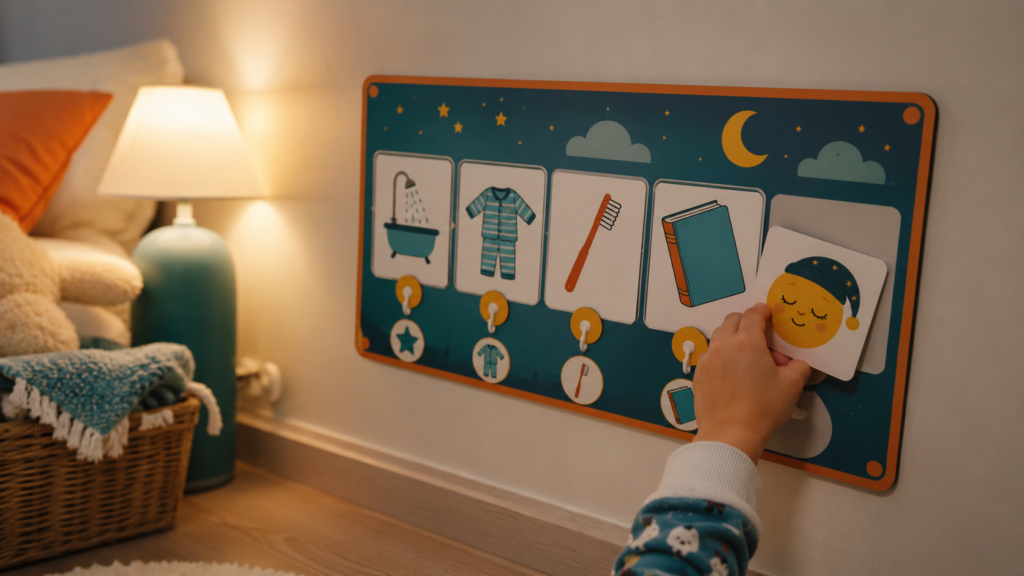
Keep it to four to six picture steps. Use real photos where you can, hang it in the bedroom or bathroom at your child’s eye level, and make it interactive — let them flip a card or move a clip as each step is done, because that small “I finished that” is what keeps them engaged night after night. You can build one yourself or use a ready-made printable; the point is getting a clear, picture-based sequence onto the wall so your toddler can help drive their own bedtime.
Handling stalling and the “just one more” trap

The curtain calls — water, another hug, one more book, a sudden urgent thought — are the part that breaks most parents, and the fix isn’t to fight each request but to remove their power as stalling tools. Structure beats whack-a-mole.
Start by building the predictable requests into the routine itself. If your toddler always wants water, put a cup by the bed as a step. If they always want one more cuddle, make the goodnight cuddle an official part of the ritual. When the things they’d stall with are already handled, there’s nothing left to negotiate. A “bedtime pass” works well for older toddlers — one token good for a single get-out request (a hug, a sip), after which it’s spent for the night. It gives a small sense of control inside a firm boundary.
My Day, My Way — The Complete Toddler Routine System
6 ready-made picture charts, 36 cut-out cards, a First–Then board, trackers & a parent guide — everything to help your toddler run their own day. 24 pages, instant download.
For the child who keeps reappearing or calling out, your response is the lever. The goal is to make leaving the bed boring. Walk them back calmly, with minimal talking, light, or eye contact, and the same short phrase every time — “it’s sleep time now, back to bed.” A long discussion, a frustrated reaction, or a negotiation all reward the re-emergence and guarantee it happens again tomorrow. Calm, dull, and consistent is what teaches a toddler that bedtime isn’t a venue for more attention. It feels repetitive on night one. By night five or six, the call-backs usually fade.
Common mistakes parents make at bedtime
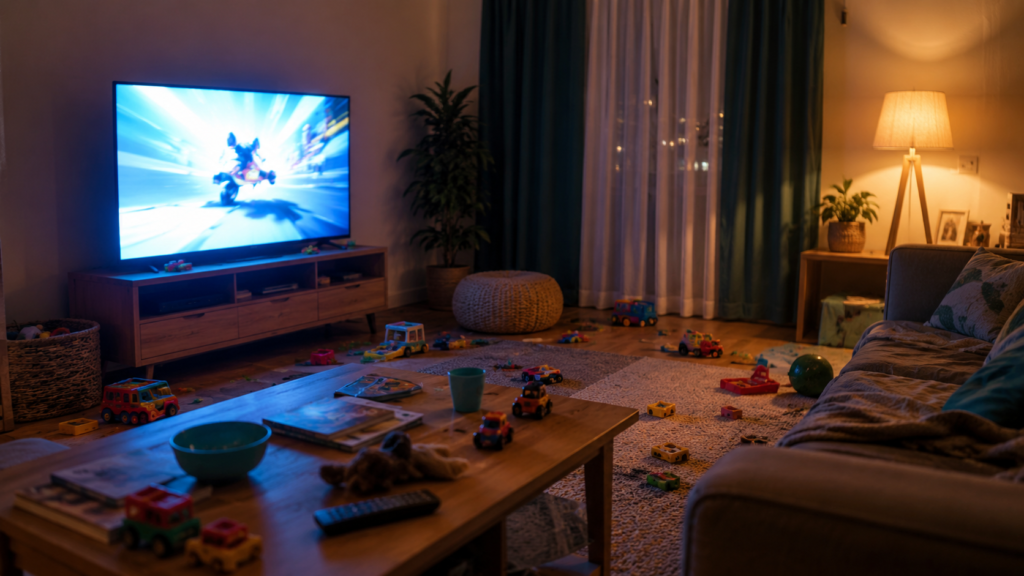
These are the errors that quietly sabotage bedtime even when you’re doing most things right.
Starting the routine too late. Waiting until your toddler is yawning and rubbing their eyes means you’ve already missed the window — they’re tipping into the overtired second wind, and the routine now has to fight stress hormones. Start the wind-down before the meltdown, not after the first yawn. An earlier, calmer start usually means a faster, easier bedtime.
Leaving screens and bright lights on until the last minute. A show “to calm them down” before bed does the opposite — the light and stimulation wind them up and delay sleep. Cut screens and dim the lights at least an hour out. The drop in light is part of the cue; skip it and the routine has to work twice as hard.
Making the routine long and elaborate. A 45-minute production with five books, three songs, and a tour of the house is impossible to keep consistent and easy for a toddler to stall inside of. Shorter and repeatable beats lovely and unsustainable. Pick four to six steps you can actually do every night, including the rough ones.
Reacting with energy to call-backs. Responding to the fifth “I need water” with a sigh, a lecture, or a negotiation hands your toddler a jackpot of attention, which cements the behavior. The most powerful response is a flat, boring, identical one every time. Save your warmth for the routine itself, not the re-emergences.
Changing it up on weekends. Running a totally different, looser bedtime on Friday and Saturday breaks the pattern your child relies on, and Sunday night becomes a fresh battle. Keep the same anchors — bath, books, bed — even when the timing slides a little. Consistency across all seven nights is what makes the routine stick.
FAQ
What time should a toddler go to bed? Most toddlers do well with a bedtime between 7 and 8pm, though the right time depends on when they wake and how much sleep they need — roughly 11 to 14 hours across 24 hours for ages one to two, and 10 to 13 for ages three to five, naps included. Work backwards from your child’s natural wake time. If bedtime battles are constant, an earlier bedtime often helps, since overtiredness makes settling harder.

How long should a toddler bedtime routine take? Aim for 20 to 40 minutes from the first wind-down step to lights-out, plus dimming the lights and cutting screens about an hour before. Longer than 40 minutes and the routine becomes hard to keep consistent and easy to stall inside of. Shorter than 20 and your toddler may not have enough runway to downshift. Pick a length you can repeat every single night, including the hard ones.
In what order should a bedtime routine go? A reliable order moves from active to calm: transition cue, bath, pajamas and teeth, books in the bedroom, then into bed with a goodnight ritual. The specific order matters less than keeping it identical every night, because the repetition is what becomes the sleep cue. End in the same place every time — usually in bed with the same phrase or song — so the close of the routine signals that sleep is here.
Why does my toddler fight bedtime? Usually one of three things: they’re overtired and running on a stress-hormone second wind, the evening was too stimulating, or they’re reaching for control over a separation they don’t want. Bedtime means leaving the people and the fun, so stalling is often a normal bid for autonomy rather than defiance. Start the routine earlier, keep the last hour calm and screen-free, and build their usual requests into the routine.
Should I lie down with my toddler until they fall asleep? It’s not “wrong,” but if your child can only fall asleep with you there, they’ll often need you again during normal night wakings, which can mean more disrupted nights for everyone. If you want to change it, do it gradually — sit beside the bed, then move a little farther away every few nights until you’re saying goodnight and leaving. Go at a pace your child can handle, and stay calm and consistent.
How do I stop my toddler getting out of bed? Make getting out boring and predictable. Walk them back calmly every single time with the same short phrase, minimal talking, and low light — no lectures, no negotiation, no big reaction. Build their common requests (water, a last hug) into the routine so there’s nothing to get up for. A “bedtime pass” good for one request can help older toddlers. It feels repetitive at first, but consistency usually settles it within a week.
The bottom line
The fastest way to fix a chaotic bedtime is to stop improvising and build a calm, predictable toddler bedtime routine your child can follow on their own — then protect the timing so you start before the overtired wall, not after it. Pick your four to six steps, dim the lights, put the sequence on the wall, and respond to the curtain calls with calm, boring consistency. Give it a full week before you judge it, and watch how much shorter bedtime gets once the routine becomes the cue.