A Christmas budget with kids works when you decide one total number before the first ad, the first wish list and the first “just this once.” Then you split that number into a few simple buckets, give each child a calm gift rule, and fill the rest of December with traditions that cost little or nothing. This guide walks you through the whole plan in five steps, with scripts for talking to kids about money and a 5-minute weekly check that keeps it on track.
Quick answer
To set a Christmas budget with kids, pick one total you can pay without debt, split it into six buckets (kids’ gifts, other gifts, food, travel, traditions and a 10% buffer), use a fixed gift rule per child such as want, need, wear, read, and tell kids early that “our family has a holiday budget.”
Why a Christmas budget with kids feels so hard
December pulls on your money from every side at once. Kids see toy ads and classmates’ lists. Relatives ask what to buy. School asks for teacher gifts, class parties and pajama days. Food, travel and hosting add up quietly in the background. Without a plan, most of these costs are decided one by one, in a tired moment, and the total only shows up in January.
A budget is not about saying no to everything. It is about deciding once, calmly, so you do not have to decide fifty times when you are stressed. Kids do better with that too: a clear plan means fewer surprises, fewer “but you said maybe” moments and a calmer Christmas morning.
Step 1: Pick one total number first
Start with the total, not with the gift list. A list always grows to fill the money; a total keeps the list honest. To find your number:
- Look at what you spent last December (bank and card statements are the most honest record).
- Check what you can pay from savings or this month’s income without carrying a balance into the new year.
- Pick the smaller of the two, round it down, and write it somewhere you will see it (the fridge, your phone lock screen).
If the number feels small, that is fine. A calm Christmas is built on rhythm and attention, not on the size of the pile under the tree. Children remember the rituals, the games and how relaxed the grown-ups were far more than the price tags.
Step 2: Split the total into 6 buckets
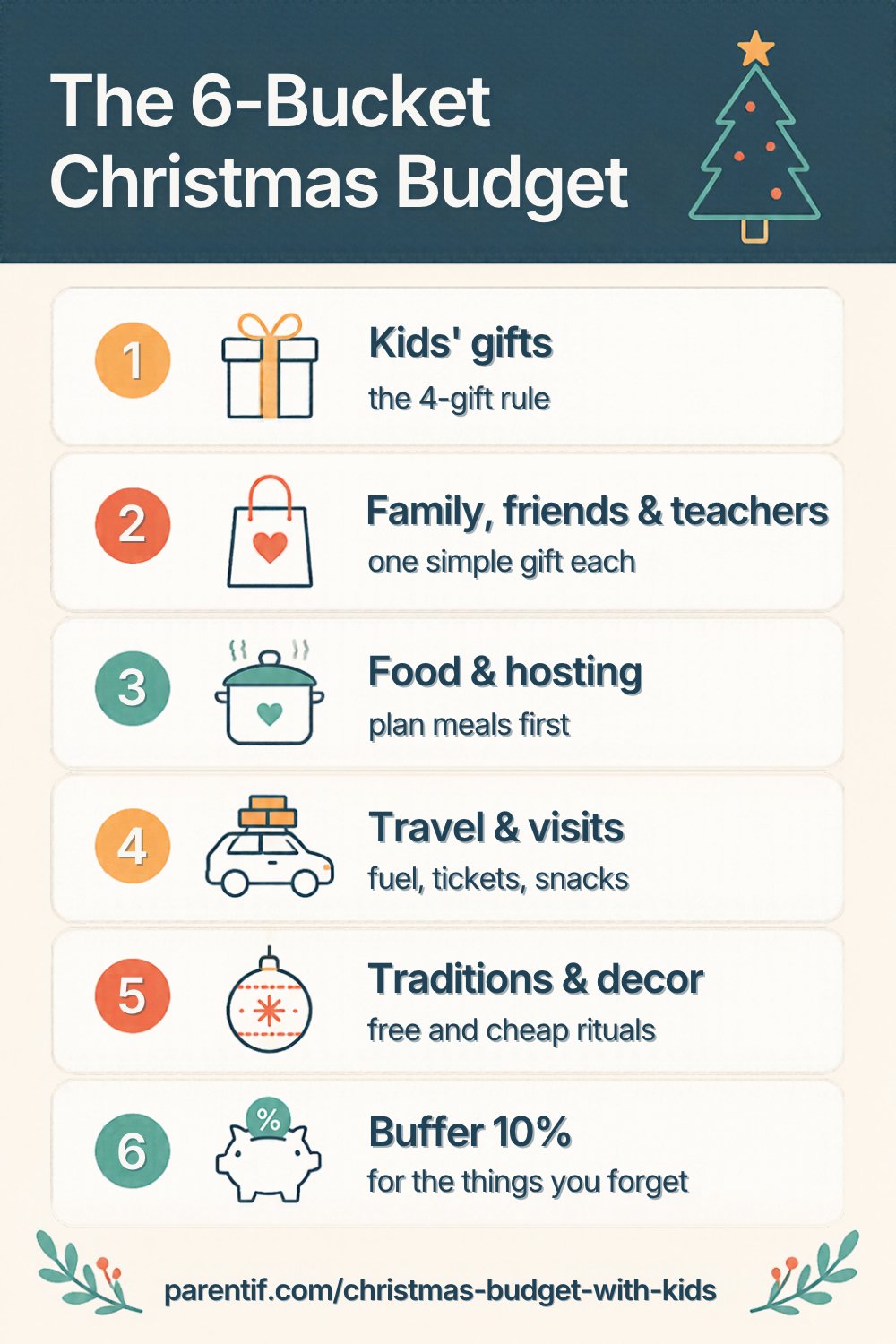
Next, split the total into six buckets. Buckets stop one category from quietly eating the others, which is what usually happens with food and last-minute gifts. Here is an example split for a $600 Christmas budget; change the numbers to fit your family.
| Bucket | What it covers | Example share | Example on $600 |
|---|---|---|---|
| Kids’ gifts | Gifts and stockings for your own children | 35% | $210 |
| Other gifts | Grandparents, siblings, teachers, friends, gift swaps | 15% | $90 |
| Food & hosting | Holiday meals, treats, guests, party contributions | 20% | $120 |
| Travel & visits | Fuel, tickets, snacks for the road, small hotel costs | 10% | $60 |
| Traditions & decor | Advent, crafts, outings, wrapping, tree | 10% | $60 |
| Buffer | The things you forget (batteries, a class party, a broken light string) | 10% | $60 |
The buffer is the bucket most families skip, and it is the one that saves the budget. Something always comes up in December. When it does, it comes out of the buffer instead of out of January.
Step 3: Give each child a calm gift rule
Most of the money and most of the stress sit in kids’ gifts, so give them a simple rule. A rule decides how many before you think about which, and it makes things fair between siblings without matching every dollar.
- The 4-gift rule: something they want, something they need, something to wear, something to read.
- One big, two small: one gift they really hoped for, plus two small ones.
- Per-child cap: the same amount per child, spent however fits each child best.
- Experience gift: one gift is a day out, a class or a special outing instead of a toy.
Whichever rule you pick, write it down and share it with your partner before shopping. For ideas on numbers and fairness between siblings, see our guide on how many gifts a child should get, and for toy-free gifts try our list of experience gifts for kids.
Stockings without the creep
Stockings are where budgets leak, one “only a few dollars” item at a time. Give stockings their own small amount inside the kids’ bucket, and fill them with useful or consumable things: a toothbrush in a fun colour, socks, a small book, stickers, a favourite snack, bath crayons. Toddlers love unwrapping more than the item itself.
Step 4: Fill December with cheap traditions
Traditions are the part of Christmas kids talk about years later, and most of them cost almost nothing. Plan a few on purpose, so the season feels full even when the gift pile is small:
- A lights walk or drive after dinner, with hot cocoa in a flask.
- An activity advent calendar: one small moment a day instead of one small toy a day.
- Baking or decorating simple cookies together, then giving a plate to a neighbour.
- A pajama movie night with a blanket fort.
- Making paper snowflakes and paper-chain countdowns.
- Free community events: library story times, carol evenings, tree lightings.
- Writing or drawing cards for grandparents.
- A “give one, keep one” toy sort before Christmas.
- A family walk on Christmas Eve morning to burn off the excitement.
- Reading the same Christmas book every year on the same night.
For a ready-made daily plan, our advent calendar ideas for toddlers include 40 no-candy fillers, and you can grab the free printable advent slips below.
24 Calm Advent Slips for Toddlers
One small, screen-free moment a day until the big day. No candy, no shopping.
- 24 cut-and-fold activity slips
- Ages 1–4, ready to print tonight
- A calm December checklist
We email you the download link. Free, no payment details.
Step 5: Talk to kids about the budget
You do not need to share numbers with young children, but you can share the idea. Kids feel safer when they know there is a plan, and it teaches them that money is something families decide about together. Keep it short, warm and matter-of-fact.
| Age | What to say | What it teaches |
|---|---|---|
| 2–4 years | “We’re choosing a few special gifts this year. Which one would make you happiest?” | Choosing, not everything |
| 5–7 years | “Our family has a Christmas budget. That means we pick what matters most.” | Budgets are normal |
| 8–12 years | “Here’s the amount for your gifts. Want to help me plan how to use it?” | Trade-offs and planning |
When a child asks for something outside the plan, stay calm and kind: “That looks fun. It’s not in this year’s plan, but let’s add it to your wish list for your birthday.” For older kids, the CFPB’s Money as You Grow has simple money ideas by age.
Grandparents, relatives and gift swaps
Other people’s gifts can double the pile in your living room, and gift swaps can double your “other gifts” bucket. A few calm moves help:
- Suggest a family gift swap with one name each and a set amount, instead of everyone buying for everyone.
- Share a short wish list for each child, including experiences and things they need.
- For teachers, a card your child made plus a small useful item is plenty.
- If toys pile up, try a kind script from our guide on how to tell grandparents no more toys.
Track it with a 5-minute weekly check
A budget only works if you look at it. Once a week in December, take five minutes: write what you spent in each bucket, move money from the buffer if something ran over, and cross off what is done. When a bucket is empty, it is empty. That one rule keeps the whole plan honest.
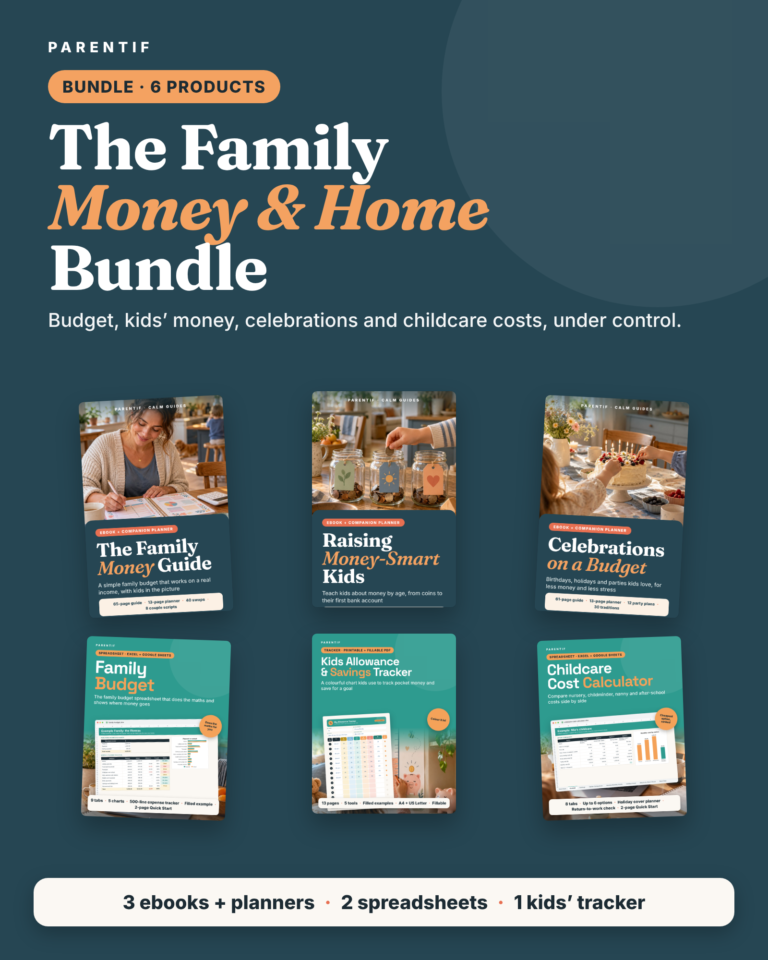
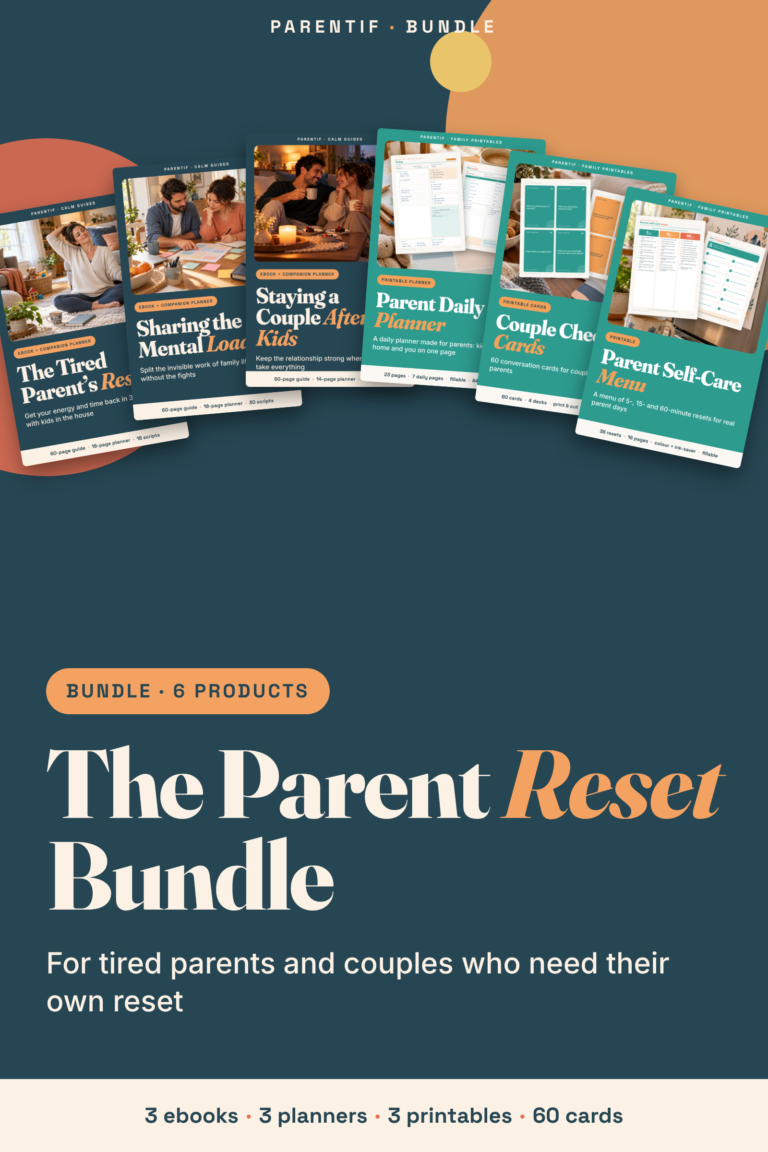
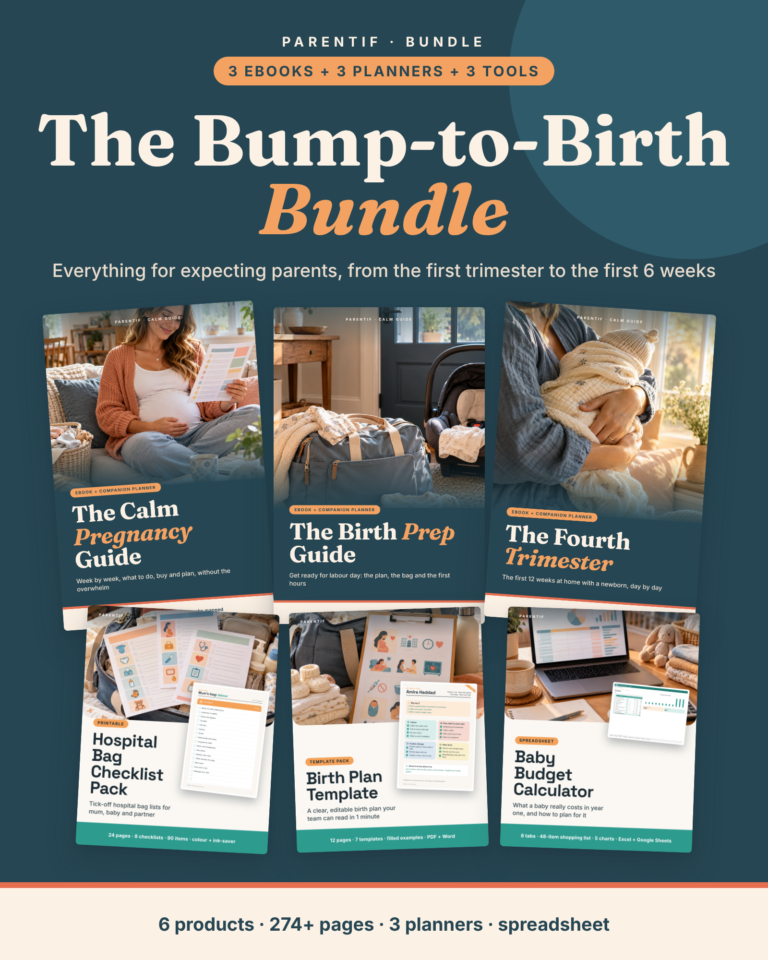
If you like a ready plan, our Celebrations on a Budget ebook and companion planner walk you through a yearly celebration budget, fewer-but-better gifts and traditions that cost nothing, and the Family Money & Home Bundle adds the full family money system for the year ahead. For the whole season in one place, see our calm holiday plan for families with toddlers.
Common Christmas budget mistakes
- Starting with the list. The list grows. Start with the total.
- No buffer. Something always comes up. Plan for it.
- Buying early, then again later. Early deals help only if you stop when the bucket is full.
- Matching siblings dollar for dollar. Match the rule, not the receipt.
- Forgetting food. Meals and treats often cost as much as gifts.
- Shopping tired. Late-night scrolling is where most extra spending happens.
Christmas budget with kids: FAQ
How much should I spend on Christmas for my kids?
There is no right number. Spend what you can pay without debt, then split it fairly between your children with a simple rule such as want, need, wear, read. A smaller budget with calm traditions often feels better to kids than a big pile and stressed parents.
How do I make Christmas fair between siblings?
Match the rule, not the price. Give each child the same number of gifts or the same per-child cap, and let the actual gifts fit each child. Older kids usually understand that some gifts cost more than others.
Should I tell my kids we are on a budget?
Yes, in simple words for their age. “Our family has a holiday budget, so we choose what matters most” helps kids feel safe and teaches that budgets are a normal part of family life.
What are cheap Christmas traditions for families?
Lights walks, baking together, a pajama movie night, paper crafts, an activity advent calendar, library events and drawing cards for grandparents all cost very little and are often what kids remember most.
How do I stop relatives from overspending on my kids?
Share a short wish list early, suggest experience gifts, or propose a family gift swap with one name each and a set amount. Kind, early messages work better than asking at the last minute.
When should I start a Christmas budget?
As early as you can, but it is never too late. Even in December, setting a total and six buckets today stops most of the extra spending that usually happens in the last two weeks.
General information, not financial or medical advice. Talk to your pediatrician, midwife or doctor about your child.






Leave a Reply