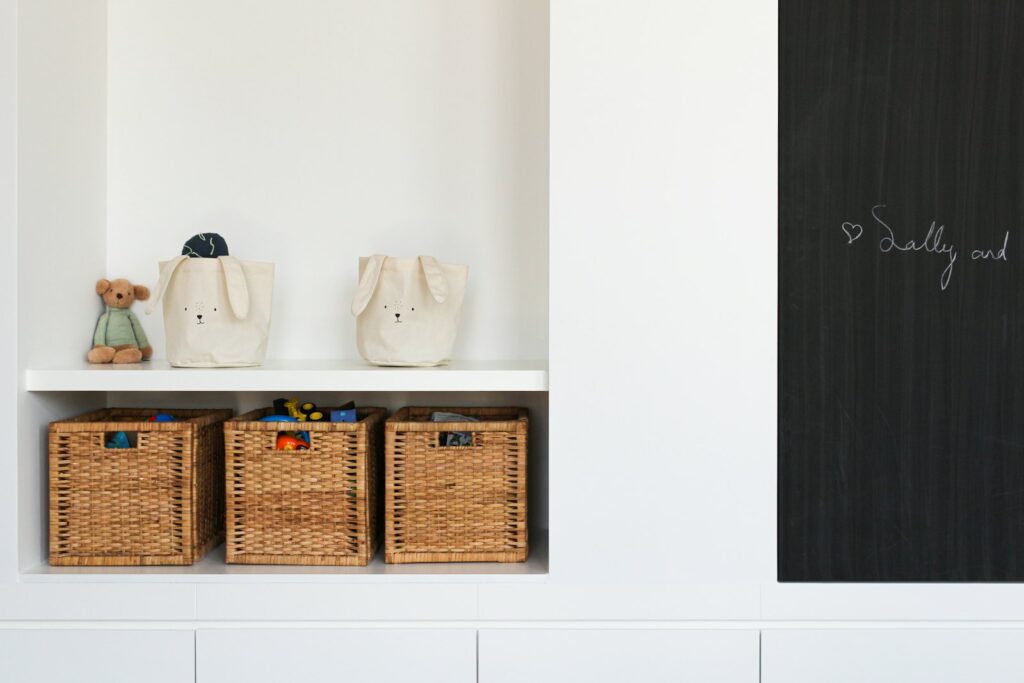
Toy rotation for toddlers means keeping only a small set of toys out and storing the rest, then swapping them on a simple schedule. If your living room floor is covered by 7 PM and your child still says there’s nothing to play with, this is usually why. Below you’ll get the exact number of toys to leave out by age, a 4-bin system you can set up in 20 minutes, what to say when your toddler asks for a stored toy, and how to keep it going without it becoming one more chore.
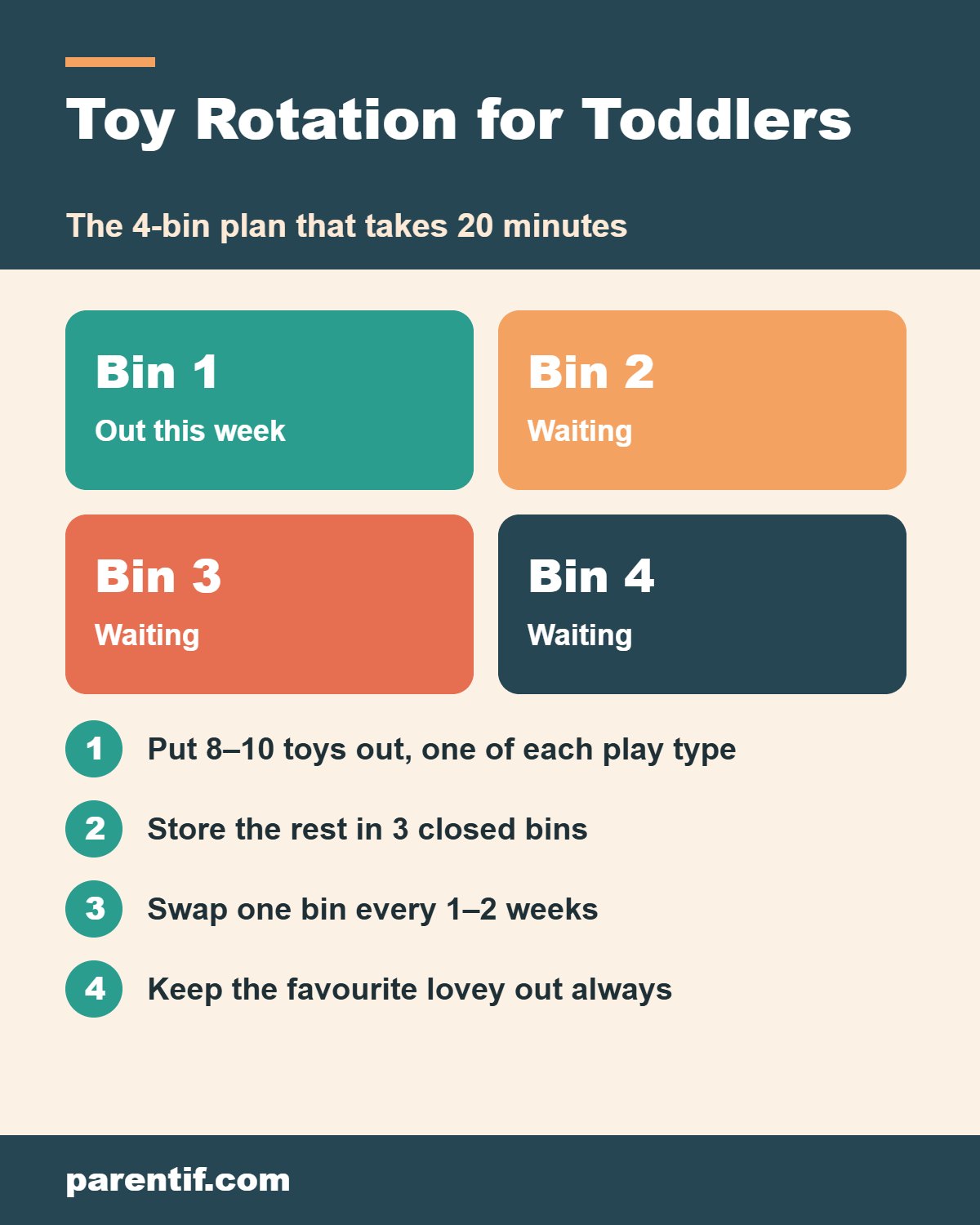
- Start with 6–10 toys out for a 2-year-old and store everything else in 3 or 4 closed bins.
- Pick toys by type of play (build, pretend, move, create, puzzle, book), not by favourite brand.
- Swap one bin every 1–2 weeks, or sooner when play drops off for three days in a row.
- Never rotate out a comfort item or a toy your child is deep into right now.
- Do the swap after bedtime, so the shelf looks new in the morning.
- Check every stored toy for loose or small parts before it comes back out.
Why Toy Rotation for Toddlers Works (and What the Research Actually Says)
This section covers why fewer toys tends to mean better play, and how far the evidence really goes. Picture the floor at 5 PM: a bin tipped over, three cars, half a puzzle, a doll with no shoe, and a toddler wandering between them touching each one for four seconds. That’s not a child who has too little to do. It’s a child with too much to choose from.
The study most parents hear about came from the University of Toledo and was published in Infant Behavior and Development. Researchers watched 36 toddlers aged 18 to 30 months play in two set-ups: one with 4 toys and one with 16. With 4 toys, the children played with each toy for longer and found more different ways to use it. That’s one small study in a lab room, so treat it as a strong hint, not a law. Still, it matches what most parents see at home within a week of trying it.

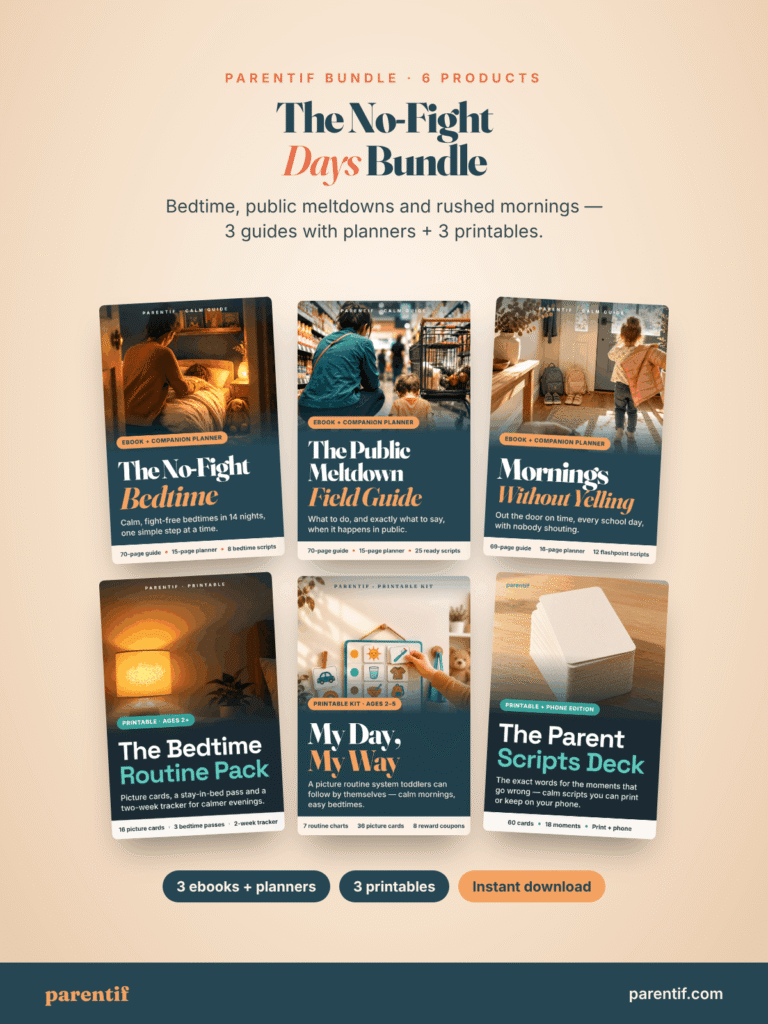
Mornings Without Yelling
Out the door on time, every school day, with nobody shouting.
Instant download · Digital download · All sales finalThere are three everyday reasons it works. A toy that has been away for two weeks feels new again, so you get the excitement of a new toy for free. A small set is easy to see, so your toddler can choose without getting stuck. And a shelf with eight things on it takes five minutes to tidy, which matters more than any of the rest at the end of a long day.
How Many Toys to Leave Out at Each Age
This section gives you a starting number, because “a few toys” isn’t something you can act on. The numbers below are an editorial rule of thumb from what works in real homes, not a developmental target. Start in the middle of the range and adjust after a week.
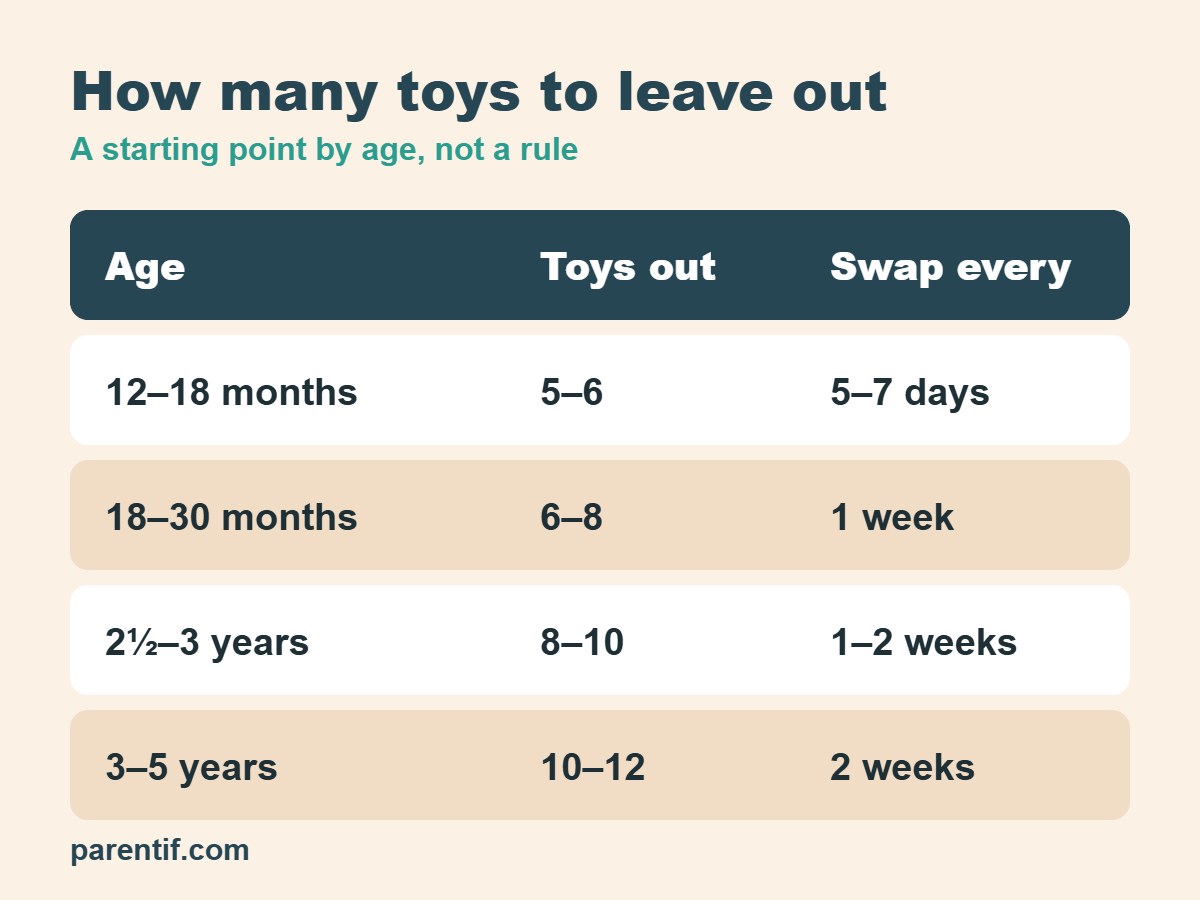
Count a set as one toy. A basket of blocks is one toy. A train track with its trains is one toy. A box of 40 loose animals is not one toy, it’s a mess waiting to happen: split it and put out 8 of them.
Books sit outside the count. Keep 5 or 6 books out in a basket and rotate them on their own schedule. And if you also run a visual schedule for your toddler, add a picture for “play time” so the shelf becomes part of the day, not a free-for-all.
The 4-Bin System: Set Up Toy Rotation in 20 Minutes
This section is the setup, step by step. Do it in one evening after bedtime with a laundry basket and four boxes. Don’t sort the whole house. Start with the main play area only.
Clearing out the rest of the house is a separate job. If the shelf is fine but the bedroom and the car are still drowning, start with our guide on how to declutter toys before you rotate.
A Sample Toy Rotation for a 2-Year-Old (Copy This)
This section shows what four real bins can look like, so you’re not staring at a pile wondering what goes where. It’s built for a typical 2-year-old with an average amount of toys. Swap the names for what you actually own; keep the mix of play types.
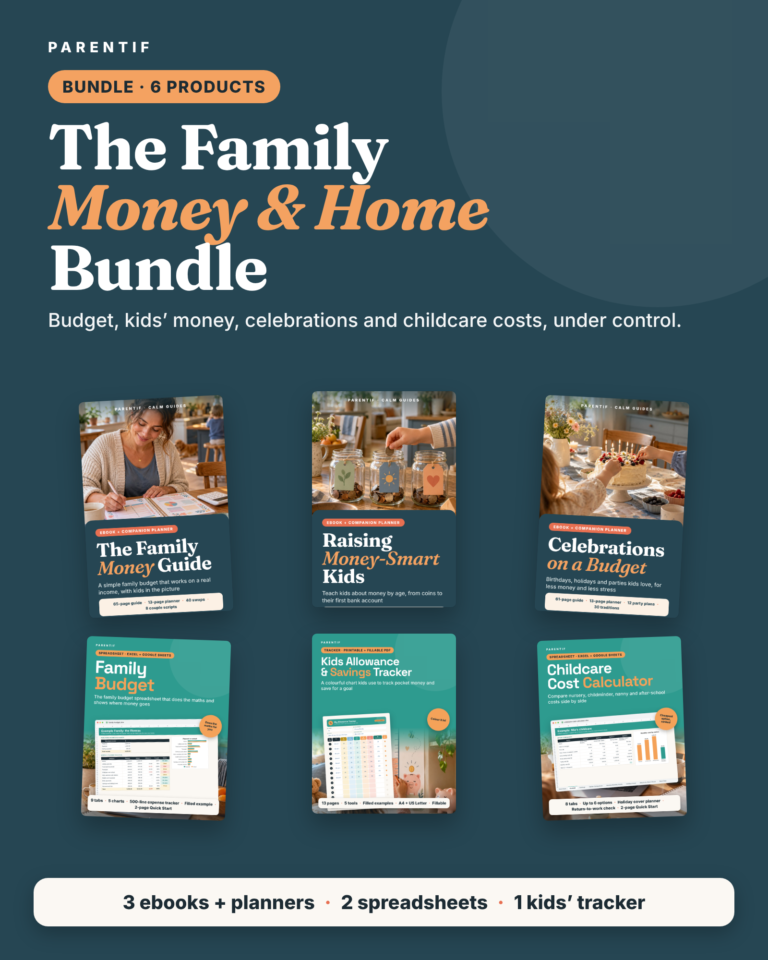
The Family Money & Home Bundle
The family budget, the kids' money, celebrations and childcare costs, under control.

| Play type | Bin 1 | Bin 2 | Bin 3 | Bin 4 |
|---|---|---|---|---|
| Build | Wooden blocks | Big interlocking bricks | Stacking cups | Large soft blocks |
| Pretend | Play kitchen + 4 foods | Doll + blanket | Farm animals (8) | Toy phone + bag |
| Move | Soft ball | Push car | Bean bags | Pull-along toy |
| Puzzle | Shape sorter | 3-piece knob puzzle | Nesting boxes | Chunky peg board |
| Create | Chunky crayons | Play dough + roller | Stickers + paper | Water-painting pad |
| Vehicles | 3 cars | Train + short track | Dump truck | Bus with people |
That’s six toys per bin, which suits most 2-year-olds. Add the book basket and the comfort toy on top, and the shelf holds eight things. A month later, Bin 1 comes back and feels new.
Two details make this work. First, each bin has something for a busy day (the ball, the push car) and something for a quiet one (the puzzle, the crayons). Second, nothing in a bin needs you to sit and run it. If a toy only works with an adult, like a board game, keep it on a high shelf for together time instead.
If your toddler goes to daycare or spends days with grandparents, you don’t need to match their toys. Children are used to different things in different places. Just keep the home shelf small, so the end of the day doesn’t start with a mess.
What to Keep Out All the Time
This section covers what never goes in a bin. Toy rotation for toddlers fails fast when it takes away the things a child uses to feel safe. Some toys are tools, not entertainment.
- Comfort items: the lovey, the blanket, the bedtime bunny. They stay wherever your child wants them.
- Current obsessions: if your child has played with the garbage truck every day this week, it stays out. Rotate it when the interest fades on its own.
- Art basics: a few crayons and paper, if your child can use them without drawing on the walls yet.
- Outdoor and bath toys: these live where they’re used and don’t count.
- A ball: one soft ball is always worth having out for the 5 PM wobble.
Late afternoon is when the shelf earns its keep. If your evenings fall apart around dinner, read our guide to the toddler witching hour and put a “quiet bin” of two calm toys out only from 4 PM.
What to Say When Your Toddler Asks for a Stored Toy
This section gives you the words, because the first week your toddler will ask for the dinosaur that’s in Bin 3. That’s fine. A rotation isn’t a punishment and the toy isn’t gone. You can say yes, as long as something else goes back.
This one-in, one-out rule keeps the number of toys out steady without a fight. Most toddlers love choosing what “goes to sleep”. If your child is two and can’t make the choice yet, offer two: “The car or the ball?”
If sharing is the bigger issue, especially with a sibling or a visiting cousin, see how to teach toddlers to share: a shelf of eight toys is much easier to take turns with than a room of eighty.
How Often to Rotate Toys (and the Signs It’s Time)
This section helps you decide when to swap without following a rigid calendar. The schedule in the table is a default. Your child’s behaviour is the better guide.
| What you see | What to do |
|---|---|
| Toys untouched for 3 days in a row | Swap that toy now, not the whole bin |
| More throwing and dumping than playing | Take 2 toys off the shelf |
| “I’m bored” every afternoon | Swap the whole bin tonight |
| One toy played with for an hour | Leave it out and add one related item |
| New sibling, move or holiday | Pause swaps for 2 weeks: familiar toys help |
Big changes deserve a pause. During a move, a new baby or a new daycare, keep the shelf the same. Familiar toys are one of the few things your child can control. Our guide on how long it takes a toddler to adjust to a new routine explains why.
Toy Rotation for Toddlers in Small Spaces
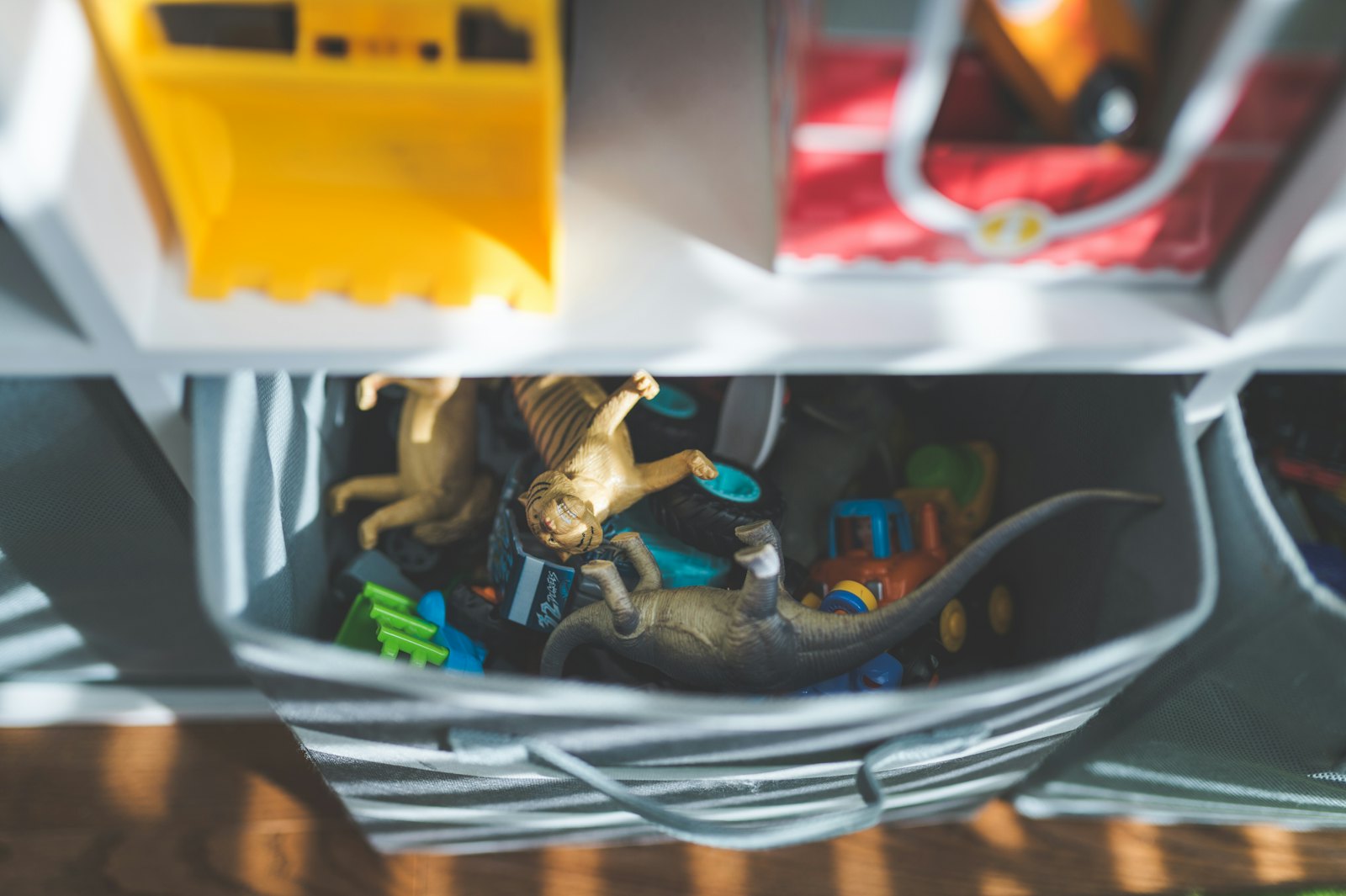
This section is for apartments and homes with no playroom. You don’t need a dedicated room or a Montessori shelf. You need one low surface and one hidden place.
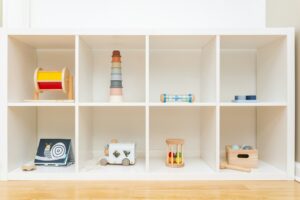
- Low surface: the bottom shelf of a bookcase, a TV unit, a sturdy crate on its side, or a tray on the floor.
- Hidden place: under the bed in flat boxes, the top of a wardrobe, a suitcase you don’t use, or the car boot (trunk).
- Use 3 bins, not 4: with less storage, keep the cycle shorter and swap weekly.
- Go vertical: a hanging shoe organiser holds small toys, finger puppets or cars in a way your toddler can see.
Holidays and birthdays are where small spaces get overwhelmed. Put new gifts straight into the bins and let them come out one at a time. If the gift pile is the real problem, our guides on how many gifts a child should get and how to tell grandparents no more toys give you the words for family.
Keep Stored Toys Safe Before They Come Back Out
This section covers the safety check that most rotation guides skip. A toy that sat in a box for a month can come back with a loose wheel or a missing eye. The American Academy of Pediatrics advises keeping all toys and parts larger than your child’s mouth and checking for button batteries and magnets: see its guide on how to buy safe toys.
☐ Battery covers still screwed shut
☐ No small pieces from an older sibling’s set mixed in
☐ Stuffed toys washed if they were stored damp
☐ Anything broken goes in the bin, not back on the shelf
Common Mistakes That Make Toy Rotation Fail
These are the mistakes parents make even after they understand the basics.
1. Putting out too many toys “just this once”
The shelf creeps from 8 toys to 20 in a month. Every time you add one, take one off. If the floor is messy again by lunch, count the shelf: it’s almost always too full.
2. Rotating by colour or brand instead of play type
A shelf of six vehicles gives your child one kind of play. Mix types: one build, one pretend, one move, one create, one puzzle. Variety in type is what makes eight toys feel like plenty.
3. Storing the bins where your toddler can see them
Clear boxes at toddler height turn into a daily negotiation. Use opaque bins or put them up high. Out of sight really is out of mind at two.
4. Doing the swap in front of your child
Swapping while they watch invites a battle over every toy. Do it after bedtime. In the morning, the shelf just looks fresh.
5. Treating the schedule as a rule
If a toy is in heavy use, it stays. If the whole bin is ignored, swap early. The point is engaged play, not a perfect calendar.
Toy Rotation for Toddlers: FAQ
How many toys should a toddler have out at once?
A good start is 6 to 8 toys for children aged 18 to 30 months and 8 to 10 for 2½ to 3 years. Count a set, like a basket of blocks, as one toy. Keep comfort items and current favourites out on top of that number. If the floor is covered within an hour, take two toys away; if play drops off, add one.
How often should you rotate toddler toys?
Every one to two weeks works for most families. Younger toddlers often need a swap every 5 to 7 days, while 3- to 5-year-olds may happily play with the same set for two weeks. Watch the signs instead of the date: three days of ignored toys or constant dumping means it’s time to swap.
What age should you start toy rotation?
You can start as soon as your baby has more toys than fit on a small mat, often around 6 to 12 months. It becomes most useful between 18 months and 3 years, when toddlers dump bins and move quickly between toys. Older children can keep rotating, and enjoy choosing what comes out.
Is toy rotation Montessori?
Toy rotation fits Montessori ideas, which favour a few toys arranged on low, open shelves with space around each one. But you don’t need Montessori materials, wooden toys or a special room. Any toys and any low surface will work. The core of it is simply fewer toys in view at one time.
Where do you store toys for toy rotation?
Store the waiting toys in closed, opaque bins out of your toddler’s sight and reach: a high closet shelf, under a bed, in the garage or in a wardrobe. Label each bin with a number. Keeping them hidden matters, because toddlers who can see a stored toy usually ask for it all day.
What if my toddler gets upset when toys are rotated?
Swap after bedtime so the change isn’t a fight, and leave any favourite or comfort item out. If a toy is asked for, use one-in, one-out: the toy comes back and another one goes to rest. For a sensitive child, swap half a bin at a time and keep big changes to calm weeks.
The Bottom Line
Fewer toys in view, swapped on a calm schedule, is the whole idea, and toy rotation for toddlers costs nothing but four boxes and one evening. Set up Bin 1 tonight, keep the lovey out, and swap next weekend. For more help by problem, browse Parenting Solutions or the Play & Learning Activities articles.
Sources: Dauch C, Imwalle M, Ocasio B, Metz AE. The influence of the number of toys in the environment on toddlers’ play. Infant Behavior and Development, via ScienceDirect. American Academy of Pediatrics, How to Buy Safe Toys (HealthyChildren.org).
Calm help for the hard parts of family life
Seven bundles of guides, planners and printables. Six products each, $37 per bundle.
 No-Fight Days Bundle
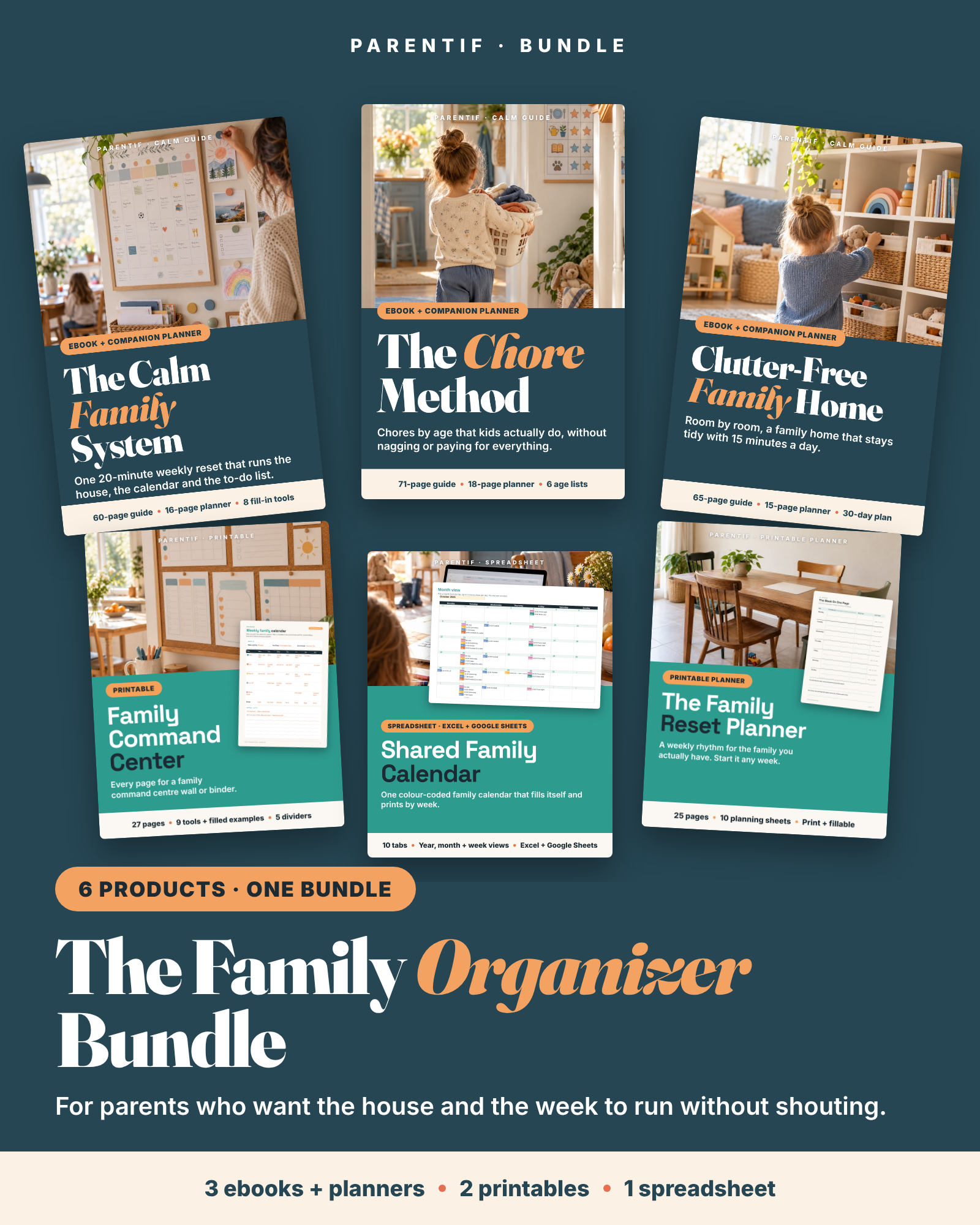 Family Organizer Bundle
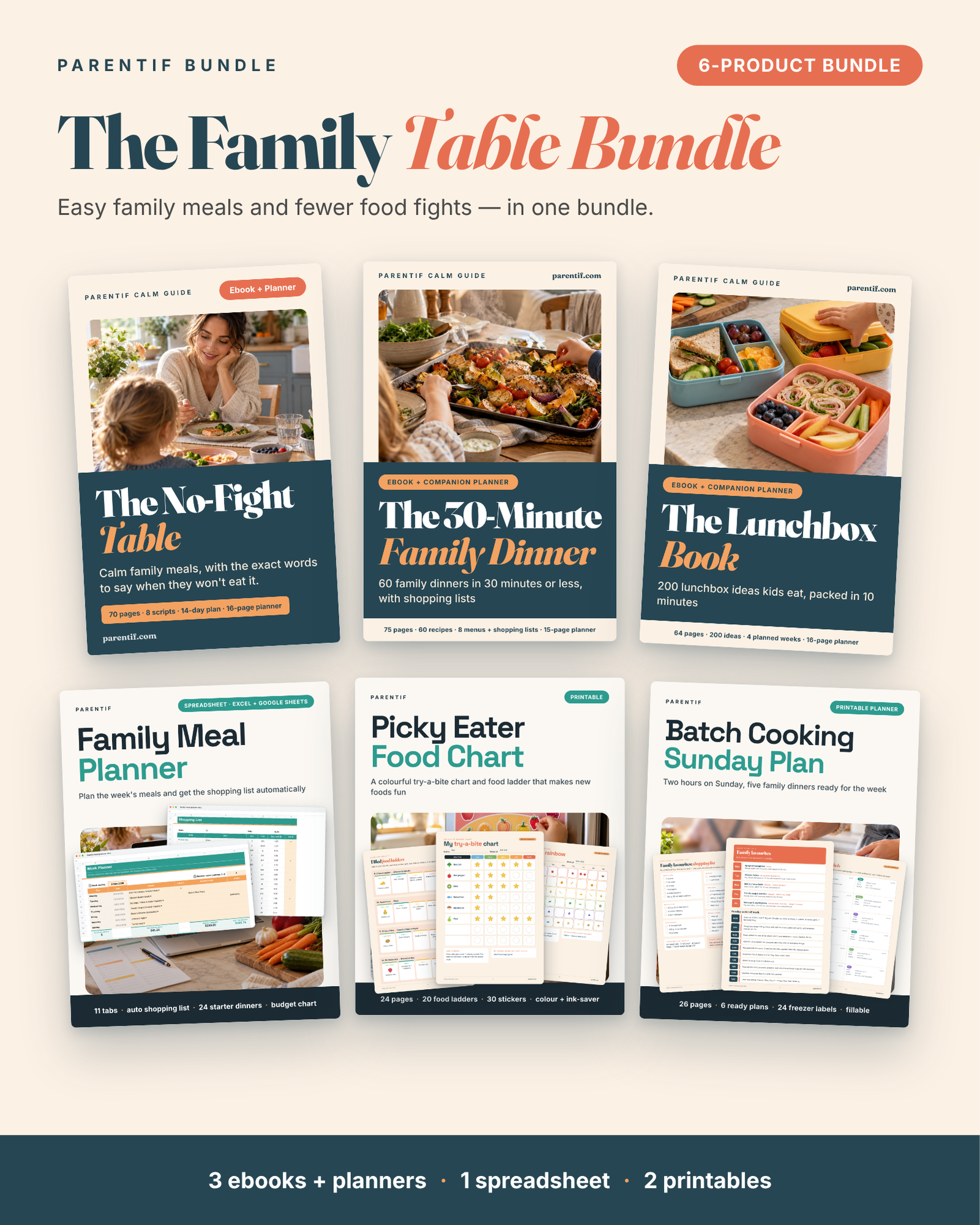 Family Table Bundle
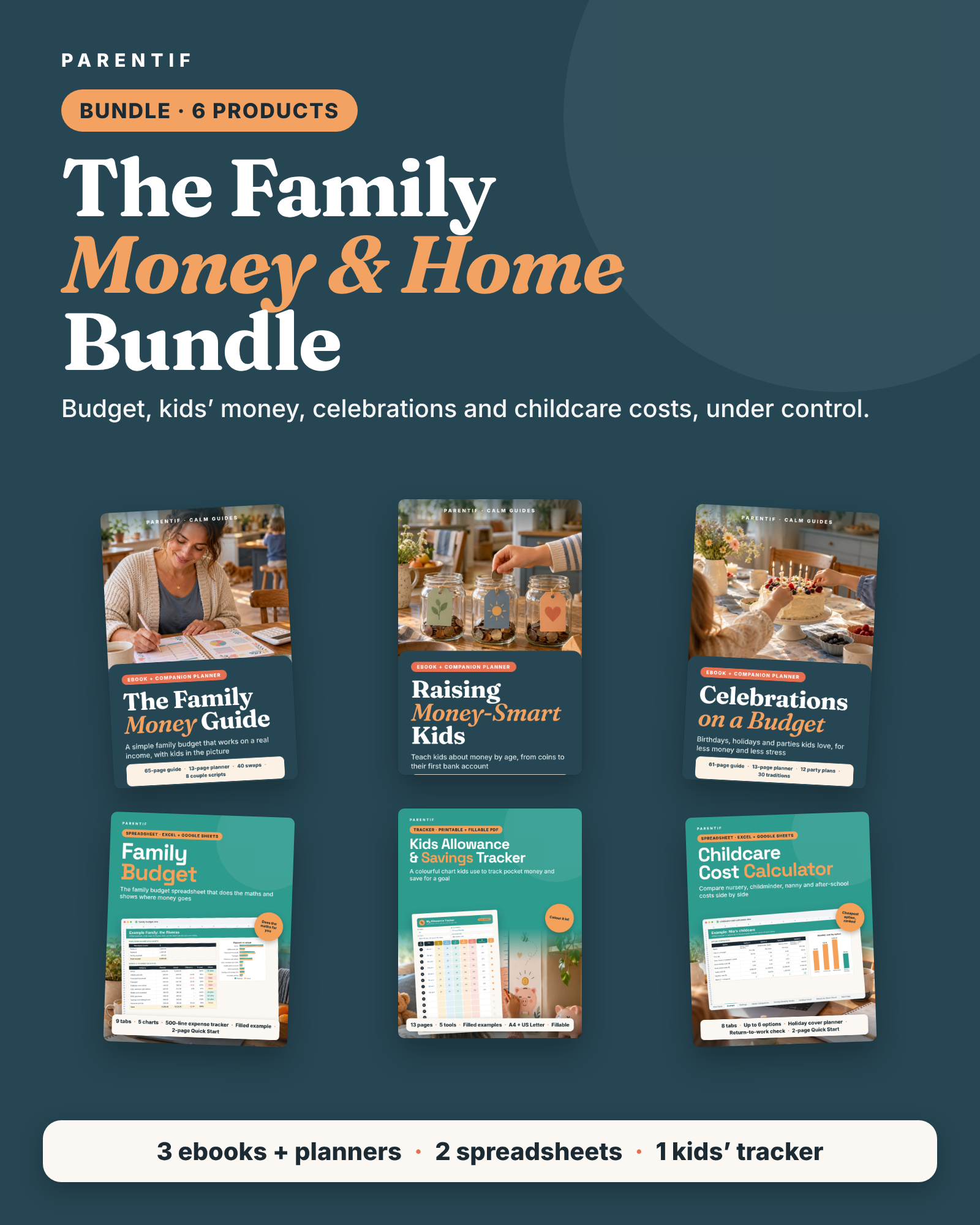 Family Money & Home Bundle
 Family Adventures Bundle
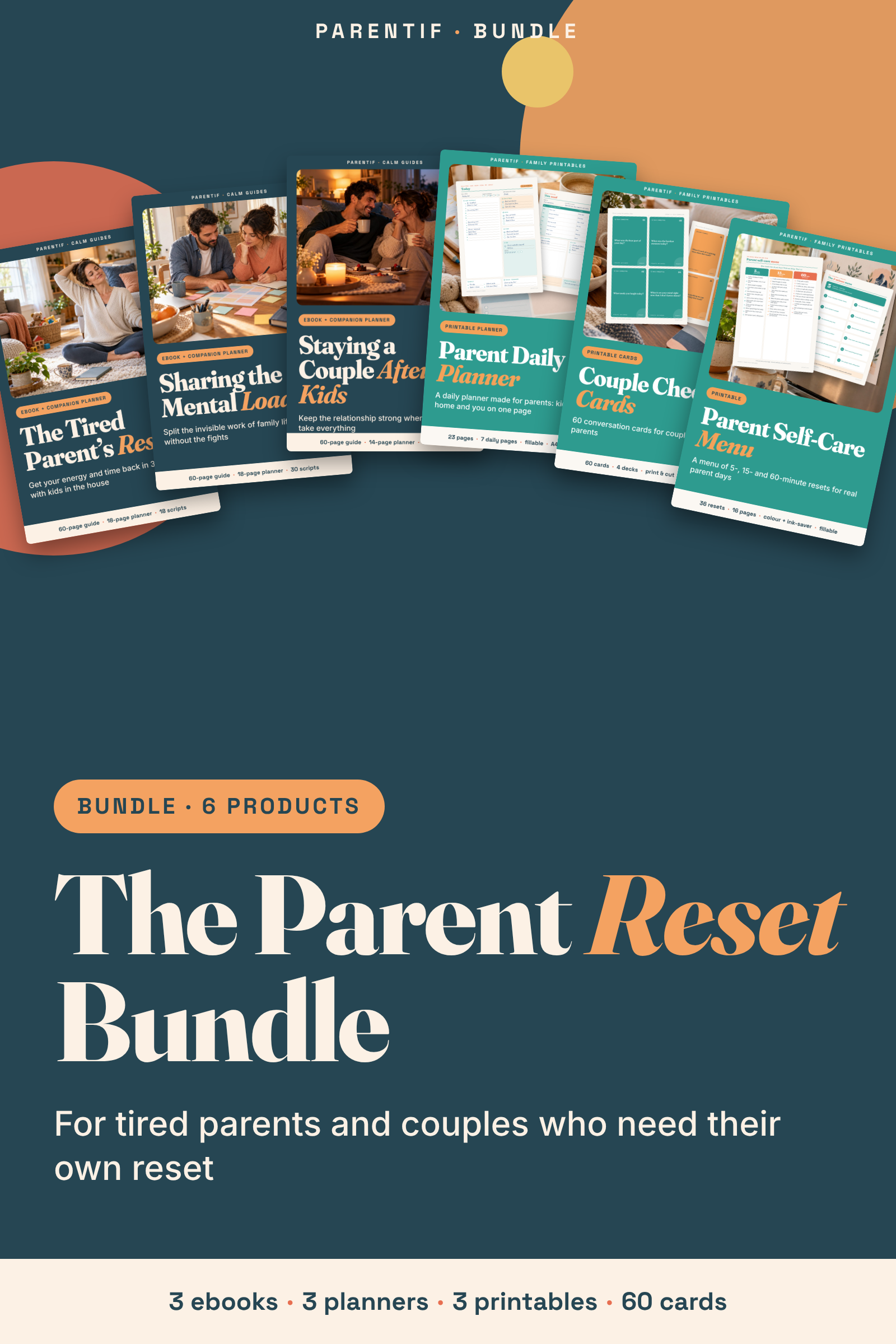 Parent Reset Bundle
 Bump-to-Birth Bundle






Leave a Reply