
If your toddler is throwing food, you are not raising a messy, defiant child. You are feeding someone who is still learning what food is for, what “full” feels like and how to tell you “I’m done” without words. The bowl hits the floor, the dog cheers, and you clean the same spot for the third time today. This guide shows you why toddlers throw food, what is normal at each age, the calm 4-step reset that cuts throwing at most meals, the exact words to say, and a 7-day plan you can start at the next meal.
- Food throwing is common from about 9 months to 2½ years and usually fades with calm, boring repetition.
- Most throwing happens at the end of a meal: it is often the toddler’s way of saying “I’m full.”
- Small portions (2–3 bites per food) cut throwing more than any rule or reward.
- A big reaction (laughing, shouting, a long talk) makes throwing more interesting, not less.
- Ending the meal is a calm consequence, not a punishment: food comes back at the next planned snack.
Why do toddlers throw food?
Toddlers throw food for a handful of reasons, and most of them have nothing to do with bad manners. Find your toddler’s reason first, because the fix is different for each one.
1. They are full or done
This is the most common reason. A toddler’s appetite changes from meal to meal and day to day. When the hunger is gone, the food on the tray turns into a toy. If the throwing starts after five or ten minutes of good eating, your toddler is very likely telling you the meal is over.
2. They are experimenting
Between about 9 and 18 months, toddlers learn by testing: what happens when peas fall? Does the yogurt make the same sound as the cracker? Does it come back? It is the same curiosity that makes them drop a spoon twenty times. Annoying, but normal learning.
3. It gets a big reaction
A gasp, a laugh from a sibling, a raised voice, a long explanation: to a toddler, all of these are exciting. If throwing reliably makes the room light up, they will try it again just to see the show.
4. There’s too much on the plate
A full plate is overwhelming for a small child. They pick out the one food they want and clear the rest out of the way, often onto the floor.
5. They don’t like the food (and can’t say so)
A new food, a strange texture or a food that touched another food can all end up on the floor. Without the words “no thank you,” throwing is the fastest way to remove it.
6. They want to get down
Long meals, waiting for adults to finish, or sitting while tired: when a toddler has had enough of sitting, the tray gets cleared. If your toddler also climbs out or refuses the chair, read our guide on what to do when a toddler won’t sit at the table.
Is food throwing normal? What to expect by age
Yes. Food throwing is one of the most common mealtime behaviours in the toddler years. What changes with age is the reason behind it and how much you can expect your child to understand.
| Age | What throwing usually means | What to expect from you |
|---|---|---|
| 9–12 months | Exploring, dropping to watch it fall, full | Tiny portions, calm “food stays on the tray,” take the tray away when the eating stops |
| 12–18 months | Testing cause and effect, done eating, dislikes a food | Teach “all done” (word or sign) and a “no thank you” bowl; one calm warning |
| 18–24 months | Testing limits and reactions, wants to get down | Same short script every meal; meal ends after the second throw |
| 2–3 years | Mostly attention or “I’m done”; can follow a simple rule | Clear rule said once before the meal; help clean up together; meal ends calmly |
| 3+ years | Less common; usually boredom, tiredness or a power struggle | Shorter meals, a job at the table, and a calm, consistent ending |
How to stop a toddler from throwing food: the calm 4-step reset
This is the order that works for most families. Use all four steps at every meal for one week before you judge it. Consistency matters more than the exact words.
Step 1: Serve small and refill on request
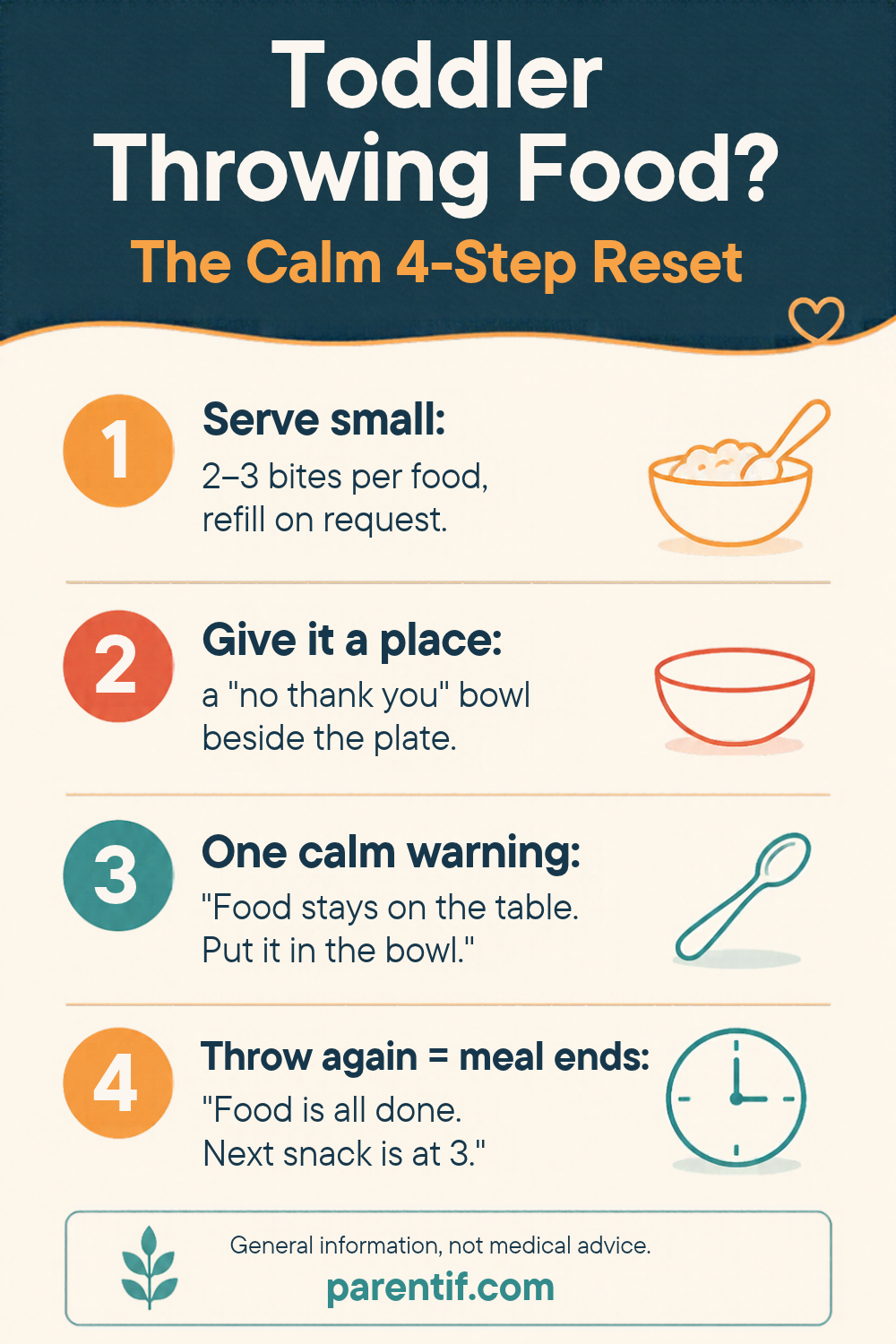
Put two or three bites of each food on the tray or plate, not the whole portion. When the bites are gone, offer more: “More pasta, or all done?” This one change does more than any rule, because there is simply less to throw and every refill is a chance to check whether your toddler is still hungry.
Keep the refill bowl next to you, not on the tray. Your toddler can see there is more, but it is not within throwing range.
Step 2: Give unwanted food a place
Set a small bowl next to the plate, the “no thank you” bowl. Show your toddler: “If you don’t want it, put it here.” Then praise the first time they use it, quietly: “You put it in the bowl. Thank you.” Many toddlers throw food because they have nowhere else to put it. Give them somewhere.
Step 3: Give one calm warning
When the first piece flies, say one short sentence in a flat, calm voice: “Food stays on the table. Put it in the bowl.” No lecture, no laughing, no big face. If your toddler is under 18 months, you can gently hold their hand for a second and guide it to the bowl.
Step 4: If it happens again, the meal ends
On the second throw, end the meal kindly: “Your body is telling me you’re all done. Food is finished. Next snack is after nap.” Take the plate, wipe hands, and lift your toddler down. No extra food, milk or snack straight after, or throwing becomes the way to get a better menu. Offer food again at the next planned meal or snack.
Ending the meal works only if meals and snacks happen at planned times. If your toddler grazes all day, they arrive at the table not hungry, and throwing is almost guaranteed.
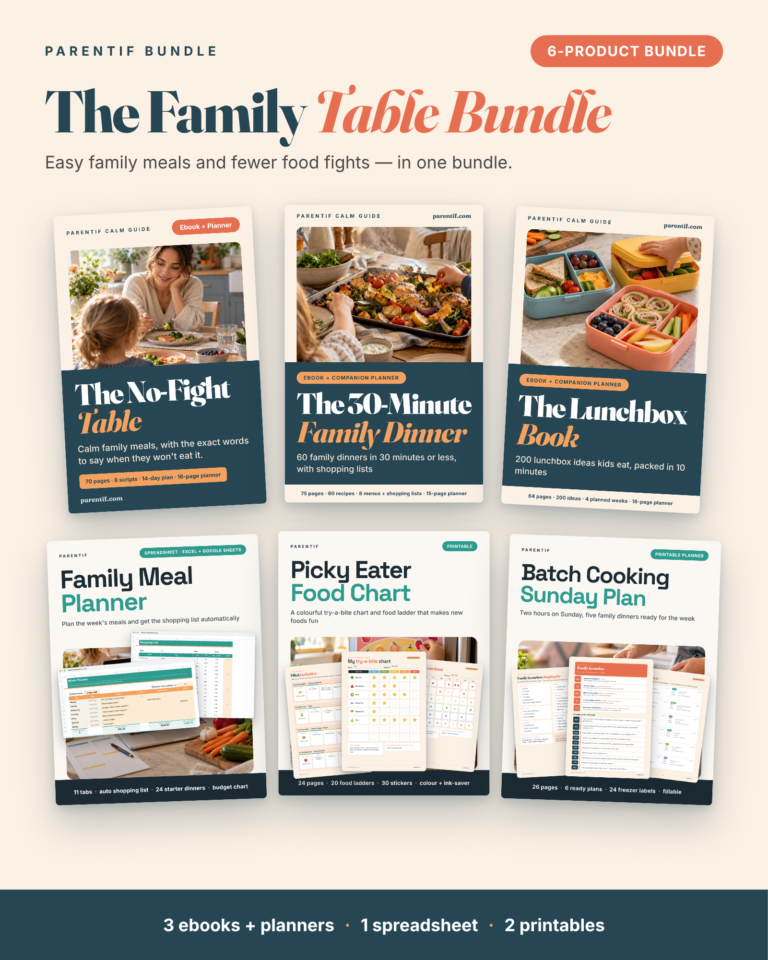
The No-Fight Table gives you the routine, the scripts and printable planners for picky eating, table manners and family meals, so every meal follows the same calm rules.
See The No-Fight Table Or get the Family Table Bundle →What to say when your toddler throws food
Short, calm and the same every time. Pick two or three lines and use them at every meal so your toddler learns exactly what comes next.
- Before the meal: “Food stays on the table. If you don’t want it, put it in the bowl.”
- First throw: “Food stays on the table. Put it in the bowl.”
- When they use the bowl: “You put it in the bowl. That’s how we say no thank you.”
- To check hunger: “Are you still hungry, or is your tummy all done?”
- Second throw: “Throwing tells me you’re all done. Food is finished.”
- If they protest: “You’re sad food is finished. Next snack is after nap.” (Then stay calm and change the scene.)
- Clean-up (2+ years): “Food fell. Let’s pick it up together.” Hand them one piece to put back.
Want more ready-made lines like these for every hard moment of the day? The Parent Scripts Deck keeps them on cards you can stick on the fridge.
What not to do
- Don’t laugh or film it. It is funny the first time, but laughter is the best reward a toddler can get.
- Don’t give a long talk. One sentence is enough. Long explanations are attention, too.
- Don’t swap in a favourite food. If throwing brings a yogurt or crackers, your toddler learns that throwing works.
- Don’t make them eat “one more bite”. Pressure makes meals tense and throwing more likely.
- Don’t let the dog clean up during the meal. A happy dog under the chair turns throwing into a game. Keep pets out of the room while your toddler eats.
- Don’t shout or punish. Food throwing is a stage. A calm ending teaches more than anger.
A 7-day plan to reduce food throwing
Most families see fewer throws within a week when every adult uses the same steps. Write the script on a card and stick it where everyone who feeds your toddler can see it.
| Day | Focus | What you do |
|---|---|---|
| 1 | Set the scene | Pets out, screens off, the “no thank you” bowl on the table, small portions only |
| 2 | Teach the bowl | Show it at every meal; praise every use quietly |
| 3 | Same words | Every adult uses the same warning and the same ending sentence |
| 4 | Check the timing | Meals and snacks 2–3 hours apart; no grazing or milk right before meals |
| 5 | Shorter meals | End when eating stops, even if it is 10 minutes in |
| 6 | Add a job | Older toddlers help set the table or wipe their spot after the meal |
| 7 | Review | Count throws per meal this week vs last week; keep what worked |
Special cases
Throwing cups and spoons
Give a small, weighted or lidded cup with a little water, and put it back on the table only when your toddler asks. A cup that lives on the tray is a cup that gets thrown. For spoons, give one and keep a spare by you.
Throwing food at restaurants or family meals
New places mean more excitement and longer waits. Bring a small snack box for the wait, order your toddler’s food first, sit them at the edge of the table so you can step out, and keep the same two sentences you use at home. If it gets too much, a short walk outside is better than a big scene; our guide to toddler meltdowns in public has a calm exit plan.
When there is an older sibling at the table
Older siblings often laugh, which makes throwing a great show. Ask them, before the meal, to “be boring” when food flies, and give them a job (refill helper) so they feel part of the plan.
When food throwing comes with picky eating
If your toddler throws most new foods, keep serving them in tiny amounts next to one food they already like. Repeated, pressure-free exposure is how most toddlers come to accept new foods. Our calm picky eater plan and the free picky eater profile quiz help you find your child’s pattern, and our toddler meal ideas keep portions small and easy.
When to talk to your pediatrician
Food throwing on its own is a normal stage. Talk to your child’s doctor if you also notice any of these:
- Your toddler refuses most foods or whole food groups for weeks
- Weight loss, or your doctor has concerns about growth
- Gagging, coughing or choking often while eating
- Meals are very distressing for your child or family most days
- Your toddler throws or hits a lot in other situations too and you are worried
Always stay with your toddler while they eat, keep them seated, and cut round or hard foods into small pieces to lower the risk of choking.
Frequently asked questions
At what age do toddlers stop throwing food?
Most children throw less after about 2 to 2½ years, once they can say “all done” or “no thank you” and meals have a steady routine. Every child is different; calm, consistent responses usually shorten the phase.
Should I punish my toddler for throwing food?
No. Punishment adds stress and attention to the moment. A short warning and a calm end to the meal is a natural consequence your toddler can understand, and it works better over time.
Is food throwing a sign my toddler is full?
Very often, yes. If your toddler ate well and then starts throwing, they are probably done. Ask “more or all done?” and end the meal if they don’t eat again.
What if my toddler throws food at the start of the meal?
Throwing right away usually means they are not hungry yet, the plate is too full or the food is new. Check the time since the last snack or milk, serve smaller portions, and add one food they already like.
Should I ignore food throwing completely?
Ignore the drama, not the behaviour. Keep your face and voice neutral, give one calm sentence, and follow through on the second throw. Total silence can turn throwing into a guessing game.
How do I stop my baby throwing food off the high chair?
For babies under one, offer a few pieces at a time, take the tray away when they stop eating, and model putting food back on the tray. At this age, dropping food is mostly exploring, and it passes.





Leave a Reply