If your toddler won’t sit at the table, you’re not raising a rude child — you’re raising a two-year-old whose body was built to move, and whose meals were probably set up for someone older. You call them, they arrive, take two bites standing on the chair, and they’re gone. This guide gives you the order to fix it in: why it happens, the four-step table routine, the exact words to say, a realistic sitting time for each age, and what to do on night three when it still isn’t working.
- Most table battles start two hours earlier, with a cracker in the car seat: a hungry toddler sits longer.
- A chair with dangling legs and a plate at chin height is uncomfortable, so fix the seat before you fix the behaviour.
- Expect minutes, not half hours: start with what your child can do today and add a minute a week.
- Use one calm limit — “Leaving the table means you’re done” — and follow it every time, without anger.
- Give it two weeks of the same routine before you judge it, and talk to your pediatrician if eating, growth or energy worry you.
Why your toddler won’t sit at the table: the 5 real reasons
This section covers the causes, because the fix depends on which one you have. Most families have two or three at once, and the most common one is the least obvious.
1. They aren’t hungry when the meal starts
A handful of crackers at 4:15, a pouch in the stroller, milk at 4:45, dinner at 5:30. By the time the plate lands, there’s no reason to sit. The American Academy of Pediatrics’ parenting site advises making sure a child is hungry when mealtime comes and not offering snacks too close to it (HealthyChildren.org: Tips for Preventing Food Hassles). Grazing is the number one reason a toddler leaves after two bites.
2. The seat is uncomfortable
Look at the chair from your child’s height. Feet dangling in the air, the table edge at their armpits, a plate they can’t see into. Adults would wriggle too. Support under the feet makes a surprising difference: a child who can plant their feet has a stable body and can use their hands for eating instead of for holding on.
3. You’re asking for more minutes than they have
Toddlers have short attention spans, and the Victorian government’s Better Health Channel advises against forcing a toddler to stay at the table until they finish. A two-year-old who sits for eight focused minutes is doing their job. The battle usually starts at minute nine, when we ask for twenty.
4. The table is boring, or the action is elsewhere
If the toddler eats alone while you cook, clean or scroll, the table is the least interesting place in the house. If the TV is on in the next room, it wins. A toddler stays where the people are.
5. Leaving gets a big reaction
Chasing, pleading, the airplane spoon, the “one more bite” negotiation — every one of these turns leaving the table into a game with a prize. You don’t need to be stricter. You need to be more boring.
The Calm Parent Roadmap
The calm next step for every age, from the first year to the teen years, in one printable map.
- What matters most at each stage
- The calm script to start with tonight
- Printable PDF, yours to keep
We email you the download link. Free, no payment details.
How long should a toddler sit at the table? A realistic guide by age
This section gives you a starting target so you stop measuring your child against an adult dinner. Use it as a guide, not a test: start from what your child can do today and add about a minute a week.
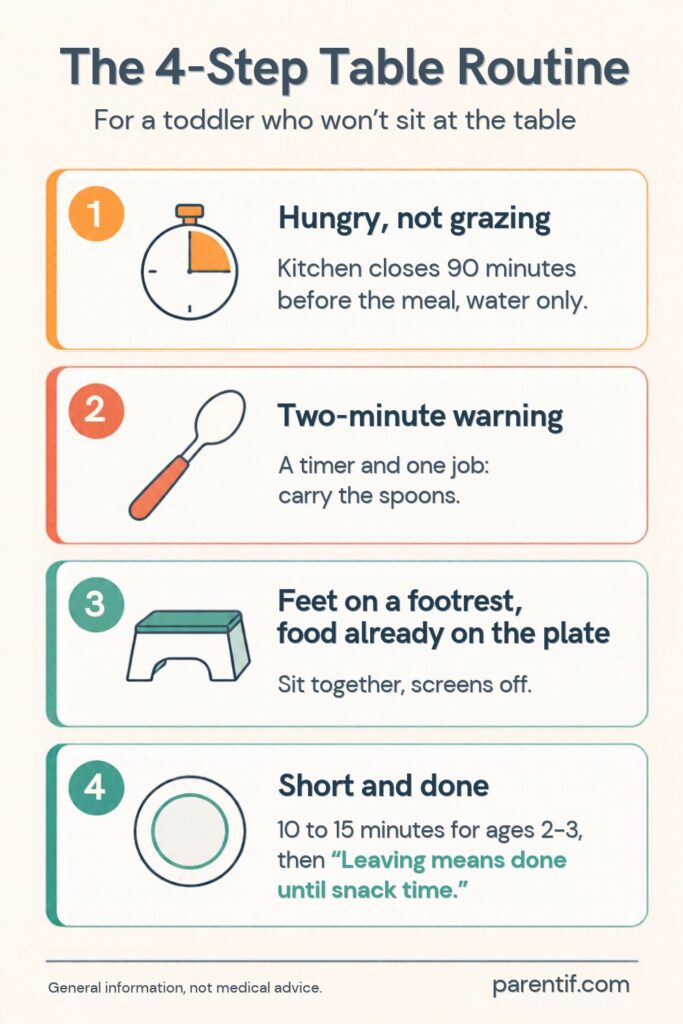
The 4-step table routine for a toddler who won’t sit at the table
This section is the routine itself. Run the same four steps at every meal for two weeks before you change anything. Predictability is half the fix: the same order every day tells a toddler what comes next without a fight.
The CDC’s mealtime routine tips also note that sitting down as a family helps a child learn how to eat and builds social skills — which is the best reason to keep the meal together, even when it’s short.
✓ Printable table routine and a two-week tracker to see the change
Set up the seat before you fix the behaviour
This section is the five-minute physical check that fixes more table problems than any sticker chart. Do it once, tonight, while your toddler is in bed.
☐ The table is at elbow height, not chin height
☐ The plate is close enough to reach without leaning out
☐ Cutlery is small enough for a small fist
☐ The chair faces the family, not the TV or the toy box
☐ Toys are out of sight from the seat
Most toddlers move from a high chair to a booster between two and three. If yours has started refusing the high chair, the refusal is often about wanting to sit like everyone else, not about food. A booster at the family table can end the fight overnight. If you’re also working on the morning, our guide to a calm toddler morning routine uses the same “set it up once” idea for breakfast.
What to say when your toddler won’t sit at the table
This section gives you the exact words for the four moments that usually go wrong. Say them once, in a flat, friendly voice, and then stop talking. The script works because it’s short and the same every time.
If the words come out sharp after a long day, that’s human. Repair is simple: “I was grumpy at dinner. Tomorrow we’ll try again.” For more ready-made lines for hard moments, the Parent Scripts Deck has them on one card each.
Make the table the best place to be for 10 minutes
This section is about the pull, not the push. A toddler stays at the table when the people they love are there and something small and interesting is happening.
- Eat the same food, at the same time. Seeing you eat it is the strongest invitation there is.
- Talk to them, not about them. “What was the loudest thing you heard today?” beats “Eat your peas.”
- Give a small choice. Two sides on the table, they choose which goes on their plate first.
- Let them serve. A small bowl and spoon to serve their own peas buys several minutes of seated focus.
- Picnic now and then. The Better Health Channel suggests pretend play like a teddy bear picnic to make sitting fun; a weekly picnic on a mat keeps the rules (sitting, eating) while changing the scene.

Grazing vs planned snacks: the change that makes sitting possible
This section compares the two eating patterns, because most toddlers who won’t sit are quietly grazing. A planned snack is a small, sit-down meal at a set time; grazing is food available on demand. Only one of them brings a hungry child to dinner. If picky eating is part of your picture too, our picky eater toddler guide covers the food side in more depth.
| Grazing | Planned snacks | |
|---|---|---|
| When | Any time they ask | Set times, about 2–3 hours apart |
| Where | Car, stroller, sofa, walking around | Sitting down, at the table or on a mat |
| Appetite at meals | Low, so they leave after two bites | Real, so they stay longer |
| Between times | Milk and juice top up | Water |
Switching from grazing to planned snacks is the hardest week of this whole plan, because there’s whining at 4:30. Hold steady and offer water and a job. If you’re still building the day’s rhythm, the visual schedule for toddlers makes snack times something your child can see coming.
Night three and it still isn’t working: what to try next
This section is for the evening when you’ve done everything and your toddler still slid off the chair after ninety seconds. That’s normal: behaviour often gets louder before it gets better, because your child is testing whether the new rule is real.
- Check the clock, not the child. Was there milk or a snack within 90 minutes of the meal? That’s the fix.
- Shorten the target. Go back to the number your child managed easily and build up from there.
- Move the meal earlier. An overtired toddler can’t sit; the Better Health Channel advises against scheduling meals when a toddler is overtired.
- Look at the day. A day full of sitting (car, daycare circle time, screens) can leave a body that needs to move. Ten minutes of running outside before dinner often buys five more at the table.
- Watch for a bigger pattern. If big feelings are spilling into every transition, our guide to the toddler witching hour covers the late-afternoon slump.
✓ Grocery lists, rotation menus and toddler-friendly portions in one place
Common mistakes that keep toddlers off their chairs
This section is for parents who already know the basics. These are the small habits that quietly undo a good routine.
1. Making the second dinner
Clearing the plate and then serving crackers twenty minutes later teaches your child that the table is optional. Instead, keep the next planned snack, and make it a good one so you don’t feel mean.
2. Talking too much
Long explanations about nutrition and manners give a toddler something to argue with. Instead, say one line once and let the routine do the work.
3. Feeding on the move to “just get something in”
Following with a spoon keeps intake up today and makes sitting harder tomorrow, and it raises the choking risk. Instead, accept a small meal today for a better routine all week.
4. Changing the plan every night
Sticker chart on Monday, timer on Tuesday, threats on Wednesday. Instead, pick the four-step routine and run it unchanged for two weeks.
5. Judging by one meal
Breakfast is often the best meal of the day and dinner the worst. Instead, look at the whole day and the whole week, the way your child’s appetite works.
FAQ: toddler won’t sit at the table
Is it normal for a 2-year-old not to sit at the table?
Yes. Two-year-olds are built to move, their appetite changes from meal to meal, and their attention span is short. Sitting for about 10 to 15 minutes is a fair target at this age. If your child sits for a few minutes, eats something, and climbs down, that’s ordinary toddler behaviour, not a discipline problem. Build the minutes slowly with the same routine every day.
Should I force my toddler to sit at the table?
No. Holding a child in a chair or insisting they stay until the plate is clean usually makes meals a power struggle and the table a place to escape. Instead, make the table comfortable and the meal short, and use one calm limit: leaving the table means the meal is over until the next planned snack. Follow it every time, kindly.
Should I let my toddler eat while walking around?
It’s better not to. Eating while walking or running is a choking risk, and food on the move teaches that meals don’t need a seat. Keep food at the table or on a picnic mat where your child is sitting. If your toddler walks away, the food stays behind and the meal ends calmly, without a lecture or a chase.
How do I get my toddler to stay at the table longer?
Start with hunger: stop grazing and keep snacks at set times with water in between. Then fix the seat with a footrest at table height, serve the food before they sit, and eat together with screens off. Start from the minutes your child manages easily and add about a minute a week. Small choices and serving themselves help too.
What if my toddler only eats a few bites before leaving?
A few bites can be a full toddler meal, and appetite varies a lot from day to day. Let them go when they’re done, keep the next planned snack at its usual time, and don’t serve extra food in between. Over a week, most toddlers eat enough. Talk to your pediatrician if you’re worried about weight, growth or energy.
Should my toddler use a high chair or a booster seat?
Use whichever keeps them stable with feet supported and the plate within easy reach. Many toddlers move to a booster at the family table between two and three, and some refuse the high chair because they want to sit like everyone else. A comfortable, well-fitted seat often ends the battle faster than any rule or reward.
The bottom line
When a toddler won’t sit at the table, fix the appetite, the seat and the length of the meal before you fix the child. Run the four-step routine for two weeks, say the same calm line every time, and let the minutes grow on their own. For the whole mealtime picture, start with our toddler meal ideas and browse more in Toddler Meals & Nutrition.
Sources: American Academy of Pediatrics, HealthyChildren.org — Tips for Preventing Food Hassles · Better Health Channel (Victoria State Government) — Toddlers and mealtime behaviour · CDC — Tips for Mealtime Routines











Leave a Reply