Morning routines · Ages 2–12
You don’t have a slow kid. You have a morning that was never actually timed.
Stop guessing at the alarm. Build the clock backwards from the door and the yelling mostly stops on its own.
How Much Time Do Kids Need to Get Ready in the Morning? The Real Numbers, By Age
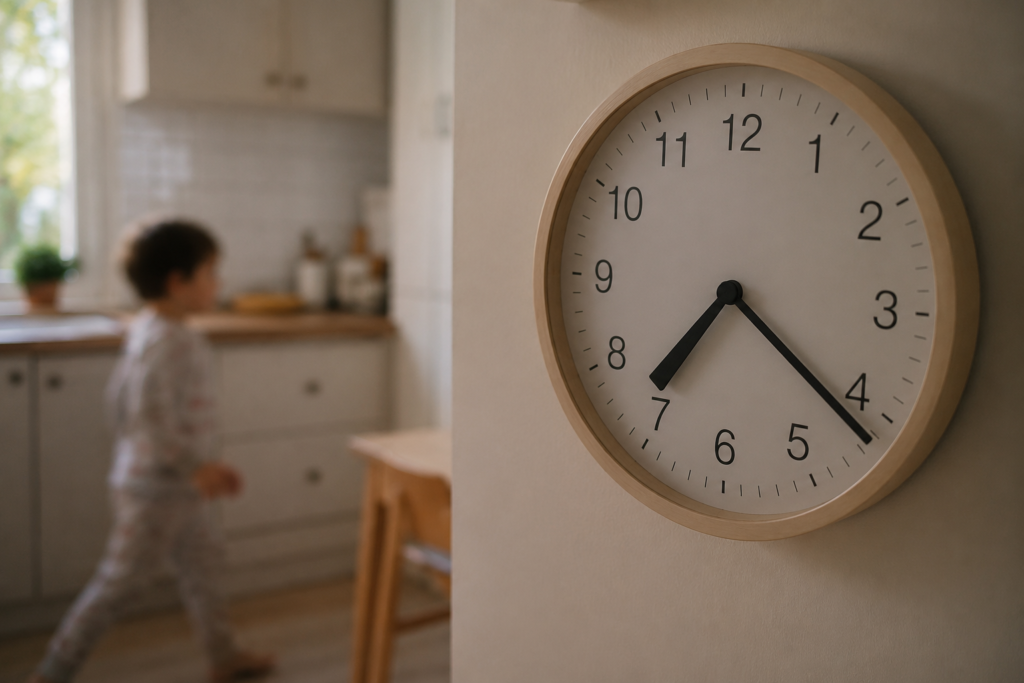
You’re not late because your kid is difficult. You’re late because you picked a wake-up time that felt about right and have been paying for it every weekday since. So: how much time do kids need to get ready in the morning? This guide gives you the actual minute budgets by age, a backwards countdown you can run tonight, and a five-day audit that finds the one block quietly eating your morning.

The whole first year, calmed.
5 calm guides + 20 printables on sleep, feeding, milestones & your recovery.
See The First Year · $27 →Most school-age kids need 45 to 60 minutes from wake-up to out-the-door. Preschoolers need 60 to 75. A 10-year-old who packs the night before can do it in 35. Budget by task, not by feeling: dressing 5–10 minutes, breakfast 15–20, teeth and shoes 10, plus a hard 10-minute buffer at the end. Add roughly 10 minutes for every extra child under seven.
Key Takeaways
How Much Time Do Kids Need to Get Ready in the Morning? Here Are the Numbers Nobody Gives You

The honest answer is a range that shrinks fast with age, and most families are running about fifteen minutes short of it. Below is what a realistic wake-to-door window looks like when the child is doing the tasks themselves rather than being dressed by an adult on the stairs.
| Age | Wake → door | What eats the time |
|---|---|---|
| 2–3 years | 70–90 min | Adult-dependent dressing, slow eating, nappy or potty stops |
| 4–5 years | 60–75 min | Wants to dress solo, can’t yet — the “I do it” tax is real |
| 6–8 years | 45–60 min | Distraction, not incapability. Breakfast drifts |
| 9–12 years | 35–50 min | Hair, screens, and hunting for one specific hoodie |
Three modifiers push you toward the top of every range. Add 10 minutes for each additional child under seven, because young siblings don’t get ready in parallel — they get ready in a queue with interruptions. Add 10 if anyone’s hair needs washing, detangling, or braiding. Add 15 if you’re catching a bus, because a bus doesn’t wait and you’ll need a genuine safety margin rather than a hopeful one.
And a quiet one people forget: subtract nothing for a child who “gets up early anyway.” Early waking doesn’t shorten the getting-ready window. It just moves it.

Warm on the feeling.
Firm on the limit.
Boring on the drama.
That's the whole method — and The No-Fight Bedtime turns it into a routine you can run on the nights you have nothing left to give.
Read what's inside$17 · 70 pages · instant download
💡 TIP
Time one ordinary morning before you change anything. Not a good one, not a disaster — a Tuesday. Most parents discover their real wake-to-door number is 12 to 20 minutes longer than the one they’ve been planning around.
The Reverse Countdown: Build Your Morning Backwards From the Door

Almost every family builds the morning forwards — alarm goes off, then everyone improvises until the panic starts. Flip it. The door time is the only fixed point in your morning, so it’s the only sane place to start counting from.
Write down the bell time, then subtract travel
School starts 8:35. Walk is 12 minutes. Your door time is 8:20 — not 8:23, because school gates and cloakrooms take minutes too.
Carve out the last-mile block: 10 minutes, untouchable
Shoes, coats, bags, the water bottle nobody filled. This is where mornings die. Ten minutes, from 8:10 to 8:20, and nothing else lives there.
Give breakfast a start time and an end time
Twenty minutes for under-sevens, fifteen above. Seated 7:50, cleared 8:10. An open-ended breakfast will swallow whatever you hand it.
Block the wash-and-dress run
Toilet, dressing, teeth, face. Fifteen minutes for a seven-year-old, twenty-five for a four-year-old. That puts you at 7:35 or 7:25.
Add the wake-up lag — then you have your alarm
Nobody’s feet hit the floor the second they wake. Give 5 minutes for an older child, 10 for a younger one. Alarm: 7:25. Not “around seven.”
Run that for one seven-year-old and you land on a 55-minute morning. Which sounds long until you total up what you’re currently doing, discover it’s 41 minutes of tasks crammed into a 38-minute window, and realise you’ve been losing by three minutes every single day for a year.
Warm on the feeling. Firm on the limit. Boring on the drama.
Explore The Toddler Years bundle →5 calm ebooks + 20 printables · $27
The Task-by-Task Minute Budget Parents Consistently Get Wrong

Here’s where the estimate falls apart: parents time the task, not the transition into the task. Getting dressed takes four minutes. Getting your six-year-old to start getting dressed takes six. Both belong in the budget.

The No-Fight Table
Every meal, without the battle. The setup that works without you saying anything, word-for-word scripts for the eight refusals, and a fourteen-day plan.
Get the guide — $1770 pages · instant PDF · yours forever
| Task block | Ages 4–6 | Ages 7–11 |
|---|---|---|
| Awake → feet on the floor | 10 min | 5 min |
| Toilet + wash face | 7 min | 4 min |
| Getting dressed (incl. the start-up drag) | 12 min | 6 min |
| Breakfast, seated to cleared | 20 min | 15 min |
| Teeth | 4 min | 3 min |
| Hair | 5 min | 5 min |
| Shoes, coat, bag, bottle | 10 min | 7 min |
| End buffer | 10 min | 10 min |
| Total | 78 min | 55 min |
Those totals look brutal, and they should — because they include what actually happens rather than what you’d like to happen. The good news is that two of those blocks are movable, and moving them is where you win back twenty minutes without waking anyone earlier.
Breathe out.
Get down.
Two sentences.
That's the four-step response — and it works in the supermarket, the restaurant, the car park and the departure gate. The Public Meltdown Field Guide gives you the exact words for each one.
Read what's inside$17 · 70 pages · instant download


Breakfast is the biggest single line and the one nobody wants to cut, so don’t cut it — start it earlier by making it require zero preparation. A bowl on the counter and cereal already portioned turns a 20-minute block into an 18-minute block and, more importantly, removes you from it entirely so you can be doing your own shoes.
Shoes and bags is the sneaky one. It looks like a two-minute job. It’s not, because it’s the only block that requires locating objects, and locating objects with a distracted child is the slowest activity in the household. Everything that can be staged by the front door the night before should be.
✨ QUICK WIN
Put a shallow basket by the door with one compartment per child. Shoes go in it at the moment they come off, every evening, no exceptions. This single habit is worth roughly seven minutes a morning, and it’s the only change on this page you can make tonight in under a minute.
Rather not draw it yourself at 10pm
The Parenting Printables & Planner Bundle
Ready-to-print morning routine charts with picture steps for pre-readers, plus chore charts and weekly planners you can fill in once and reuse.
Built for exactly this: a child who can check their own list instead of waiting to be told the same four things.
See the bundle →Why Waking Them 20 Minutes Earlier Usually Backfires

Most advice about slow mornings gets this backwards. The standard fix is “set the alarm earlier,” and it fails for two reasons that compound each other.
Inside The Preschool Years bundle:
- Big Emotions, Small Humans
- Whining, Hitting, Talking-Back
- Preschool Bedtime Battles
- Screen Time at 3–5
- Kindergarten Ready
- + 20 printables
First, kids expand to fill the available time. Give a seven-year-old an extra twenty minutes and you don’t get a calm morning with twenty minutes spare — you get the same morning, stretched, with two additional negotiations in it. The work doesn’t grow to fit the clock because children are lazy. It grows because unstructured time reads to a child as permission time.
Second, and more seriously, earlier waking without an earlier bedtime is just sleep debt on an instalment plan. The American Academy of Sleep Medicine’s guidance is that children aged 6 to 12 need 9 to 12 hours per 24-hour period, and 3- to 5-year-olds need 10 to 13 including naps. The AAP, which supports those guidelines in its own parent guidance on healthy sleep habits, links regular shortfalls to irritability and trouble concentrating — which is to say, the exact behaviours that make a morning slow. Shave twenty minutes off the night to buy twenty in the morning and you’ve made a losing trade.
“An earlier alarm buys you minutes. An earlier bedtime buys you a different child.”
The lever that actually works is relocation, not extension. Every task you can shift to the evening is a task removed from a window where everyone is tired, cold, and under time pressure. Here’s roughly what belongs where.
| Move to the night before | Minutes saved |
|---|---|
| Clothes chosen and laid out, socks included | 4–8 |
| Bag packed and standing by the door | 5 |
| Shoes in the basket, coats on hooks | 5–7 |
| Lunch made and in the fridge | 6–10 |
| Breakfast things out on the counter | 3 |
| Permission slips and forms signed | 2–5, plus your sanity |
Do all six and you’ve relocated 25 to 38 minutes out of the worst window of the day into a window where nobody’s watching a clock. That’s the whole game. If evenings are already the harder end of your day, the fixes in our guide to the 5pm witching hour pair well with this — you need a survivable evening before you can bank one.
⚠️ WARNING
Don’t move the wake time and the bedtime on the same night. Shift bedtime first, in 15-minute steps every two or three days, and leave the morning alone until the earlier bedtime is actually holding. Changing both at once gives you a tired child and no way to tell which change caused what.
The 3 Timers That Replace 30 Reminders
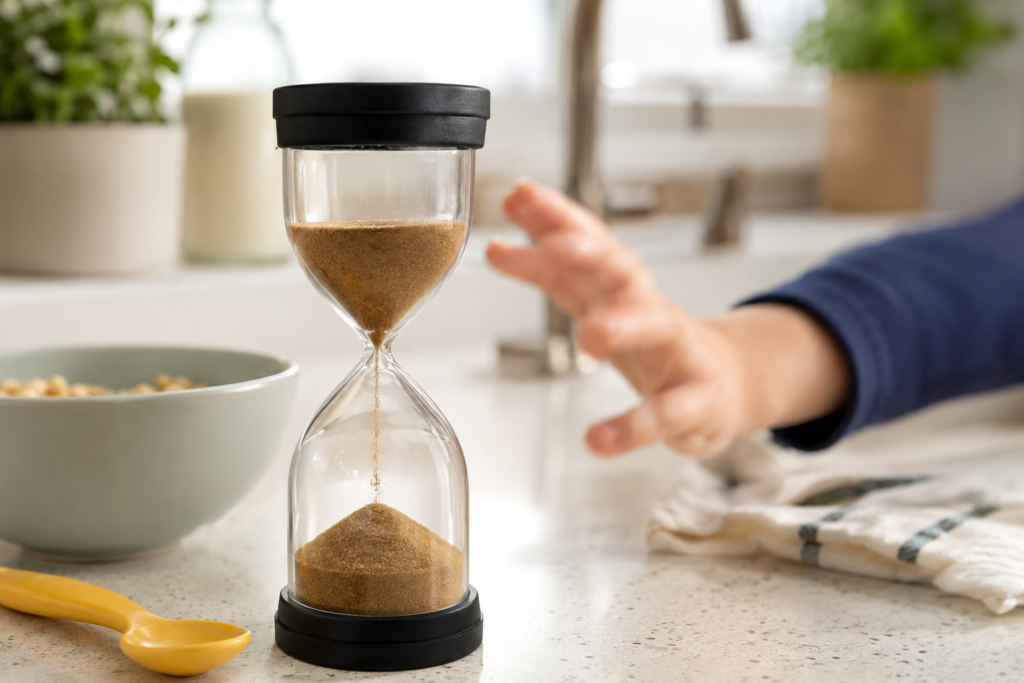
The reason you repeat yourself eleven times before eight o’clock is that you’ve made yourself the clock. Hand that job to something that isn’t you, and the argument stops being with a parent and starts being with a beeping object — which children argue with far less.
The Child Mind Institute’s guidance on helping kids with transitions points at previews and countdowns as the practical fix, and notes that visual cues work where verbal ones bounce off. Three alarms, placed at the three real seams of the morning, is that principle at its cheapest.
- Timer one — breakfast, 15 or 20 minutes, visible. A sand timer or a phone with the screen showing. It starts when the bowl lands, not when the child sits.
- Timer two — “shoes on,” set for door minus 10. Different sound from timer one. This one means the last-mile block has begun and everything else is over.
- Timer three — final call, door minus 3. Short, sharp, and it means you are leaving whether or not the hair situation is resolved.
What matters as much as the timers is what you say when they go off. Swap the pressure sentence for a pointing sentence — you’re directing attention to the system rather than adding your voice to the noise.
| Instead of | Say this |
|---|---|
| “Hurry up, we’re going to be late!” | “Timer’s on five. What’s left on your card?” |
| “Why aren’t you dressed yet?” | “Trousers or top first — your call.” |
| “I’ve told you four times.” | “Go check number three.” |
| “Put your shoes on NOW.” | “Shoes now, then you get the last two minutes for the book.” |
| “You’re making everyone late.” | “We leave at 8:20. I’ll be at the door.” |
That last one does the heaviest lifting, and it’s the hardest to say calmly. It works because it removes you as the obstacle. There’s no one left to resist — just a time, and a parent who has already gone to stand by the door.
For children who can’t read yet, the “card” in those scripts is a picture strip on the wall. Four to six images, at their eye level, in the room where the task happens rather than on the fridge where nobody looks. Our walkthrough on building a visual schedule covers the format that survives contact with an actual four-year-old, and the routine chart guide covers how many steps a chart can hold before it stops being used.

My Day, My Way — The Complete Toddler Routine System
6 ready-made picture charts, 36 cut-out cards, a First–Then board, trackers & a parent guide — everything to help your toddler run their own day. 24 pages, instant download.
How Much Time Do Kids Need to Get Ready in the Morning When There Are Two or Three of Them?

More children doesn’t multiply the morning, but it doesn’t run in parallel either. What it creates is queueing — and the queue always forms at the bathroom sink and the breakfast table.
The rule I’d give any family with siblings is to stagger by ten minutes rather than starting everyone together. Whether you wake the oldest or the youngest first depends on one question: who still needs an adult in the room?
"You can't control the teen years. You can stay close through them."
The Teen Years is five calm, practical guides for ages 13–18 — pulling away, the hard talks, independence, moods, and letting go.
Read more about The Teen Years →| Your setup | Who wakes first | Total window |
|---|---|---|
| Two kids, both 7+ | Together — they can share the sink | 55–65 min |
| One 7+, one under 5 | Older first, solo. Then you’re free for the little one | 70–80 min |
| Two under 5 | The slower one first, 10-min stagger | 85–95 min |
| Three, mixed ages | Oldest, then youngest, middle child last | 90–100 min |
That third row surprises people. Waking the slower child first feels counterintuitive — you’d rather bank an easy win. But the slow one sets the finish time for the whole household, so every minute you give them at the front is a minute you don’t lose at the back with everyone standing in coats.
The middle-child-last placement in row four isn’t a personality theory. It’s just that middle children in mixed-age houses tend to be the most independent per minute of parent attention, so they’re the cheapest to leave until the queue has cleared.
📝 NOTE
One bathroom and three kids is a scheduling problem, not a behaviour problem. Assign each child a two-minute sink slot with a named order that never changes, and post it on the bathroom door. Arguments about whose turn it is disappear the moment the answer stops being negotiable.
The 5-Day Time Audit That Finds Your Real Bottleneck
If your mornings are chronically bad and you don’t know why, stop guessing and collect five days of data. This takes about eight seconds a morning and it’s the most useful thing in this article.
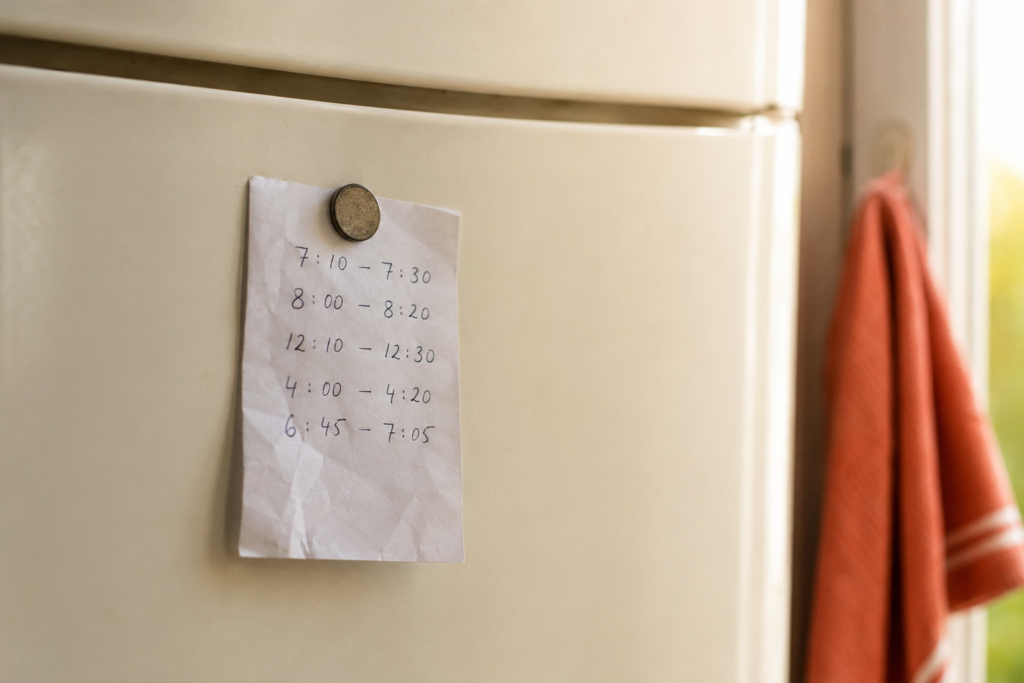
Note three timestamps only. Feet on the floor. Sat down to eat. Shoes on. Write them on a scrap of paper stuck to the fridge — no app, no spreadsheet, because anything more effortful than a pen won’t survive to Thursday.
At the end of the week you’ll have four gaps: wake-to-breakfast, breakfast duration, breakfast-to-shoes, and shoes-to-door. One of them will be visibly fatter than you expected. That’s your problem, and here’s what each one means.
| The fat gap | What it actually means | The fix |
|---|---|---|
| Wake → breakfast | Not enough sleep, or dressing has no defined start | Move bedtime 15 min earlier; put clothes on the bed, not in the drawer |
| Breakfast itself | Open-ended eating, or a screen at the table | Visible timer, food already out, nothing on a screen until shoes are on |
| Breakfast → shoes | The transition, not the tasks. Classic drift zone | A second timer with a different sound; a picture card they can check alone |
| Shoes → door | Objects aren’t where they live. Pure logistics | Basket by the door, bags packed at night, one home for every item |
In my experience, the gap that turns out to be fattest is almost never the one parents blame. Everyone arrives certain that breakfast is the problem. Roughly half the time it’s the breakfast-to-shoes drift zone — twelve minutes of nothing much, spread thin enough that no single moment feels like a delay.
❗ IMPORTANT
If the audit shows your child is genuinely trying and still can’t hold a sequence of three steps, that’s worth mentioning to your pediatrician or their teacher rather than solving with a better chart. Persistent difficulty with sequencing, attention, or waking is information, not misbehaviour.
5 Mistakes That Quietly Add 15 Minutes to Every Morning
Spreading the buffer instead of parking it
Adding “a couple of extra minutes” to each block feels prudent and does nothing — the slack gets absorbed by whichever task is running when it appears. Take the whole buffer, make it ten minutes, and place it in one lump immediately before the door. Then late is visible, early is bankable, and you can actually tell whether the schedule works.
Getting yourself ready last
If you’re still in a dressing gown at 8:05, every remaining minute has to cover two people. Get yourself completely door-ready before you wake anyone — dressed, shoes findable, coffee in a travel cup. It feels indulgent at 6:50 and it’s the difference between supervising a morning and being another person in the queue.
Letting the routine change on Fridays
Non-uniform day, swimming kit, later start — Fridays get treated as a special case, and one improvised morning a week is enough to stop the other four from becoming automatic. Keep the same sequence and the same times; change only the contents of the bag, which you packed on Thursday anyway.
Using screens as the morning bribe
“Get dressed and you can have ten minutes of tablet” works exactly once. After that the tablet becomes the fixed point of the morning and every other task gets compressed to protect it — and prising a child off a screen costs more minutes than the dressing ever did. If a screen is in your morning at all, put it after shoes, never before.
Rescuing at minute eight
You built a schedule where your six-year-old dresses himself in twelve minutes, then took over at minute eight because it was faster. Do that a few times and the twelve-minute block silently becomes a four-minute block plus a parent — and the whole plan is now load-bearing on you. Let the slow version happen for a fortnight. It gets faster; the rescue never does.
Your Morning Timing Questions, Answered
Print it once, use it all year
The Parenting Printables & Planner Bundle
Morning and evening routine charts in picture and word versions, chore charts by age, and weekly planners with a night-before column — so the twenty-five minutes you’re relocating out of the morning actually has somewhere to go.
Browse the printables →Once the morning has a shape, the rest of the day gets easier to hold — the same backwards-from-the-deadline thinking is what makes a bedtime routine stick, and it’s why an early-years toddler morning routine is worth building before school even starts. If mealtimes are the piece dragging your clock, the calm mealtime plan for picky eaters will do more for your breakfast block than any timer. For naps and the sleep side of the equation, start with gentle fixes for a toddler who won’t nap, and if resistance is showing up as full meltdowns, our guide to what causes toddler tantrums is the better starting point. You’ll find the rest of the age-by-age material in the school and learning section, and it’s worth checking your expectations against what’s developmentally reasonable before you decide a child is being slow on purpose.
How much time do kids need to get ready in the morning? Less than you fear, once the clock actually matches the tasks inside it — because this was never really a question about children. Time one honest Tuesday, count backwards from the door, and move whatever you can into the night before. Do that much and the morning stops being something you survive and starts being something that just runs.
General parenting guidance only — not medical, developmental, or psychological advice. Children vary enormously in pace and in how much sleep they need, and the timings here are practical planning ranges rather than clinical benchmarks. If you’re concerned about your child’s sleep, attention, ability to follow multi-step instructions, or persistent difficulty waking, speak with your pediatrician, who can assess your child directly.
Parenting, from "I do" to "they're grown."
A free 13-page guide: 8 life stages, one calm method, and exactly what matters at each step. Enter your email to get it instantly.
Instant PDF · join the Sunday Note · unsubscribe anytime.